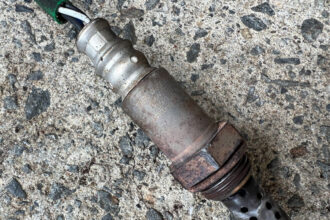

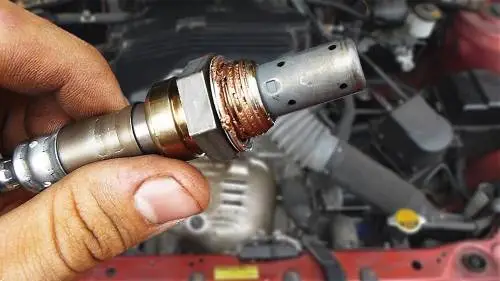
An O2 (oxygen) sensor measures the amount of oxygen in your car’s exhaust gases. It helps the engine control unit (ECU) adjust the air-fuel mixture so the engine runs efficiently and produces fewer emissions. Most modern cars have at least two O2 sensors, one before and one after the catalytic converter.
1. What Is an O2 Sensor?
An O2 sensor, also called an oxygen sensor, is a small part inside your car’s exhaust system that measures the amount of oxygen in the exhaust gases.
It tells the ECU:
- is the engine burning too much fuel (rich)?
- is it burning too little (lean)?
- is the catalytic converter working properly?
In simple words:
The O2 sensor helps your engine breathe properly and burn fuel efficiently.
2. What Does an O2 Sensor Do?
The O2 sensor continuously checks:
- Is the engine burning too much fuel? (rich)
- Is the engine burning too little fuel? (lean)
- Is the catalytic converter working properly?
- Is the emission level safe?
The sensor sends this data to the ECU multiple times per second.
Based on this, the ECU adjusts:
- fuel injection
- ignition timing
- air-fuel ratio (AFR)
So your engine stays smooth, efficient, and eco-friendly.
Without a working O2 sensor, the car becomes “blind.”
3. Where Is the O2 Sensor Located in a Car?
Most cars have 2 to 4 oxygen sensors, located in these positions:
1. Upstream O2 Sensor (Sensor 1)

- Located before the catalytic converter
- Also called the pre-cat sensor
- Its job: control air-fuel mixture
2. Downstream O2 Sensor (Sensor 2)

- Located after the catalytic converter
- Also called the post-cat sensor
- Its job: monitor catalytic converter efficiency
So the upstream sensor controls the engine.
The downstream sensor checks emissions.
4. How Does an O2 Sensor Work?

An O2 sensor measures the difference in oxygen levels between the exhaust gases and the outside air.
Inside the sensor is a ceramic element (usually zirconia) coated with a thin layer of platinum. When heated, this element generates a small voltage based on the difference in oxygen concentration.
- Around 0.1 volts usually indicates a lean mixture (too much air).
- Around 0.8–0.9 volts usually indicates a rich mixture (too much fuel).
The ECU constantly reads this voltage signal and adjusts fuel injection to maintain the ideal air-fuel ratio (about 14.7:1 for gasoline engines). This process is called closed-loop fuel control.
When the sensor switches rapidly between rich and lean readings, it shows the system is working properly.
5. Real Example From My Own Car — Tested Live Using OBD2
To help you understand how oxygen sensors behave in real driving conditions, here is a live O₂ sensor recording from my own car using an OBD2 scanner. Before we look at the clip, here is a quick explanation of what these two sensors do.
What Are O2S1 and O2S2?
O2S1 (Sensor 1 – Upstream)
This sensor is placed before the catalytic converter.
Its job is to constantly check whether the engine is running rich or lean and help the ECU adjust the air-fuel mixture.
O2S2 (Sensor 2 – Downstream)
This sensor is placed after the catalytic converter.
Its job is to monitor how well the catalytic converter is cleaning the exhaust gases.
It does not control fuel mixture; it only checks efficiency.
What Does a Downstream O2 Sensor Actually Do?
A downstream O2 sensor is located after the catalytic converter. Its main job is to monitor how efficiently the catalytic converter is cleaning the exhaust gases.
Unlike the upstream sensor, the downstream sensor does not directly control the air-fuel mixture. Instead, it compares its readings with the upstream sensor.
If the catalytic converter is working properly, the downstream sensor’s signal should be more stable and show fewer fluctuations. If both sensors show very similar readings, it may indicate that the catalytic converter is not filtering emissions effectively.
When this happens, the ECU may trigger a check engine light, often related to catalytic converter efficiency.
Live O₂ Sensor Recording
What’s Happening in This Clip?
“In this clip, both O₂ sensors (O2S1 and O2S2) are moving up and down between 0.1V and 0.9V while the car is being driven. This is exactly what a healthy oxygen sensor system should do.
The ECU keeps adjusting fuel mixture as driving conditions change, and both sensors are quickly responding to those changes.
The important thing is that both sensors are switching smoothly and not getting stuck at one voltage. A stuck or flat reading would indicate a failing O₂ sensor. Here, the switching pattern shows that the sensors and catalytic converter are working perfectly during real driving.”
6. Why Do O2 Sensors Have a Heater?
In many cars, the O2 sensor has a built-in heater.
Why?
Because the sensor only works correctly at ~600°C.
The heater warms it up quickly so the ECU can enter closed-loop mode faster, improving fuel efficiency and reducing emissions.
If the heater fails, you get codes like:
- P0135
- P0141
- P0155
7. Causes of O2 Sensor Failure
O2 sensors fail mainly due to:
- carbon buildup
- oil burning
- coolant leaks
- old age (60,000–100,000 km)
- poor fuel quality
- exhaust leaks
- short trips (sensor never heats fully)
If your vehicle starts running rough or the check engine light appears, it may help to review the common symptoms of a faulty O2 sensor before deciding on replacement
8. Different Types of Oxygen Sensors
Just for awareness:
1. Zirconia O2 Sensor (most common)
2. Titanium O2 Sensor
3. Wideband / Air-Fuel Ratio Sensor (modern cars)
Wideband sensors give more accurate readings and are used in most modern engines.
9. Can You Clean an O2 Sensor?
Not recommended.
Cleaning rarely works because internal ceramic elements get worn out.
Only replace.
10. How Long Do O2 Sensors Last?
Generally:
80,000 to 150,000 km
If you use high-quality fuel and avoid short trips, they last longer.
11. How to Prevent O2 Sensor Failure
- Use good quality fuel
- Fix oil burning issues
- Fix coolant leaks
- Avoid extremely rich tune
- Don’t drive with misfires
- Avoid unnecessary idling
- Take longer trips (sensor heats fully)
12. Can You Bypass or Delete an O2 Sensor?
- Illegal in most countries
- Fails emission tests
- Can damage catalytic converter
- Causes engine issues
Not recommended unless for off-road racing.
13. Conclusion
The O2 sensor is a small but extremely important part of your car.
It controls how efficiently your engine burns fuel, how clean your emissions are, and how smooth your car drives.
A failing oxygen sensor can cause:
- poor mileage
- sluggish performance
- rough idle
- check engine light
- potential catalytic converter damage
The good news?
It’s easy to diagnose and affordable to replace.
Fixing it early restores performance, saves fuel, and protects your engine.
14. Reference
For further reading, here is a trusted external resource on oxygen sensors:
https://en.wikipedia.org/wiki/Oxygen_sensor
Last Updated: February 2026
15. FAQ’s
Engine will run rich or lean → poor mileage → possible catalytic converter damage
Not recommended. Cleaning rarely works because internal elements get worn out.
Yes, incorrect air-fuel readings can lead to misfires.
Yes, it will start. But performance will drop.
Absolutely. Hesitation and sluggish acceleration are common symptoms.
Usually 2–4 depending on engine.
Indirectly, via lean mixture.
Upstream sensor on engine bank 1.
Downstream sensor after catalytic converter.

Founder of TheCarLane | Automotive Enthusiast
Ayush shares practical automotive knowledge based on real-world ownership and hands-on experience. His work focuses on diagnostics, engine systems, common car problems, and clear explanations that help everyday drivers understand their vehicles better.