
A HEMI engine is a type of internal combustion engine that uses a hemispherical combustion chamber to improve airflow, fuel burning, and power output. The name “HEMI” comes from the word hemisphere, which describes the shape of the chamber inside the engine.
HEMI engines are best known for their use in muscle cars, performance sedans, and SUVs, where they deliver strong torque, smooth power, and a distinctive V8 character. This guide explains what a HEMI engine is, how it works, why it’s powerful, how reliable it is, and why it’s still used today.
1. What Is a HEMI Engine?
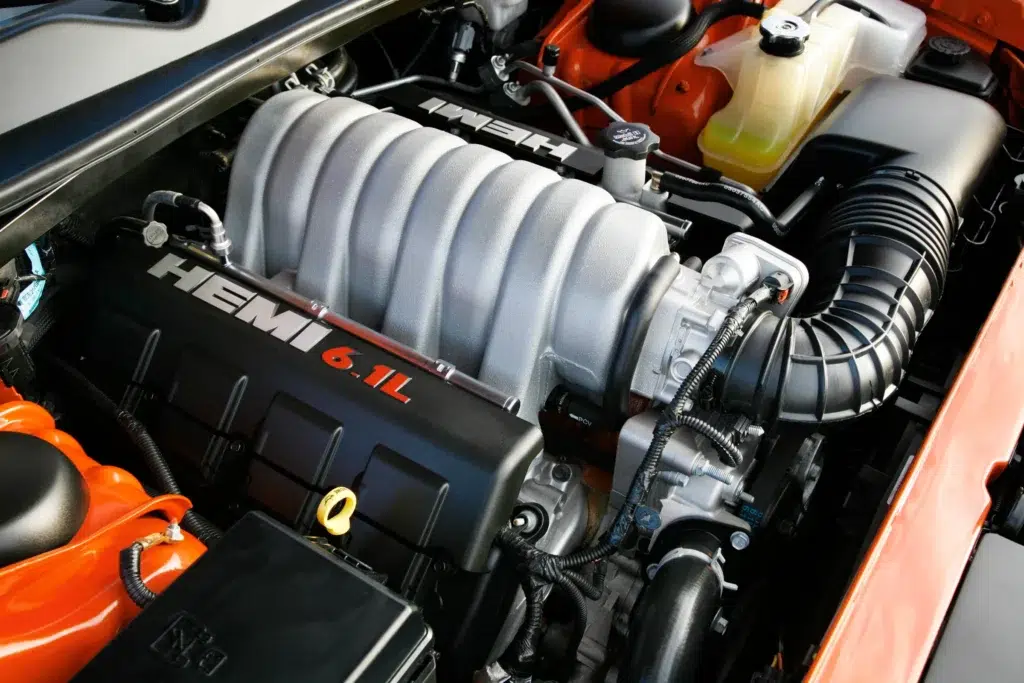
A HEMI engine is an internal combustion engine that uses a hemispherical combustion chamber inside the cylinder head.
The word “HEMI” comes from hemisphere, meaning half of a sphere.
A HEMI engine is an engine where the combustion chamber is shaped like half a sphere.
This design is different from traditional flat or wedge-shaped combustion chambers used in many normal engines.
2. What Is a HEMI Motor? (Engine vs Motor)
A HEMI motor and a HEMI engine mean the same thing.
- “Engine” is the correct technical term
- “Motor” is commonly used in casual conversation
So if someone says HEMI motor, they’re simply referring to a HEMI engine.
3. Why Do They Call It a HEMI Engine?
It’s called a HEMI engine because of the hemispherical shape of the combustion chamber.
Combustion chamber comparison:
Normal engine
- Flat or wedge-shaped chamber
- Valves are closer together
- Airflow is more restricted
HEMI engine
- Dome-shaped (hemisphere)
- Intake and exhaust valves sit on opposite sides
- Spark plug sits closer to the center
This shape allows the engine to:
- breathe better
- burn fuel more efficiently
- produce more power
That unique chamber design is the reason for the name HEMI.
4. How Does a HEMI Engine Work?
The working of a HEMI engine is similar to any petrol engine, but the combustion process is more efficient.
Step-by-step HEMI engine working:
- Air and fuel enter the cylinder
- The hemispherical chamber allows smooth airflow
- The centrally placed spark plug ignites the mixture
- Combustion spreads evenly across the chamber
- The piston is pushed down, generating power
Why this matters:
- Faster flame travel
- More complete combustion
- Less energy loss
- Higher power output
This is the core mechanical advantage of a HEMI engine.
5. Who Invented the HEMI Engine?
The hemispherical combustion chamber concept dates back to the early 20th century.
However, Chrysler is the company that:
- perfected the design
- commercialized it
- made “HEMI” a household name
Chrysler introduced its famous HEMI V8 engines in the 1950s, and they quickly became dominant in racing and performance cars.
So while Chrysler didn’t invent the idea, they popularized and refined it.
6. What Is So Special About a HEMI Engine?
HEMI engines stand out because of design efficiency, not just size.
Key features that make HEMI engines special:
1. Better airflow
The hemispherical chamber allows air to enter and exit more freely.
2. Larger valves
HEMI heads can fit bigger intake and exhaust valves, improving breathing.
3. Central spark plug location
This allows the flame to spread evenly, improving combustion efficiency.
4. Strong torque delivery
HEMI engines are known for high torque, especially at low and mid RPM.
These characteristics make HEMI engines ideal for:
- muscle cars
- performance sedans
- pickup trucks
- towing applications
7. Why Are HEMI Engines So Powerful?
HEMI engines are powerful because they can move more air and burn fuel more efficiently.
In simple terms:
Better airflow + efficient combustion = more power
HEMI engines typically produce:
- strong low-end torque
- smooth power delivery
- high horsepower potential
This is why HEMI engines perform well even without heavy tuning.
8. HEMI Engine vs Normal Engine
Understanding the difference helps explain why HEMI engines gained popularity.
Normal engine:
- Flat or wedge-shaped combustion chamber
- Smaller valves
- Less airflow efficiency
- Lower torque output
HEMI engine:
- Hemispherical combustion chamber
- Larger valves
- Better airflow
- Stronger torque and power
Downsides of HEMI engines:
- Larger physical size
- Heavier design
- Higher fuel consumption
So while HEMI engines are powerful, they are not always the most fuel-efficient option.
9. What Size HEMI Engines Are There?
Modern HEMI engines come in different displacements.
Common Chrysler HEMI engine sizes:
- 5.7L HEMI – most common and widely used
- 6.1L HEMI – performance-focused
- 6.4L HEMI (392) – high-performance naturally aspirated
- 6.2L Supercharged HEMI (Hellcat) – extreme performance
Each size affects:
- power output
- torque
- fuel consumption
- intended use
10. What Does 5.7 HEMI Mean?
The term 5.7 HEMI refers to:
- 5.7 liters of engine displacement
- An engine that uses HEMI combustion chamber design
It does not indicate:
- horsepower
- number of cylinders (it’s usually a V8)
- performance level by itself
The 5.7 HEMI is popular because it balances:
- performance
- durability
- daily usability
11. Are HEMI Engines Reliable?
Yes, HEMI engines are generally reliable when properly maintained.
Strengths:
- strong engine block
- durable internal components
- designed for torque and longevity
Common issues (model-dependent):
- lifter and camshaft wear in some versions
- higher fuel consumption
- heat buildup in performance variants
With regular oil changes and proper care, many HEMI engines easily last 200,000 km or more.
12. Pros and Cons of HEMI Engines
Pros of HEMI Engines
1. Strong Power and Torque
HEMI engines are known for producing high torque, especially at low and mid RPM.
This makes them feel powerful in daily driving, towing, and acceleration.
2. Better Airflow Design
The hemispherical combustion chamber allows air to flow more freely, which improves:
- combustion efficiency
- throttle response
- overall engine performance
3. Smooth and Refined Performance
Despite being large V8 engines, HEMI engines run smoothly and feel refined, especially on highways.
4. Proven and Durable Design
HEMI engines are built for strength. With proper maintenance, they are capable of running for many years and high mileage.
5. Great for Trucks and Performance Cars
Because of their torque-focused nature, HEMI engines work extremely well in:
- pickup trucks
- SUVs
- muscle cars
Cons of HEMI Engines
1. Higher Fuel Consumption
HEMI engines are not fuel-efficient compared to smaller turbocharged engines.
They consume more fuel, especially in city driving.
2. Larger and Heavier Engine
The design makes HEMI engines:
- physically bigger
- heavier than most engines
This affects vehicle weight and fuel economy.
3. Maintenance Can Be Costly
While reliable, repairs (if needed) can be expensive due to:
- V8 complexity
- parts cost
- labor cost
4. Not Ideal for Everyone
If someone prioritizes fuel savings or compact vehicles, a HEMI engine may not be the best choice.
13. Common Problems of HEMI Engines (And How to Fix Them)
Like all engines, HEMI engines are not perfect. Here are the most common issues, explained simply.
1. Lifter and Camshaft Issues
Problem:
Some HEMI engines are known for lifter wear, which can lead to camshaft damage if ignored.
Symptoms:
- ticking or knocking noise
- rough idle
- loss of power
Fix:
- timely oil changes
- using the correct engine oil
- early inspection if noise appears
Preventive maintenance makes a big difference here.
2. High Fuel Consumption
Problem:
HEMI engines burn more fuel, especially in city driving.
Why it happens:
- large displacement
- V8 layout
- torque-focused tuning
Fix:
- smooth driving habits
- proper tire pressure
- regular engine maintenance
This is more a characteristic than a fault.
3. Heat Management in Performance Models
Problem:
High-performance HEMI variants (like Hellcat engines) generate a lot of heat.
Symptoms:
- heat soak
- reduced performance under extreme conditions
Fix:
- proper cooling system maintenance
- high-quality coolant
- avoiding prolonged abuse without cooling breaks
4. Spark Plug Replacement Cost
Problem:
HEMI engines use multiple spark plugs, which increases replacement cost.
Fix:
- replace spark plugs at recommended intervals
- use OEM or high-quality replacements
This is routine maintenance, not a reliability flaw.
14. Cars That Come With HEMI Engines
There are many cars that comes with hemi engines but these are the most popular ones that’s why I included these as examples.
1. Dodge Charger
The Dodge Charger is available with multiple HEMI V8 engines. The most common 5.7-liter HEMI V8 produces around 370–375 horsepower and delivers strong low-RPM torque for quick acceleration. Performance-focused Charger variants use the 6.4-liter HEMI with about 485 horsepower, while the top models feature a 6.2-liter supercharged HEMI producing 700+ horsepower.
Power figures may vary by model year and trim.

2. Dodge Challenger
The Dodge Challenger is one of the best-known HEMI-powered muscle cars. The entry-level 5.7-liter HEMI makes roughly 370–375 horsepower, offering classic V8 performance. The 6.4-liter (392) HEMI produces around 485 horsepower, while the supercharged 6.2-liter HEMI in high-performance models delivers anywhere from 700 to over 800 horsepower, depending on the variant.
Power figures may vary by model year and trim.

3. Dodge Durango
The Dodge Durango combines SUV practicality with V8 performance using HEMI engines. The 5.7-liter HEMI V8 produces approximately 360 horsepower, giving the Durango strong towing and highway performance. Performance versions of the Durango use the 6.4-liter HEMI, which produces around 475 horsepower, making it one of the most powerful SUVs in its segment.
Power figures may vary by model year and trim.

4. Chrysler 300c
The Chrysler 300C is powered by the 5.7-liter HEMI V8, producing about 360–370 horsepower. This engine is tuned for smoothness and refinement rather than aggressive performance, offering strong mid-range torque and effortless highway cruising while maintaining the classic HEMI V8 character.
Power figures may vary by model year and trim.

15. Why HEMI Engines Are Still Relevant Today
Even in the age of:
- turbocharged engines
- downsized displacement
- hybrid technology
HEMI engines remain relevant because they offer:
- raw, naturally aspirated power
- simple mechanical performance
- strong towing capability
- iconic sound and feel
They represent a classic approach to engine design focused on airflow and combustion efficiency rather than complexity.
16. Who Should Choose a HEMI Engine?
A HEMI engine is ideal for people who:
- enjoy powerful engines
- want strong torque
- drive trucks or performance cars
- value engine sound and character
A HEMI engine may not be ideal for people who:
- prioritize fuel economy
- drive mostly in heavy traffic
- want low maintenance costs
17. Custom Builds and Tuning Potential of HEMI Engines
One reason HEMI engines are so popular is their strong tuning and customization potential. Because they are built with large displacement and strong internals, HEMI engines respond well to both basic and advanced performance upgrades.
This makes them a favorite choice for enthusiasts who want more power without sacrificing reliability.
1. Can HEMI Engines Be Tuned?
Yes, HEMI engines can be tuned very effectively.
From factory, HEMI engines are tuned conservatively to:
- meet emissions regulations
- improve reliability
- work across different driving conditions
Because of this, there is room for safe performance gains through ECU tuning and hardware upgrades.
2. Stage 1 Tuning on HEMI Engines (Beginner Level)
Stage 1 tuning is the most common and safest starting point for HEMI owners.
A typical Stage 1 tune may include:
- ECU remapping
- optimized ignition timing
- improved throttle response
- adjusted air–fuel ratios
What beginners can expect:
- noticeable power increase
- smoother acceleration
- better mid-range torque
- no internal engine modifications
Stage 1 tuning works especially well on 5.7L and 6.4L HEMI engines used in daily-driven cars and trucks.
You can read a detailed beginner-friendly guide on ECU remapping, commonly known as Stage 1 tuning, to understand how it improves performance and power delivery.
3. Stage 2 Tuning and Performance Upgrades
Stage 2 tuning goes a step further by combining ECU tuning with hardware upgrades.
Common Stage 2 upgrades include:
- performance air intake
- upgraded exhaust system
- high-flow catalytic converters
- better cooling components
With proper tuning, Stage 2 builds offer:
- stronger top-end power
- faster throttle response
- improved engine breathing
Stage 2 tuning is still street-friendly but is better suited for owners who want a more aggressive performance setup.
I have made a in depth article on Stage 1 vs Stage 2 vs Stage 3 tuning so that you can compare what’s the best for your car.
18. Custom Builds and High-Performance Setups
HEMI engines are also well-known for custom performance builds.
Because of their strong base design, HEMI engines are often used for:
- drag racing
- track builds
- high-horsepower street cars
Advanced builds may include:
- superchargers or turbochargers
- upgraded fuel systems
- strengthened internals
- custom ECU tuning
This is how high-performance HEMI engines reach very high power levels while maintaining durability when built correctly.
19. Why HEMI Engines Are Great for Tuning
HEMI engines are tuning-friendly because:
- they have strong engine blocks
- they handle increased power well
- there is good aftermarket support
- tuning knowledge is widely available
This makes them suitable for both beginners and experienced builders.
20. Final Perspective on HEMI Engines
HEMI engines are:
- powerful
- well-engineered
- reliable with maintenance
- designed for performance, not efficiency
They are not outdated — they simply represent a different philosophy of engine design.
Where modern engines focus on:
- downsizing
- turbocharging
- efficiency
HEMI engines focus on:
- airflow
- torque
- simplicity
- mechanical strength
That is why they still have a loyal fanbase worldwide.
21. FAQs
HEMI means hemispherical, referring to the shape of the combustion chamber inside the engine. This design helps improve airflow, fuel burning, and overall power output.
HEMI engines are powerful because their combustion chamber design allows better airflow and more efficient combustion, which results in higher torque and strong performance compared to many standard engines.
Yes, HEMI engines are generally reliable for daily use when properly maintained. Regular oil changes and proper servicing are key to long-term reliability.
The main difference is the combustion chamber shape. A HEMI engine uses a hemispherical chamber for better airflow, while most normal engines use flat or wedge-shaped chambers that are more focused on efficiency.
5.7 HEMI refers to a 5.7-liter engine that uses HEMI combustion chamber design. It does not directly indicate horsepower, but it is one of the most commonly used and balanced HEMI engines.

Founder of TheCarLane | Automotive Enthusiast
Ayush focuses on engines, tuning, diagnostics, and real-world driving knowledge to bring accurate, easy-to-understand car content to readers.