
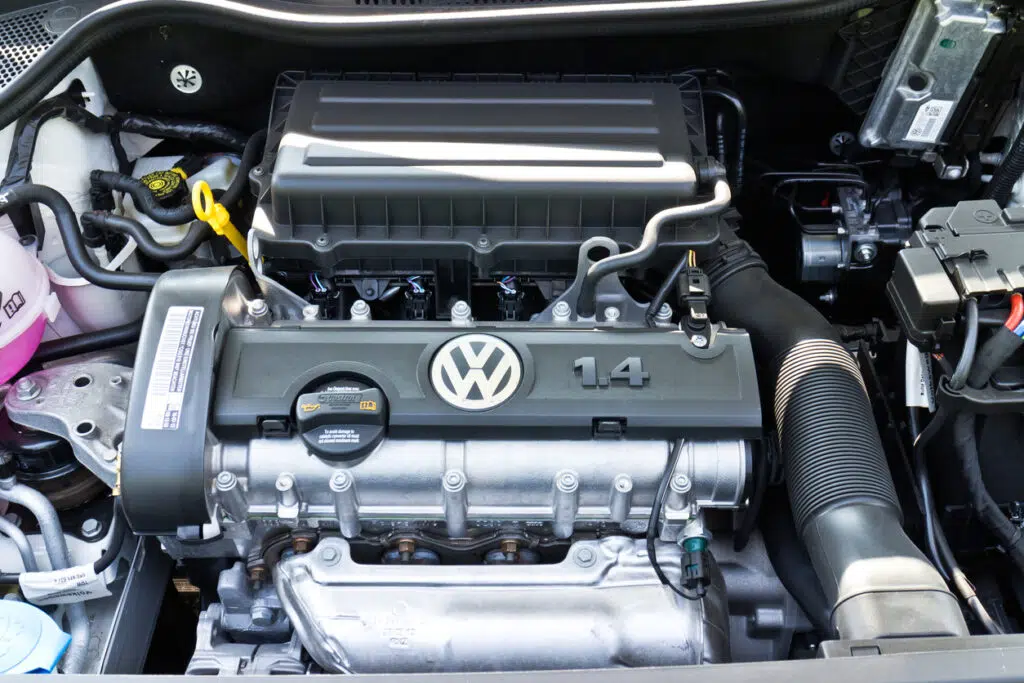
The Volkswagen EA111 engine family used both timing chains and timing belts. The answer depends on the specific variant you have.
Chain-driven EA111 variants: 1.2 TSI (engine codes CBZA, CBZB, CBZC), 1.4 TSI twincharger (BLG, BMY, BWK, CAVA to CAVG, CTHA to CTHG), 1.4 TSI single turbo (CAXA, CAXC, CMSA, CMSB), and the 1.2 three-cylinder (AWY, BMD, AZQ, BZG, CGPA, CGPB).
Belt-driven EA111 variants: 1.4 16V (BUD, BCA, CGGA), 1.6 8V (BSE, BSF, CFNA), and 1.6 FSI (BAG, BLF, BLP).
The pattern is straightforward. The turbocharged engines and the 1.2 three-cylinder use a chain. The 1.4 and 1.6 16-valve engines use a belt. The pre-2014 1.4 TSI Twincharger has a documented chain failure problem covered later in this guide.
This guide identifies your variant by engine code, explains the chain risk for affected owners, and covers UK costs for both chain and belt replacement.
EA111 Timing System by Engine Variant
| Engine Variant | Engine Codes | Timing System | Common UK Models | Years |
|---|---|---|---|---|
| 1.2 TSI | CBZA, CBZB, CBZC | Chain | Polo, Fabia, Ibiza, Audi A1 | 2010–2015 |
| 1.4 TSI Twincharger | CAVA, CAVB, CAVC, CAVD | Chain | Golf Mk5 GT and Mk6 160, Scirocco, Jetta, Touran, Tiguan, Polo GTI, Fabia vRS, Ibiza Cupra, Audi A1 185 | 2005–2014 |
| 1.4 TSI Single charger | CAXA, CAXC, CMSA, CMSB | Chain | Golf Mk6, Jetta, Touran, Passat, Octavia Mk2, Superb, Yeti, Leon Mk2, Audi A1 and A3 | 2007–2014 |
| 1.4 16V (non-turbo) | BUD, BCA, CGGA | Belt | Polo, Fabia, Ibiza | 1999–2014 |
| 1.6 8V | BSE, BSF, CFNA | Belt | Golf, Caddy, Touran | 2003–2010 |
| 1.6 FSI | BAG, BLG, BLP | Belt | Golf Mk5, Audi A3, Touran | 2003–2008 |
Note that the 1.0 TSI does not appear in this table because it’s not an EA111 engine — it’s part of the newer EA211 family covered later in this guide.
How to Find Your EA111 Engine Code
Don’t guess by year or model alone. A 2013 Polo could carry a 1.4 TSI EA111 with a chain, or a 1.0 MPI from a different engine family entirely. Always verify the engine code before making any maintenance decisions.
This guide focuses on UK-registered cars. Non-UK readers should check their equivalent registration document.
Three reliable methods:
Check your V5C logbook. The engine number is field P.5, and on a VAG car its first three letters are the code: CAVA, BUD, CBZA. If the DVLA recorded only digits, the sticker in the boot floor and the service book print the code on its own line.
Look at the engine itself. The code is stamped onto the cylinder block, usually near the gearbox bell housing. On most transverse-mounted EA111s, which covers virtually every UK Polo, Fabia, Ibiza, Octavia, and Golf — you’ll see it from above when looking toward the bulkhead. A torch helps. The stamping is small and often dirty.
Decode your VIN. A free VAG VIN decoder returns your build sheet, including the engine code, paint code, and original specification. You’ll need the full 17-character VIN, which appears on the V5C, on the dashboard at the base of the windscreen, and inside the driver’s door jamb.
Once you have the engine code, go back to the table above. That’s your timing system answer.
The 1.4 TSI Twincharger Chain Failure Problem
If your engine code starts BL, BM, BW, CAV or CTH, you have the EA111 variant with the documented chain failure issue. Pre-2014 examples are the worst affected. The 2005 to about 2012 CAV, BLG, BMY and BWK engines are the worst; the CTH revision from about 2012 brought a stronger tensioner and better pistons. The single-turbo CAXA, CAXC, CMSA and CMSB in the Golf, Octavia, Yeti, Leon and A3 shared the same fundamental design and have similar problems, though typically less catastrophically because of lower engine stress.
VW never issued a recall in the UK, but independent specialists have been replacing failed and stretched chains on these engines for over a decade. The pattern is consistent enough that pre-2014 1.4 TSI Twinchargers without documented chain replacement should be treated as carrying real risk.
What Goes Wrong
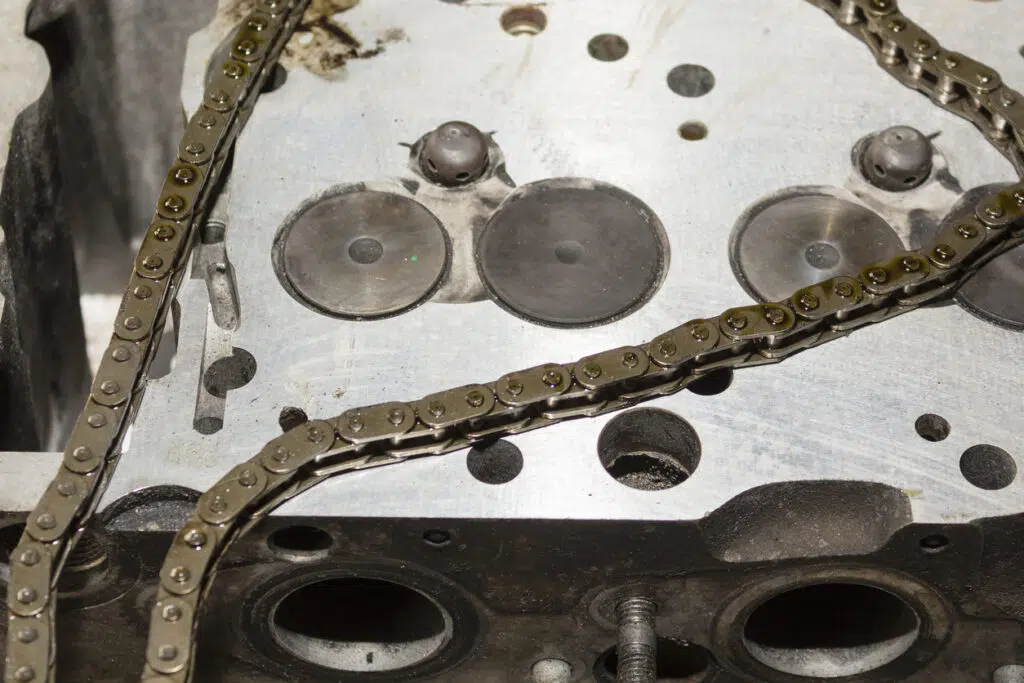
The 1.4 TSI used a single row timing chain that wasn’t strong enough for the load it carried. The hydraulic tensioner that keeps it tight loses pressure during cold starts. Over time the chain stretches. Once the stretch exceeds what the tensioner can compensate for, the chain skips a tooth on the camshaft sprocket. When that happens valve timing collapses, valves contact pistons, and the engine destroys itself in seconds.
There is no software fix. By the time the engine is running on a stretched chain, you’re not preventing damage anymore. You’re paying for a new engine.
Symptoms To Watch For
The clearest early warning is a rattle on cold starts that lasts two or three seconds before settling. A healthy chain stays quiet. The reason is mechanical: the tensioner hasn’t built oil pressure yet, and a stretched chain slaps against the guides during those first seconds.
Other symptoms appear later, closer to failure:
- Misfire codes in the P0300 series with no obvious coil pack or spark plug fault
- Reduced low end torque, often described as the car feeling tired pulling away
- Intermittent check engine light at idle, especially after the engine warms up
- A harsher, more mechanical engine note than the car had a year ago
The cold start rattle is the one to act on. The other symptoms tend to appear when the chain is closer to the failure point.
What To Do Based On Your Situation
If you currently hear the cold start rattle: Book a diagnostic with a VAG specialist this week. Preventive chain replacement runs £700 to £1,300” (WhoCanFixMyCar’s VW average is £931, the RAC’s July figure £779). A jumped chain means bent valves at best, £1,500 to £3,000, and a replacement engine at worst, £2,000 to £3,500 fitted. The maths is obvious.
If you own a pre-2014 1.4 TSI without chain replacement on the service history: Schedule an inspection at your next service. A specialist can read the cam to crank correlation through OBD2 and estimate chain stretch. It’s not perfect, but it catches most cases before catastrophic failure. A stretched chain sets P0016 on a 1.4 TSI before it jumps; that page has the adaptation check and the costs.
If you’re considering buying one: Either confirm chain replacement is documented on the service history, negotiate the price down by £1,000 or more to absorb the inevitable replacement cost, or walk away. The risk should sit with the seller, not you. The chain is one of six faults on this engine. The 1.4 TSI engine problems page covers the rest, pistons, wastegate, water pump, fuel pump, with the engine codes and UK costs, and a code map for every VW, Skoda, SEAT and Audi that used it.
How To Extend The Life Of A Healthy Chain
If your 1.4 TSI is currently silent and the service history is clean, careful maintenance significantly extends chain life:
- Oil changes every 10,000 miles on a fixed interval. Not longlife. Extended drain intervals were part of why these chains failed in the first place.
- VW 502.00 specification oil at 5W-30 viscosity. Not 0W-20, which belongs to the later EA211 evo engines.
- Avoid lugging the engine at low RPM in high gears. The tensioner doesn’t like sustained low pressure operation.
- Treat the engine gently for the first minute of every cold start while oil pressure builds.
None of this guarantees the chain holds. But strict maintenance has kept many 1.4 TSI engines running well past 150,000 miles without chain failure. Healthy chains can outlast neglected ones by a factor of two or three.
EA111 Belt-Driven Engines: 1.4 16V, 1.6 8V, and 1.6 FSI
The non-turbo EA111 variants are the quietly reliable ones. They don’t generate dramatic YouTube content because nothing dramatic happens to them.
1.4 16V (BUD, BCA, CGGA): Naturally aspirated, multi-port injection, 16-valve cylinder head. Used in entry-level Polo, Fabia, and Ibiza. Cambelt change interval is 60,000 miles or 4 years on the UK service schedule. A specialist replacement with belt, tensioner, and water pump runs £350–£500. No widespread chronic issues — the engine is mechanically simple and ages well.
1.6 8V (BSE, BSF, CFNA): Slightly larger displacement, similar reliability profile. Used in heavier cars — Golf, Touran, Caddy. Same cambelt service interval. Replacement runs £400–£550. Slightly thirstier than the 1.4 but more torque, which suits the heavier applications.
1.6 FSI (BAG, BLG, BLP): Direct injection version of the 1.6, still belt-driven for the main timing system. Some owners report balancer shaft chain stretch, a separate component from the main timing belt and a smaller issue when it happens. Cambelt service runs £450–£650 with water pump.
If you have any of these three, the maintenance plan is straightforward. Stick to the service schedule, change the belt before it fails, and the engine will outlast most other parts of the car.
EA111 Timing System Replacement Costs (UK 2026)
Costs vary significantly between specialists and main dealers, and between variants. The figures below reflect typical UK pricing in 2026 for a full kit replacement — meaning the chain or belt plus all the wear parts that should be replaced at the same time.
| Service | Specialist | Main Dealer | Parts Only |
|---|---|---|---|
| 1.4 TSI chain replacement (full kit) | £900–£1,300 | £1,400–£1,800 | £350–£500 |
| 1.2 TSI chain replacement | £750–£1,100 | £1,200–£1,600 | £280–£420 |
| 1.4 16V belt + tensioner + water pump | £350–£500 | £550–£750 | £130–£200 |
| 1.6 8V belt + tensioner + water pump | £400–£550 | £600–£800 | £140–£220 |
| 1.6 FSI belt + tensioner + water pump | £450–£650 | £650–£900 | £160–£260 |
Three things worth knowing before you book the work:
Always replace water pump and tensioner with the belt. The labour to access these components is the most expensive part of the job. Doing them separately means paying for the same access work twice. Any garage that suggests skipping the water pump on a 60,000-mile belt change is cutting corners that will cost you later.
For chain jobs, never replace just the chain. The full kit means chain, tensioner, guides, and stretch bolts. Replacing only the chain on a worn tensioner is a guaranteed comeback within 20,000 miles. Reinforced chain kits from specialists like STR Performance address some of the original design weakness, though stock parts work fine if maintained properly.
VAG specialists usually beat main dealers by 30–40%. They see these engines daily, they know which parts to use, and they don’t carry the dealer overhead. For an EA111 with no remaining warranty, there’s almost no scenario where the main dealer is the better choice.
EA111 vs EA211: What Changed in the Successor
| Aspect | EA111 (2005–2018) | EA211 (2012–present) |
|---|---|---|
| Timing system | Chain (TSI) or belt (non-turbo) | Belt (all variants) |
| Belt life | 60,000 miles where applicable | Engine-life design (~120,000 miles) |
| Cylinder head | Conventional exhaust manifold | Integrated exhaust manifold in head |
| Oil specification | VW 502.00 (5W-30) | VW 504 00 (5W-30) |
| UK availability | Used market only | Used and current models |
The EA211 was VAG’s response to the EA111’s reliability problems — particularly the 1.4 TSI chain failures. The EA211 1.4 TSI has its own short list of faults, the thermostat housing and the turbo actuator; both are on the 1.4 TSI engine problems page. Belts on the EA211 are designed for the life of the engine, with VW lists the belt as maintenance-free; Skoda UK quotes five years or 140,000 miles, and dealers often advise four to five years. The cylinder head was redesigned to integrate the exhaust manifold, which improves thermal management. The 2012 to 2017 EA211 engines stayed on VW 504 00; 0W-20 to 508 00 arrived with the EA211 evo in 2017.
The 1.0 TSI from 2015 is the most common EA211 variant in UK Polos, Fabias, and Ibizas. If you’re trying to identify whether your car uses an EA111 or EA211, the 1.0 TSI never appeared in the EA111 family, it’s exclusively an EA211 engine. We’ve covered the 1.0 TSI in detail in our engine review with 51,000 km of real ownership data.
FAQs
It depends on the specific variant. TSI versions (1.2 TSI and 1.4 TSI) use a timing chain. Non turbo versions (1.4 16V, 1.6 8V, and 1.6 FSI) use a timing belt. The full breakdown by engine code is in the table at the top of this guide.
It depends on the variant. The naturally aspirated EA111s — 1.4 16V, 1.6 8V, and 1.6 FSI are mechanically simple and have aged well, with no widespread chronic issues. The turbocharged TSI variants are more mixed: the 1.2 TSI is generally reliable, while the pre-2014 1.4 TSI Twincharger has the well documented chain problem covered in this guide.
VW didn’t switch entirely to chains, they used both systems concurrently. The TSI versions of the EA111 used chains from 2005 onwards, while the naturally aspirated versions kept timing belts throughout the family’s production. Then with the EA211 successor introduced in 2012, VW switched back to belts across all variants, including TSI engines.
EA111 is a Volkswagen Group engine family built from 1999 to about 2015; the 1.4 TSI from 2005, the 1.2 TSI from 2009, replaced by the EA211 from 2012. It includes naturally aspirated petrol engines (1.4 16V, 1.6 8V, 1.6 FSI) and turbocharged TSI variants (1.2 TSI, 1.4 TSI). The family was used across VW, Skoda, SEAT, and Audi brands, and was progressively replaced by the EA211 family from 2012 onwards.
VW never issued a formal recall for the 1.4 TSI EA111 timing chain failures in the UK, despite over a decade of documented problems. Some affected owners received goodwill contributions toward repair costs in the early years (2010-2013), but this was discretionary and case-by-case. There is no current recall, warranty extension, or organised redress scheme for affected vehicles.
Last Updated: October 2026

Founder of TheCarLane | Automotive Enthusiast
Ayush shares practical automotive knowledge based on real-world ownership and hands-on experience. His work focuses on diagnostics, engine systems, common car problems, and clear explanations that help everyday drivers understand their vehicles better.