
The EPC warning light on your VW, Skoda, Audi, or SEAT means your car’s electronic throttle system has detected a fault and most of the time, it’s a cheap fix.
This guide covers the six real causes ranked by how often they actually happen, how to diagnose each one with a basic OBD2 scanner, real UK repair costs for each fix, and the unusual fuel cap trick that resolved my own EPC light on a Skoda Rapid.
CAN YOU DRIVE WITH THE EPC LIGHT ON?
Yes, cautiously, if the car still drives normally.
Steady EPC light, mild power reduction, no jerking: drive calmly, avoid hard acceleration, and get it scanned within a day or two.
Stop driving if: the light is flashing, a flashing check engine light joins it, the car loses most of its power, it stalls or lurches, or it enters limp mode.
EPC Warning Light – What It Means
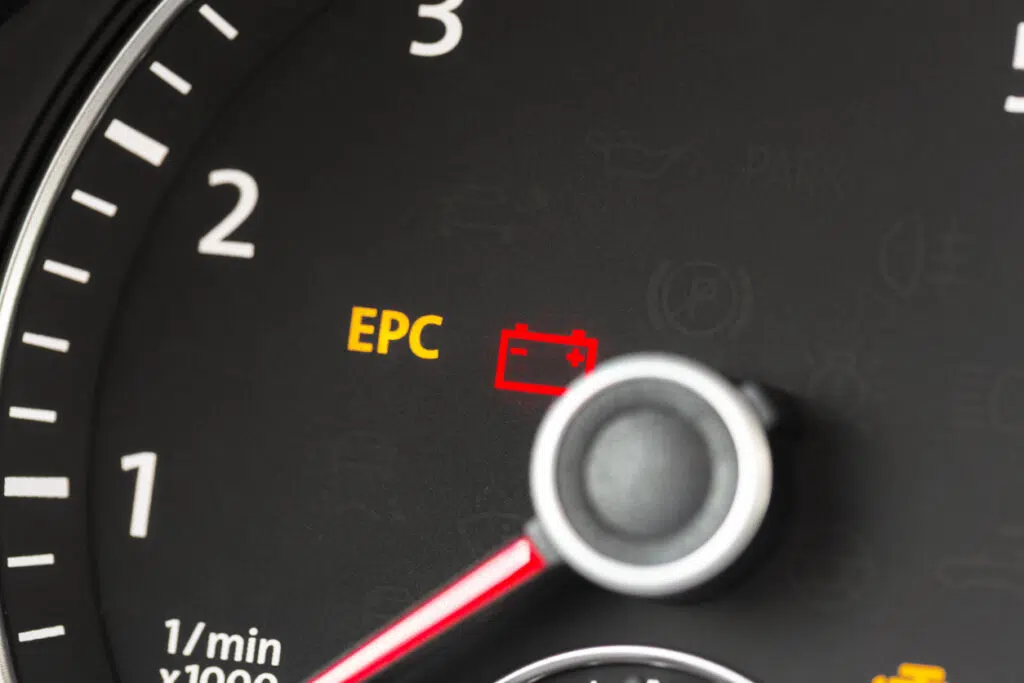
The EPC warning light means your car’s electronic throttle system has detected a fault and is protecting itself. It stands for Electronic Power Control, a system unique to Volkswagen, Skoda, Audi, and SEAT that manages how your engine responds to the accelerator pedal. When it triggers, the car limits engine power as a safety measure, which is why you might feel sluggish acceleration or limp mode. The light is amber, not red, meaning it needs attention soon but is not an immediate stop-now emergency. Most EPC faults trace back to something straightforward like a brake light switch, a dirty throttle body, or a faulty sensor rather than a serious engine problem.
What Happens When the EPC Light Comes On?
The most immediate thing most drivers notice is a sudden drop in power, the accelerator feels unresponsive, the car struggles to pick up speed, or it locks into limp mode where the engine deliberately limits itself to prevent further damage. Throttle response becomes slow or delayed, cruise control cuts out, and in some cases the idle becomes rough or hesitant.
It can also appear with no symptoms at all, the system flagging an irregular sensor reading early. Take it seriously even when the car feels fine.
Common Causes of the EPC Light
The EPC light is a warning, not a diagnosis. Below are the most common real-world causes, especially in Volkswagen Group cars.
Brake Light Switch Failure
It’s almost always the first thing to check, and it’s usually the cheapest to fix. The brake light switch tells the ECU when you’re pressing the brake pedal. If it sends the wrong signal, stuck in the “pressed” position, or failing to register a press at all, the ECU sees a conflict between braking and acceleration and triggers EPC immediately.
In the UK, a brake light switch typically costs £15-40 for the part and 15-30 minutes to fit. On most VAG models you can do it yourself with basic tools. Always check this first before spending money on anything else.
Throttle Body Problems
The throttle body controls how much air enters the engine. Carbon buildup over time, a faulty throttle motor, or a throttle position sensor mismatch can all trigger EPC; the stored code is usually P2101, the throttle actuator fault. This is particularly common on 1.0 TSI, 1.4 TSI, and 1.6 petrol engines after 60,000-80,000 km. If the scanner shows P2102 instead, it’s the motor’s wiring shorted to ground, not carbon, and no amount of cleaning will clear it.
A dedicated throttle body clean, followed by a throttle adaptation, often resolves this without replacement and costs £50-120. Replacement is £200-600 and only necessary if cleaning doesn’t restore proper function.
Faulty Engine Sensors
If any sensor sends abnormal readings, EPC may activate. The most common culprits are MAF (mass airflow), MAP (manifold absolute pressure), IAT (intake air temperature), and O2 sensors. Even if the engine seems to run fine, incorrect sensor data confuses the power control system.
MAF sensor failure is well-documented on Audi 1.8T and 2.0 TFSI engines specifically.
Wiring or Electrical Problems
Loose connectors, corroded terminals, damaged wiring, or moisture intrusion are common causes, especially on older vehicles or cars with aftermarket electrical modifications. These appear most often on higher-mileage Polo, Jetta, and Skoda Rapid models.
Accelerator Pedal Position Sensor Issues
If this sensor sends inconsistent or conflicting signals, the EPC system limits throttle response to prevent unintended acceleration. Less common than the causes above, but worth checking if the brake switch and throttle body have been ruled out.
Fuel System Pressure Buildup
On VAG cars, a long unbroken highway drive can build fuel vapour pressure past what the ECU expects, a rare but distinctive trigger, more likely in warm weather. My own EPC light came from exactly this; the full story is below.
EPC Light When Accelerating – Why It Happens Under Load
When the EPC light comes on specifically during acceleration, a fault in the throttle or engine management chain is revealing itself under load, not at idle, not at startup, but when the engine is working hard. That timing is itself diagnostic information.
Misfires under load. Worn spark plugs or failing ignition coils often behave adequately at idle but fail when acceleration demands more from the ignition system. This is why the EPC light appears during acceleration but not at steady speed, the fault only surfaces under load. Slight shaking, hesitation, or rough acceleration alongside the EPC light points here.
Airflow or boost issues on turbocharged cars. Acceleration raises boost pressure and places greater demands on the airflow system. A boost leak, a faulty boost control valve, or incorrect airflow readings make the EPC system limit power as a protective response. If the light appears specifically at higher revs or under hard acceleration on a turbocharged engine, boost and airflow are worth checking first.
Fuel pressure that sags under load. On a TSI the fuel system has to keep up with the turbo, and when the in-tank pump, the filter or the high-pressure pump falls behind, the EPC light comes on with the engine light on hills and overtakes. The code is P0087, fuel rail pressure too low, and that guide shows the live-data test that separates a £40 filter from a £900 pump.
Loose wiring or connector faults. Loose plugs, moisture or ageing wiring can also cause EPC warnings that come and go, because vibration under load disturbs a marginal connection. These are the hardest faults to find without proper equipment.
One pattern worth understanding: the EPC light appearing consistently in heavy traffic, hot weather, or stop-and-go driving doesn’t mean those conditions caused the fault, higher engine temperatures and more frequent throttle demands simply make an existing issue easier for the system to detect.
Is It Safe to Drive With the EPC Light On?
Yes for short distances, if the car drives normally and the light is steady. No, if the light is flashing or the car has entered limp mode.
What that quick answer leaves out is the cost of stretching it. Driving for days with EPC active raises fuel consumption and can push one marginal sensor into secondary failures, which is how a £15 brake-switch fault grows into a £200 repair bill. Limp mode changes the decision entirely: it exists to protect the engine, not to let you finish your week. A short, gentle drive straight to a workshop is acceptable; commuting on it until the weekend is how EPC gets expensive. And if the car loses power somewhere it isn’t safe to continue, arranging recovery costs less than what pushing on can break.
What to Do When the EPC Light Comes On
Step 1: Observe the car Notice whether the car is accelerating normally, whether throttle response feels delayed, and whether power has dropped suddenly. If the car feels significantly weaker or unstable, don’t continue the drive.
Step 2: Reduce speed, pull over if needed Gradually slow down, avoid overtaking, and keep RPM low. If you experience limp mode, jerking, an unresponsive accelerator: indicate, pull over safely, and turn the engine off. Wait a few minutes before restarting.
Step 3: Restart once Restart the engine and check if the EPC light remains on. If it disappears, drive cautiously and get the car diagnosed soon. If it returns immediately, stop driving.
Step 4: Read the code yourself before paying for a diagnosis: a £30/₹4,000 Bluetooth adapter and a free app show you the exact fault in five minutes, the Vgate iCar Pro is the one I use every week, and on a VW, Audi or Skoda the OBDeleven 3 free plan reads every module, not just the engine. New to scanning? Start here.
What to avoid: don’t unplug sensors to test whether the light clears, don’t attempt throttle body cleaning without knowing the correct procedure for your specific engine, and don’t keep accelerating hard to replicate the fault, electronic throttle systems are sensitive to ongoing faults, and repeated hard acceleration can turn a cheap fix into an expensive one.
What EPC Actually Feels Like – My Skoda Rapid Experience
I drove my Skoda Rapid on a continuous 175 km highway drive without stopping. After a two-hour break, I drove back the same way. Around 30 km from home, the EPC light turned on.
The symptoms were immediate, power loss, limp mode, jerking, and an almost unresponsive accelerator. I pulled over, switched the engine off, waited, and tried again. The car felt normal briefly, then EPC came back within 500 metres.
I called a Skoda technician. His suggestion was unusual: open the fuel filler cap, leave it open for 10–15 minutes, then close it and restart.
It worked and here’s likely why.
After a long continuous highway drive, fuel vapour pressure builds inside the tank. In VAG vehicles, this pressure is managed by the EVAP system. If that pressure exceeds what the ECU expects even slightly it can trigger the EPC light as a precautionary response. Opening the fuel cap releases that pressure, letting the system reset to normal.
This doesn’t mean the fuel cap fix works for every EPC situation it almost certainly won’t. But if your EPC light appeared after a long unbroken highway drive with no other symptoms, this is worth trying before calling a mechanic.
Since that day, the EPC light has not returned on my Skoda Rapid.
Can the EPC Light Turn Off By Itself?
Sometimes, but the fault code stays stored in the ECU after the light goes out, so get it scanned while the code is fresh
Why Does the EPC Light Come On and Then Go Off When the Engine Starts?
There are three different situations:
Normal startup behaviour: When you turn the ignition on, the car runs a self-diagnostic check. The EPC light (and other warning lights) briefly illuminate as part of this routine. Once the engine starts and systems check out, the lights go off. This is completely normal, not a fault.
Light appears while driving, disappears after restart: an intermittent fault, and the code is still stored. See above.
EPC only on cold starts, disappears once warm: A known pattern on several VW and Audi models. Often points to a sensor or wiring connector that behaves differently when cold. If it’s becoming more frequent, get the throttle body connections and relevant sensors inspected before the issue becomes permanent.
How to Diagnose the EPC Light Properly
Plug your OBD2 scanner into the diagnostic port (under the dashboard on the driver’s side for VW Group cars), turn the ignition on without starting the engine, and let the scanner connect. Read the stored fault codes and write them down before clearing anything, this is the most important step. Without the codes, you’re guessing at what to fix.
For VAG-specific cars, generic OBD2 codes only tell part of the story. Manufacturer-specific codes (those starting with “P1” instead of “P0”) often reveal more. Apps like Car Scanner with a Vgate iCar Pro adapter can read these. Common EPC-related codes include P0571 (brake switch fault), P2279 (intake air leak), P0507 (idle control irregular), and P0420 (catalyst efficiency, sometimes triggers EPC alongside DPF on diesels).
EPC Light vs Check Engine Light
EPC light points to an electronic power and throttle control issue specifically. The check engine light points to a broader emissions or engine system fault. Sometimes both appear together, sometimes separately. When EPC appears without a check engine light, it still requires attention, the absence of CEL doesn’t mean the EPC issue is minor.
EPC Light Across VAG Group Vehicles – VW, Audi, Skoda and SEAT
The EPC light appears across all VAG vehicles because every model runs drive-by-wire throttle technology, no physical cable between the accelerator and engine, everything controlled through sensors and the ECU. That includes every VW, Audi, Skoda and SEAT built in the last two decades: same platform, same failure patterns.
A few brand-specific patterns are worth knowing: ignition coil issues trigger EPC alongside the check engine light on higher-mileage VW and Audi models, and on SEAT Leon Cupra and FR variants the throttle system is more sensitive to sensor mismatch, minor inconsistencies that would not trigger EPC on a standard Leon can do so on a performance variant.
On VAG diesels, the EPC light can appear alongside a DPF warning light when the emissions system is struggling. If both lights are on together, the DPF is usually the primary cause.
EPC Light on Skoda Models: Rapid, Fabia, Octavia and Kushaq
The EPC light on a Skoda means exactly what it means on any VW Group car, and the causes above apply to all of them. What differs by model is which cause turns up most, and knowing your model’s pattern saves a diagnostic hour.
| Model | The EPC pattern owners report most | Check first |
|---|---|---|
| Rapid (1.0, 1.2 and 1.6 petrol) | EPC after a long unbroken highway run, especially in heat: the fuel vapour pattern from my own case above | Open the fuel cap for 10 to 15 minutes and restart, then the brake light switch |
| Fabia Mk3 (2014 to 2021) | EPC arriving together with a stop-start error | Battery voltage, then the brake light switch |
| Octavia Mk3 (2013 to 2020) | EPC under acceleration on the TSI engines, usually stored as P2101 | Throttle body clean, then the adaptation |
| Kushaq and Kodiaq (India) | EPC in traffic on a hot day after highway driving, the Rapid pattern with 38°C added | Fuel cap release, then a scan for stored codes |
If your Skoda isn’t listed, start with the two universal checks, the brake light switch and the throttle body, and the fuel cap release if the light came on after a long drive.
For every other warning light on a Skoda, the Skoda warning lights guide covers what each symbol looks like, what it means and whether it is safe to drive.
How to Reset the EPC Light
Before resetting, understand this clearly: resetting the EPC light without fixing the underlying problem will not solve anything. The light will come back, often within the same drive or the next time you start the car.
Here is how a proper EPC reset works:
Step 1: Read the fault codes first
Read and note the fault codes first (see the diagnosis section above).
Step 2: Address the fault
Fix the component the codes point to; if the codes are unclear, a mechanic can read them in minutes.
Step 3: Clear the codes using the scanner
Once the fault is repaired, use the OBD2 scanner to clear the stored codes. The EPC light should turn off.
Step 4: Drive and confirm
Take the car for a short test drive, start with a 10-15 minute mix of low-speed and motorway-style driving so the car can finish its self-checks. If the repair was successful, the EPC light won’t return. If it comes back within the same drive, the fault wasn’t fully resolved or there’s a secondary issue that wasn’t addressed by the initial repair.
Battery disconnection: Turns the light off temporarily but does not fix the fault, it usually returns within minutes. Can also reset throttle body adaptation on some VW/Audi models, which may need recalibrating separately.
When to Fix It Yourself vs When to Call a Mechanic
If the fault code points clearly to a brake light switch or throttle body cleaning, do it yourself, these are the two most common EPC causes and both are genuinely DIY. Reading the code yourself (step 4 above) is usually the difference between a cheap DIY fix and an unnecessary diagnostic bill.
Anything involving ECU faults, throttle body replacement (which needs a throttle adaptation with a VAG tool), or persistent EPC after a remap needs a specialist. Same goes for EPC combined with check engine or DPF warnings, that’s a system-level fault, not a single-component fix. If the codes don’t clearly point to one accessible part, a £30-60 diagnostic at an independent VAG specialist is cheaper than guessing at parts. Find a good independent VAG specialist before you need one, they’re 40-50% cheaper than main dealers with the same equipment.
Is the EPC Light Expensive to Fix?
Most EPC faults are not expensive. The majority of real-world cases come down to a brake light switch, a throttle body clean, or a sensor replacement, all of which cost well under £150 in the UK, $150 in the US, or ₹5,000 in India. Cost only climbs if the fault traces to a full throttle body replacement or rarely an ECU issue.
| Fault | India | UK | US |
|---|---|---|---|
| Brake light switch | ₹300–800 | £15–40 | $15–40 |
| Throttle body clean | ₹500–1,500 | £50–120 | $60–130 |
| MAF / O2 sensor replacement | ₹3,000–8,000 | £80–200 | $80–200 |
| Accelerator pedal sensor | ₹2,000–6,000 | £60–180 | $70–180 |
| Wiring / connector repair | ₹1,500–6,000 | £80–250 | $100–300 |
| Throttle body replacement | ₹8,000–20,000 | £200–600 | $250–700 |
| ECU fault (rare) | ₹15,000+ | £500+ | $600+ |
Ranges reflect typical market rates, always get a quote before authorising work.
How to Prevent EPC Issues
Most EPC faults develop gradually from small ignored issues. Here is what actually prevents them:
Scan periodically, even without warning lights. Stored fault codes often appear weeks before the EPC light activates. Catching them early means a cheap fix instead of an expensive one. A basic OBD2 scanner takes 2 minutes to check.
Keep the throttle body clean on high-mileage petrol engines. Carbon buildup is gradual and preventable. A throttle body clean every 40,000–50,000 km costs very little compared to a full replacement.
Use OEM or quality OEM-equivalent sensors. Cheap non-OEM sensors can produce slightly inconsistent readings that confuse the ECU over time.
Fix small electrical faults before they reach the throttle system. A corroded connector that is causing an intermittent issue today becomes a permanent fault within months.
On long continuous highway drives, take a break every 150–200 km, sustained vapour-pressure buildup is a genuine EPC trigger.
FAQs
Yes, in some cases a weak or failing battery can trigger the EPC light. Low voltage can cause incorrect sensor readings or communication errors between electronic systems. This is more common in older batteries or after long periods of driving followed by rest.
Yes. Aftermarket intakes, throttle modifications, tuning changes, or poorly installed electrical accessories can interfere with sensor signals and cause EPC warnings if not calibrated or installed correctly.
Yes. Some EPC issues only appear under load, during overtaking, uphill driving, or hard acceleration. This usually points to MAF sensor inconsistencies, throttle response issues at high airflow, or wiring faults that show up under stress. On 1.0 TSI engines specifically, this pattern often indicates carbon buildup on the throttle body.
Volkswagen, Skoda, Audi, and SEAT have all issued TSBs (technical service bulletins) for EPC-related faults on specific models, not full recalls, but documented manufacturer guidance for known issues. Ask your main dealer to check your VIN against open campaigns before spending money on repairs. Some fixes may already be covered by the manufacturer regardless of warranty status.
Not by itself. The EPC lamp isn’t one of the warning lights an MOT tester checks. It fails the test when the engine warning light is on alongside it, which has been a major defect since 2018 and is usually the case with EPC faults, or if limp mode affects the emissions test. Fix the fault and clear the codes before the test, not after.
Yes, and this is what catches most drivers off guard. The car can drive completely normally with no power loss while EPC is illuminated. This usually means the system has flagged a sensor reading that’s outside expected range but hasn’t triggered the protective limp mode response. Don’t ignore it just because the car feels fine, the underlying fault is still developing.
Last Updated: September 2026

Founder of TheCarLane | Automotive Enthusiast
Ayush shares practical automotive knowledge based on real-world ownership and hands-on experience. His work focuses on diagnostics, engine systems, common car problems, and clear explanations that help everyday drivers understand their vehicles better.