
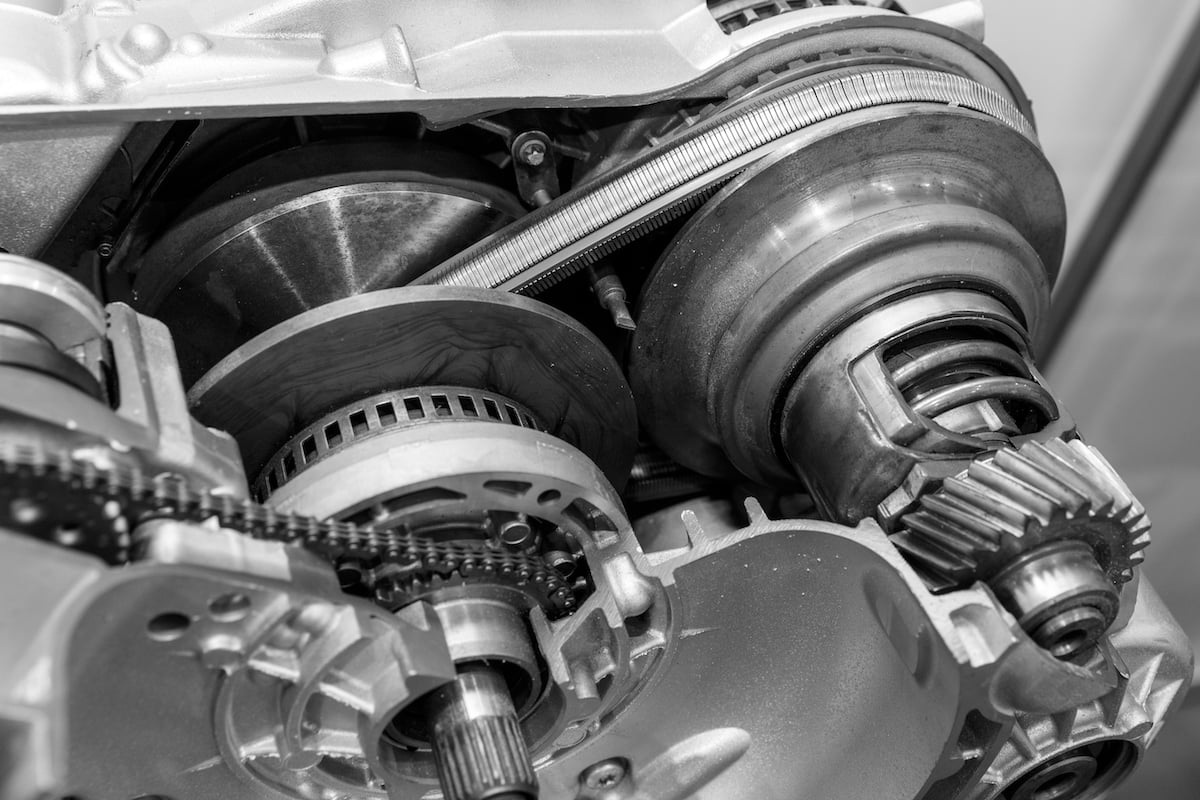
A Continuously Variable Transmission (CVT) is a type of automatic transmission that does not use fixed gears like a traditional automatic or manual gearbox.
Instead of shifting between gears (1st, 2nd, 3rd…), a CVT changes ratios smoothly and continuously, keeping the engine running at the most efficient speed for the situation.
In simple words
A normal transmission changes gears in steps.
A CVT has no steps.
As you accelerate, the car smoothly gains speed without noticeable gear changes, making the drive feel different but very smooth.
1. How does a CVT actually work?

A CVT mainly uses three parts:
- Two pulleys
- One connected to the engine
- One connected to the wheels
- A belt or chain
- Made of steel (not rubber)
- Hydraulic or electronic control system
- Adjusts pulley sizes
What happens while driving?
- When the pulley on the engine side gets smaller
- The pulley on the wheel side gets bigger
- The ratio changes smoothly
This allows infinite gear ratios within a range.
No gear changes. No shifting delays.
While this behavior is normal, CVT transmissions can develop issues over time if maintenance is ignored. Learn more about the common CVT transmission problems, symptoms, and warning signs here.
2. Why were CVTs created?
CVTs were developed mainly to improve:
- Fuel efficiency
- Smooth driving
- Lower emissions
By keeping the engine at an optimal RPM instead of constantly shifting gears, a CVT helps reduce wasted energy.
3. How is a CVT different from other transmissions?
3.1 CVT vs Automatic (Torque Converter)
| Feature | CVT | Traditional Automatic |
|---|---|---|
| Gears | No fixed gears | Fixed gear steps |
| Shifting | Smooth, continuous | Noticeable shifts |
| Fuel efficiency | Usually better | Slightly lower |
| Driving feel | Different / elastic | Familiar |
3.2 CVT vs Manual
| Feature | CVT | Manual |
|---|---|---|
| Driver control | Low | High |
| Clutch pedal | No | Yes |
| Learning curve | Easy | Steep |
| Engagement | Low | High |
3.3 CVT vs DCT (Dual-Clutch Transmission)
| Feature | CVT | DCT |
|---|---|---|
| Performance feel | Smooth | Sporty |
| Gear changes | None | Very fast |
| Efficiency | High | High |
| Complexity | Medium | High |
4. Why does a CVT feel “different” to drive?
Many drivers notice:
- Engine RPM stays high
- Speed increases without gear changes
- A “rubber band” feeling during acceleration
This is normal behavior, not a fault.
A CVT is designed to hold the engine at its most efficient RPM instead of increasing and decreasing RPM with each gear change.
This is why some people describe the feel as a “rubber band effect.”
5. What are the main advantages of a CVT?
1. Better fuel efficiency
The engine stays at optimal RPM longer.
2. Smooth acceleration
No jerks, no gear hunting.
3. Simpler driving experience
Very easy for city traffic.
4. Fewer mechanical gear parts
No planetary gearsets like traditional automatics.
6. What are the disadvantages of a CVT?
1. Driving feel
Some people dislike the lack of gear shifts.
2. Noise during hard acceleration
Engine may sound strained even when it’s not.
3. Heat sensitivity
CVTs are sensitive to:
- Overheating
- Poor maintenance
4. Repair cost
If something fails, repairs can be expensive.
7. Is a CVT reliable?
Yes — when maintained properly.
Most CVT problems come from:
- Skipping fluid changes
- Aggressive driving when cold
- Overheating
- Towing beyond limits
Modern CVTs are far more reliable than early versions.
8. Does a CVT have gears at all?
Technically:
- No traditional gears
- But some CVTs simulate gears using software
You may see:
- “7-speed CVT”
- “8-step CVT”
These are programmed ratios, not real gears.
9. Where are CVTs commonly used?
CVTs are popular in:
- Compact cars
- Sedans
- Hybrids
- City-focused vehicles
Manufacturers choose CVTs to:
- Meet fuel economy regulations
- Improve urban drivability
10. Is CVT good for highway driving?
Yes.
On highways:
- CVTs maintain steady RPM
- Reduce fuel consumption
- Provide smooth cruising
They are less ideal for:
- Aggressive driving
- Heavy towing
- Track use
11. Is CVT good for city traffic?
This is where CVTs shine.
- Smooth stop-and-go driving
- No gear shifting stress
- Better mileage in traffic
For daily commuting, CVTs are very practical.
12. Does a CVT need special maintenance?
Yes.
CVT maintenance basics:
- Use only CVT-specific fluid
- Change fluid at recommended intervals
- Avoid overheating
- Avoid sudden full-throttle launches
CVT fluid is not the same as ATF.
13. How long does a CVT last?
With proper care:
- 150,000–200,000 km (or more) is realistic
Longevity depends on:
- Vehicle design
- Driving style
- Maintenance
14. Common myths about CVT (important)
❌ “CVTs are weak”
→ Modern CVTs handle normal power levels well.
❌ “CVTs always fail early”
→ Poor maintenance is the real cause.
❌ “CVTs can’t be smooth”
→ Smoothness is actually their biggest strength.
15. Who should choose a CVT?
A CVT is ideal if you want:
- Comfortable driving
- Good fuel economy
- Low effort in traffic
It may not suit you if you want:
- Sporty gear changes
- Aggressive driving feel
- Manual control
16. Is CVT good for beginners and first-time drivers?
Yes — CVTs are actually ideal for beginners.
Reasons:
- No gear changes to manage
- Smooth acceleration
- Predictable behavior in traffic
- Less stalling or jerking
For someone learning to drive or driving mostly in cities, a CVT offers a stress-free experience.
17. Can a CVT handle hills and slopes?
Yes, but with some understanding.
On hills:
- CVTs automatically adjust ratios to maintain torque
- Engine RPM may rise more than expected
- The car may feel “different” compared to geared transmissions
This is normal.
Using:
- Proper throttle input
- Low gear mode (if available)
helps improve control on steep slopes.
18. Is CVT suitable for hot climates and heavy traffic?
Modern CVTs are designed to handle:
- Hot weather
- Long traffic jams
- Stop-and-go driving
However, heat is still the biggest enemy of a CVT.
To protect it:
- Avoid aggressive driving in traffic
- Let the car warm up properly
- Ensure cooling systems are working correctly
Good thermal management = long CVT life.
19. Why does a CVT keep the engine RPM high?
One common concern people have is:
“Why does the engine sound loud even when I’m not accelerating hard?”
This happens because a CVT is designed to hold the engine at its most efficient RPM, not to mimic gear changes.
In a traditional automatic:
- RPM rises
- Gear changes
- RPM drops
- Then rises again
In a CVT:
- RPM rises to an optimal point
- Stays there
- Speed increases smoothly
This behavior is intentional, not a sign of stress or damage.
20. Can you tow with a CVT?
CVTs are not ideal for heavy towing.
Why?
- Continuous load generates heat
- Belt and pulleys experience higher stress
Some vehicles allow light towing, but:
- Always follow manufacturer limits
- Avoid frequent towing
- Use proper cooling support if required
For frequent or heavy towing, traditional automatics are usually better.
21. Why do manufacturers still use CVTs?
Despite criticism, manufacturers continue using CVTs because they offer:
- Better fuel economy
- Lower emissions
- Smoother urban driving
- Lower production complexity for certain vehicles
They are especially popular in:
- Fuel-efficiency-focused models
- Compact cars
- Hybrids
22. Are CVTs improving over time?
Yes — significantly.
Modern CVTs are:
- Stronger
- Better cooled
- Smarter electronically
- More refined in behavior
Early reliability issues shaped public opinion, but today’s CVTs are very different from older designs.
23. What should you check before buying a CVT car?
Before choosing a CVT vehicle:
- Check maintenance requirements
- Understand fluid change intervals
- Read owner experiences (not just specs)
- Consider your driving style
CVTs work best for:
- Fuel efficiency focus
- Calm driving
- Daily commuting
24. Final thoughts
A Continuously Variable Transmission (CVT) is not a “bad” or “weak” transmission — it is simply different.
When understood properly:
- It offers smooth, efficient driving
- Works well in daily use
- Requires mindful maintenance
- Excels in city conditions
Choosing a CVT depends less on fear and more on how you drive and what you expect from a car and whether buying a car with a CVT makes sense for you.
25. FAQs
CVT is better for smoothness and efficiency.
Traditional automatics feel more familiar and sporty.
Most car CVTs do not use a traditional clutch like manuals.
They rely on torque converters or start-up clutches.
Some CVT issues can be repaired, but major failures often require replacement.
Preventive maintenance is critical.
Routine maintenance is not expensive.
Major repairs can be costly if neglected.

Founder of TheCarLane | Automotive Enthusiast
Ayush focuses on engines, tuning, diagnostics, and real-world driving knowledge to bring accurate, easy-to-understand car content to readers.