
CVT transmissions behave differently from conventional automatics, which means some things that feel wrong are actually norma, and some things that seem minor are early warnings worth taking seriously. Knowing the difference is what this guide is about: what a CVT actually is, what healthy behaviour feels like, the symptoms that mean trouble, what repairs honestly cost, and, if you’re shopping, when a CVT car makes sense and when to walk away.
What a CVT Is (and How It Actually Works)
A Continuously Variable Transmission is a type of automatic gearbox that doesn’t use fixed gears. Where a traditional automatic steps through first, second, third and so on, a CVT slides through an infinite range of ratios smoothly and continuously, no steps, no shifts, no interruptions in power delivery.
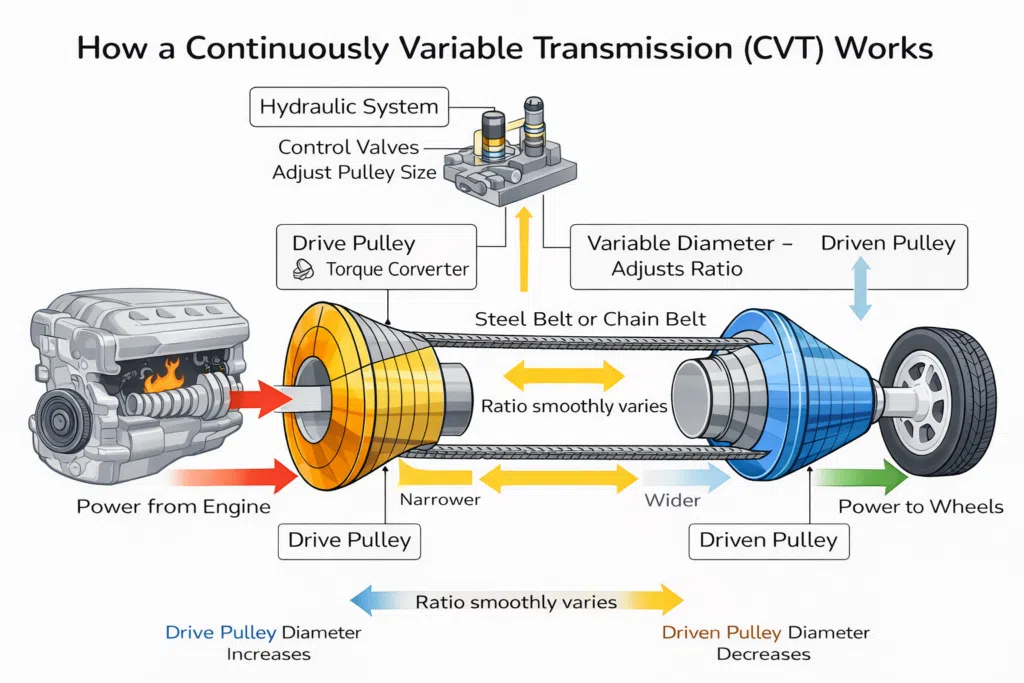
The mechanism is simpler than most people expect. A CVT uses two cone-shaped pulleys connected by a steel belt or chain, not a rubber belt, which is a common misconception. One pulley connects to the engine, the other to the wheels, and each can change its effective diameter by moving its two halves closer together or further apart. When the engine-side pulley widens, the belt rides lower and the ratio favours torque, useful for pulling away. As speed builds, that pulley narrows while the wheel-side pulley widens, shifting toward efficiency. A hydraulic and electronic control system manages this in real time. The driver experiences none of it, the car simply accelerates without shifting.
The result is an engine that holds its most efficient RPM while the car accelerates, rather than climbing and dropping through gear changes. That’s the core idea, and it’s also the source of most false alarms, which is where we start.
What’s Normal CVT Behaviour – Not a Problem
Engine RPM rising and holding steady during acceleration is by design, the CVT keeps the engine at its most efficient power band while speed builds underneath it. The engine may sound more strained than you’d expect from the pace of acceleration, and that’s also normal. Smooth speed increases with no noticeable gear changes, slight droning under hard acceleration, and a general sense that engine and road speed aren’t tracking together the way a conventional gearbox would, all of this is expected behaviour from a functioning CVT.
Common CVT Transmission Problems
Slipping or Delayed Acceleration
The clearest sign of a slipping CVT is engine RPM climbing while vehicle speed lags behind — you press the accelerator, the revs rise, but the car doesn’t pull away with the urgency you’d expect. You might also notice hesitation when pulling away from a stop, or a delayed response when you increase throttle mid-speed.
The most common causes are a worn CVT belt or chain, low or degraded CVT fluid reducing hydraulic pressure, or internal pulley wear. Check fluid condition first, it’s the cheapest diagnosis and the most frequent culprit. If symptoms persist after a fluid service, don’t keep driving on it. Continued use with a slipping CVT turns gradual wear into accelerated damage quickly.
Jerking, Shuddering, or Vibration
Shuddering during low-speed acceleration, jerking when slowing to a stop, or vibration at steady speeds all point toward contaminated or incorrect CVT fluid, a worn start-up clutch, pulley surface wear, or occasionally a software calibration issue resolvable with a dealer update.
The fluid angle matters more here than people realise. Using standard ATF in a CVT, even once, can trigger exactly this kind of shuddering, it’s one of the most common workshop errors on CVT-equipped cars. A fluid inspection and software check are the right starting points. Catch it early and it’s manageable. Leave it and pulley and clutch wear compounds fast.
Whining, Humming, or Grinding Noises
A high-pitched whine that rises with vehicle speed usually means bearing wear or pulley damage. A persistent hum points toward insufficient lubrication or early belt wear. Grinding means something is already in contact that shouldn’t be, and at that point the damage is likely significant.
CVT noise rarely stays stable, what starts as a faint whine tends to get louder and then becomes a mechanical problem if driving continues. Get it inspected promptly. The earlier it’s caught, the lower the bill.
Overheating Warning or Limp Mode
If the transmission temperature warning appears or the car suddenly limits its own speed and throttle response, the CVT has entered a protective state. This typically happens under sustained heavy load — long traffic jams in hot weather, steep climbs, or towing near the rated limit. A blocked transmission cooler or low fluid level compounds the problem significantly.
When an overheating warning comes on, stop and let the transmission cool fully before continuing. Then check fluid level and cooling system condition. Driving through an overheating warning is the fastest way to turn a recoverable situation into a replacement.
Poor Fuel Economy or Inconsistent RPM
A noticeable drop in fuel efficiency, unexpected RPM fluctuations at steady speeds, or a general loss of smoothness can all point to degraded fluid, a sensor fault, or a control system calibration issue. Less dramatic than the others, but worth paying attention to, these symptoms often show up before the bigger ones do. A diagnostics scan and fluid inspection usually get to the bottom of it quickly.
Can You Keep Driving With CVT Problems?
It depends on the symptom.
| Symptom | Safe to drive short-term? |
|---|---|
| Mild hesitation | Yes (monitor closely) |
| Shuddering | Limited driving only |
| Whining noise | Not recommended |
| Overheating warning | No |
| Limp mode | No |
The pattern here is consistent: the more dramatic the symptom, the less you should be driving on it. Ignoring early symptoms doesn’t give you more time, it converts a moderate repair into a major one.
Signs Your CVT Transmission is Failing
There is a difference between a CVT behaving unusually and a CVT that is genuinely failing. Unusual behaviour can often be resolved with a fluid change or software update. Failure signs mean internal damage is already happening and continued driving is accelerating it. These are the signs that indicate your CVT has moved past the warning stage.
Early Warning Signs – Act Soon
| Sign | What It Means | Urgency |
|---|---|---|
| Hesitation pulling away from stop | Belt or pulley wear beginning | Act within weeks |
| RPM flare without matching acceleration | CVT slipping under load | Act within weeks |
| Shuddering at low speeds | Fluid contamination or start clutch wear | Act within weeks |
| Slight whine at highway speeds | Early bearing wear | Act within weeks |
| Fuel economy dropping noticeably | CVT efficiency loss | Monitor closely |
Serious Failure Signs – Act Immediately
| Sign | What It Means | Urgency |
|---|---|---|
| Loud grinding or clunking | Internal component contact | Stop driving |
| Overheating warning light | Thermal protection triggered | Stop driving |
| Limp mode activated | ECU detected critical fault | Stop driving |
| Complete loss of drive | Belt or pulley failure | Do not drive |
| Burning smell from transmission | Fluid breakdown or friction damage | Stop driving |
| Jerking violently at all speeds | Advanced pulley or belt damage | Stop driving |
The progression from early warning to serious failure is not always gradual. Some CVTs deteriorate slowly over thousands of kilometres. Others move from first symptom to limp mode within weeks if the underlying cause is not addressed. The common thread in most severe CVT failures is that early symptoms were present but ignored.
If you are experiencing any signs in the serious failure category, stop driving and have the vehicle transported to a workshop rather than driven. Continuing to drive with active
CVT failure converts a repairable situation into a replacement.
Which Car Brands Have Had CVT Problems?
Nissan has the most documented CVT history of any mainstream manufacturer. The Altima (2013–2018) is the most cited example, shuddering, hesitation from a standstill, and premature failure were reported widely enough that Nissan extended powertrain warranties on affected vehicles in some markets. The Sentra, Rogue, Qashqai, and Pathfinder from similar years carry the same flags. Newer Nissan CVT units have improved, but used models from this generation need extra scrutiny before buying.
Honda issues are less severe and mostly concentrated in early Jazz, Fit, and first-generation HR-V models — low-speed shuddering and occasional hesitation, usually fluid-related rather than a design fault. Later Honda CVT generations have a cleaner record.
Toyota uses CVTs selectively. Their hybrid e-CVT system (Corolla Hybrid, Yaris Hybrid, Prius) uses motor-generators rather than a belt-pulley setup and has a strong reliability record. Conventional CVT-equipped Toyota models have fewer documented issues than Nissan or Honda equivalents.
Ford CVT problems are mostly historical, the CFT30 unit fitted to the Freestyle, Five Hundred, and Taurus X between 2005 and 2009 had a well-documented reputation for shuddering and premature failure. Current Ford models don’t use CVTs.
Repair or Replace – What’s Realistic
Minor issues like fluid contamination, software miscalibration, and sensor faults are straightforward and relatively inexpensive to address. Valve body problems and worn clutch components fall in the moderate range — repairable but not cheap. When the belt, pulleys, or bearing assembly suffer full internal damage, most mechanics recommend a replacement unit over a rebuild, because the labour costs of a full CVT rebuild typically exceed the price of a remanufactured replacement.
The consistent message from CVT repair costs is that early intervention is dramatically cheaper than late intervention. A fluid service and inspection at the first sign of symptoms costs a fraction of what replacement costs once those symptoms have been allowed to develop.
What CVT Repairs Actually Cost
Repair costs vary enormously with what failed and how long symptoms were ignored — the difference between catching a problem at the fluid stage and the replacement stage is often $5,000 or more.
| Repair type | What it fixes | Approx. US cost |
|---|---|---|
| CVT fluid change | Contaminated or degraded fluid | $100–$200 |
| Solenoid replacement | Pressure and shift control issues | $300–$600 |
| Valve body repair | Hesitation and erratic behaviour | $500–$1,000 |
| Belt or chain replacement | Slipping and RPM surge | $1,000–$2,500 |
| Pulley replacement | Shuddering and noise | $1,500–$3,000 |
| Rebuild | Multiple internal failures | $2,500–$4,500 |
| Remanufactured replacement | Severe internal damage | $3,500–$6,000 |
| Brand-new replacement | Total failure | $5,000–$8,000 |
by brand:
| Brand | Remanufactured Unit | Brand New Unit | Labor |
|---|---|---|---|
| Nissan | $1,500–$3,500 | $3,000–$5,000 | $500–$1,200 |
| Honda | $1,800–$3,500 | $3,500–$5,500 | $500–$1,000 |
| Toyota | $2,000–$4,000 | $4,000–$6,000 | $500–$1,200 |
| Subaru | $2,000–$4,000 | $4,000–$6,500 | $600–$1,200 |
| Mitsubishi | $1,500–$3,000 | $3,000–$5,000 | $500–$1,000 |
By region:
| Region | Fluid change | Rebuild | Full replacement |
|---|---|---|---|
| United States | $100–$200 | $2,500–$4,500 | $3,500–$8,000 |
| United Kingdom | £90–£180 | £2,000–£4,000 | £3,000–£6,500 |
| Europe (DE/NL) | €90–€180 | €2,000–€4,000 | €3,000–€6,500 |
| Australia | A$150–A$280 | A$3,500–A$6,000 | A$5,000–A$9,000 |
| India | ₹3,000–₹8,000 | ₹60,000–₹1,20,000 | ₹80,000–₹2,00,000 |
Figures are approximate; dealership rates run 20–30% above independent specialists in most markets. Always get multiple quotes before committing to major CVT work. When belt, pulleys, or the bearing assembly suffer full internal damage, most mechanics recommend a replacement unit over a rebuild — the labour of a full rebuild typically exceeds the price of a remanufactured unit.
The fluid change deserves special mention because it’s the single most cost-effective item on any CVT car: $100–$200 (₹3,000–₹8,000 in India) on schedule, versus the four-figure repairs skipping it invites. Every manufacturer specifies its own approved fluid — never substitute standard ATF, regardless of what a workshop suggests. The viscosity and friction-modifier requirements are fundamentally different, and wrong fluid is one of the most common causes of premature CVT failure seen in independent workshops
How to Prevent CVT Problems
Most CVT failures are maintenance failures, not design failures. The prevention list is short:
- Change CVT fluid at the manufacturer’s specified interval, typically every 40,000 to 60,000 km, shorter under severe use
- Use only manufacturer-approved CVT fluid, never substitute ATF
- Avoid hard acceleration on a cold transmission, let it reach operating temperature first
- Stay within the manufacturer’s towing limit, not close to it
- If the car sits in heavy traffic regularly in hot weather, ensure the transmission cooler is clean and functioning
A CVT that receives correct fluid on time and isn’t pushed beyond its design limits will outlast most of the cars it’s fitted to.
How Much Does a CVT Fluid Change Cost
A CVT fluid change is the single most cost effective maintenance item on any CVT equipped car. The difference between doing it on schedule and skipping it is often the difference between a $150 service and a $5,000 repair. Every CVT manufacturer specifies their own approved fluid, using standard automatic transmission fluid even once can trigger shuddering and accelerate internal wear significantly.
| Vehicle | OEM Fluid Required | DIY Fluid Cost | Workshop Total |
|---|---|---|---|
| Nissan Altima/Rogue/Sentra | Nissan NS-3 | $25–$40 | $100–$200 |
| Honda Fit/HR-V/CR-V | Honda HCF-2 | $30–$50 | $100–$180 |
| Toyota Corolla/Yaris Hybrid | Toyota CVT Fluid | $25–$40 | $90–$170 |
| Subaru Outback/Forester | Subaru ECVT Fluid | $30–$50 | $100–$200 |
| Mitsubishi Outlander/Eclipse | Mitsubishi CVT-J4 | $25–$40 | $90–$160 |
| Independent Shop Generic | Aftermarket CVT Fluid | — | $80–$150 |
Recommended interval: Every 30,000 to 60,000 miles depending on manufacturer. Check your owner’s manual for the exact figure for your car, some manufacturers specify longer intervals under normal conditions but shorter intervals under severe use such as frequent towing, stop-start city driving, or extreme heat.
Never substitute standard ATF for CVT fluid regardless of what a workshop recommends. The viscosity and friction modifier requirements of a CVT are fundamentally different from a conventional automatic. Using the wrong fluid is one of the most common causes of premature CVT failure seen in independent workshops.
Should You Buy a CVT Car?
The short answer: it depends entirely on how you drive and on the specific model, not the CVT category.
When a CVT makes sense
If you spend most of your time in urban or suburban traffic, stop-and-go, frequent speed changes, short to medium trips, a CVT handles that better than almost any other transmission, and its smoothness and fuel-economy advantages actually show up. It rewards calm, progressive driving; a well-maintained unit will serve that style for well over 150,000 km. It’s also a strong choice for new drivers: smooth, forgiving, nothing to manage.
When to avoid one
Aggressive driving is the first dealbreaker, a CVT will cope short-term, but sustained hard use generates heat and stress that measurably shortens its life versus a conventional automatic.
Towing is the second: avoid CVTs entirely if you tow regularly, because sustained high-torque load is exactly the stress profile they handle worst, and manufacturer towing limits reflect it.
Tuning plans matter too, even a Stage 1 remap pushes torque beyond what the CVT was rated for at the factory, and while some people run modest tunes without immediate problems, the long-term risk is real.
Used-car buyers with repair costs in mind should also weigh the downside honestly: major internal failures need a full replacement unit rather than targeted repair, which costs more than equivalent work on a torque-converter automatic and if you’re buying used with repair costs in mind: major internal failures need a full replacement unit rather than targeted repair, which costs more than equivalent work on a torque-converter automatic.
Not all CVTs are the same. The unit in a 2015 Nissan Altima, a 2022 Honda Jazz, and a Toyota Yaris Hybrid’s e-CVT are fundamentally different systems with different track records. Research the specific model and year, “2016 Nissan Rogue CVT” tells you something; “CVT” as a category doesn’t.
Buying used — check these specifically: fluid condition (dark, burnt-smelling fluid means it’s been running degraded; fresh fluid with documented history is a good sign), test-drive behaviour (any low-speed shuddering, standstill hesitation, or delayed throttle response is a warning, a healthy CVT feels seamless), documented fluid changes at correct intervals (no records = risk regardless of how it drives), and known model-year issues in owner forums before viewing. On any used CVT above 60,000 km, pay for a pre-purchase inspection from a mechanic who knows CVTs, it costs far less than what you might miss.
Last Updated: August 2026
FAQs
Heat and fluid sensitivity. Firstly, CVTs rely on clean, correct fluid far more than conventional automatics. As a result, degraded fluid or excess heat accelerates belt and pulley wear rapidly. Worse still, damage is cumulative and silent, by the time symptoms appear, significant wear has already occurred.
With proper maintenance, 150,000–200,000 km is realistic on modern units. However, the biggest variable isn’t mileage, it’s whether fluid changes were done on time with the correct fluid. Conversely, poor maintenance compresses that lifespan significantly.
The progression follows a predictable pattern. First, hesitation or delayed acceleration. Then, shuddering at low speeds. After that, unusual noises, and finally, overheating warnings or limp mode. Importantly, each stage is a window to intervene before the next, costlier one begins.
Yes, consistently. Unlike some mechanical issues, CVT problems rarely plateau, they progress. Fluid degradation accelerates wear, which generates heat, which degrades fluid faster. As a result, the cycle compounds. In practice, early symptoms are cheap to fix, ignored ones rarely are.
In the US, $100–$200 at independents, $150–$250 at dealerships. Meanwhile, UK owners pay £90–£180 and Australian owners A$150–A$280. By contrast, Indian owners pay just ₹3,000–₹8,000. Regardless of location, always use manufacturer-approved CVT fluid, never standard ATF.
CVT replacement costs $4,000–$7,000 in the US for a remanufactured unit including labor. A full rebuild costs $2,500–$4,500. UK owners should budget £3,000–£6,500. The same repair caught at the fluid stage costs $100–$200, which is why addressing CVT symptoms early matters so much.
Not universally. CVTs are smoother and more efficient in city driving; torque-converter automatics handle high torque, towing, and aggressive driving better and cost less to repair at the severe end. Which is better depends on how you drive.

Founder of TheCarLane | Automotive Enthusiast
Ayush shares practical automotive knowledge based on real-world ownership and hands-on experience. His work focuses on diagnostics, engine systems, common car problems, and clear explanations that help everyday drivers understand their vehicles better.