
Steering Wheel Shakes While Braking? Here’s What Fixed It on My Skoda Rapid
If your steering wheel shakes while braking, you’re probably worried. I was too. This happened on my 2021 Skoda Rapid 1.0 TSI, and after getting it properly inspected and fixed, I want to share exactly what the problem was, what I replaced, and what you should check if you’re experiencing the same thing.
What the Problem Felt Like
The steering wheel would shake noticeably every time I applied the brakes, especially at higher speeds. It wasn’t a violent shake, but it was consistent and impossible to ignore. The wobble came through the steering column directly into my hands whenever I slowed down.
It didn’t happen randomly, it was specifically triggered by braking. That detail matters because it helps narrow down where the problem actually lives.
Possible Causes of Steering Wheel Shaking While Braking
Steering wobble under braking has several potential causes. Some are straightforward and relatively inexpensive to fix. Others are more serious. Here’s what mechanics typically look for:
Warped or grooved brake discs: The most common cause. When the disc surface develops grooves or warps from heat, braking becomes uneven and that unevenness travels up as a wobble. This was part of what happened on my Rapid.
Worn or uneven tyres: Often overlooked. Uneven tyre wear disrupts balanced contact with the road during braking, which can cause or amplify the wobble even if the brakes themselves are fine.
Brake pads gone completely: When pads wear completely, metal contacts disc directly. Usually accompanied by a grinding noise alongside the wobble.
Worn wheel bearings: Introduces play into the wheel assembly that shows up as vibration under braking load.
Tie rods: Develop play over time which causes looseness and vibration, especially under braking when load shifts forward.
Worn tie rods and ball joints often announce themselves with a squeaking noise when turning before the wobble under braking develops — if you’re hearing both symptoms, the wear has likely progressed past the early stage.
Ball joints: Similar to tie rods, worn ball joints introduce unwanted movement into the steering and suspension system.
Suspension bushing wear: Deteriorated bushings mean small vibrations that would normally be absorbed instead travel through to the steering wheel.
Stuck brake caliper: Keeps the pad in partial contact with the disc after braking, causing heat buildup and pulsation.
Getting the Car Inspected Properly
I drove with the wobble for around two to three months before finally taking it in. Honestly I kept putting it off thinking it might sort itself out, which it obviously didn’t. If anything it became more noticeable over time, which is what eventually pushed me to act.
When I did take it in, I went straight to the Skoda service centre and had the car put on a lift. This is the right move with this kind of symptom, steering wobble under braking has several possible causes and you don’t want to start replacing parts without knowing what’s actually wrong. A lift inspection costs relatively little compared to guessing wrong.
The mechanic went through everything systematically. Tie rods, ball joints, suspension bushings and wheel bearings were all checked for play and wear. Everything came back clean. No looseness, no deterioration, nothing that needed immediate attention. That was actually reassuring because it ruled out the more serious and expensive suspension components and pointed the diagnosis clearly toward the brakes and tyres.
What Was Actually Wrong
The brake discs had visible grooves on them. Over time, disc surfaces wear and develop grooves from constant contact with the brake pads. When the surface is no longer smooth, braking becomes uneven, instead of the pad gripping a flat surface uniformly, it’s catching on ridges. That uneven friction causes the wobble you feel through the steering wheel.
All four tyres had uneven wear. The stock Goodyear tyres on my Rapid had worn unevenly across the tread. Uneven tyre wear affects how the car contacts the road, and when you brake, the car depends on all four tyres maintaining consistent grip and balance. With uneven wear, that balance breaks down.
Here’s what I think most people miss, it wasn’t one problem, it was two problems working together. Grooved discs reduced the braking surface contact quality. Uneven tyres disrupted the balance across all four corners. Together, they created a wobble that neither issue alone might have caused as severely.
What I Replaced
Brake discs and pads — OEM from Skoda
I went back to Skoda for the discs and brake pads. For braking components specifically, I didn’t want to take chances with aftermarket parts. The dealer replaced both discs and pads together.
Worth mentioning, the brake pads still had around 4,000km of life left on them. The mechanic confirmed this. But since the discs were already coming off and everything was apart, it made sense to replace the pads at the same time rather than revisiting the job in a few thousand kilometers. If you’re doing discs, do the pads together. It’s the right call.
Tyres — Bridgestone Sturdo (all four)
After the Skoda visit, I went to an independent tyre shop and replaced all four Goodyear stock tyres with Bridgestone Sturdo. I drove 52000kms on stock Goodyear tyres, replacing all four together rather than just two ensures even wear from day one and maintains balanced braking across all corners, which was part of the original problem.
After both jobs were done, the steering wheel wobble was completely gone.
The Bill
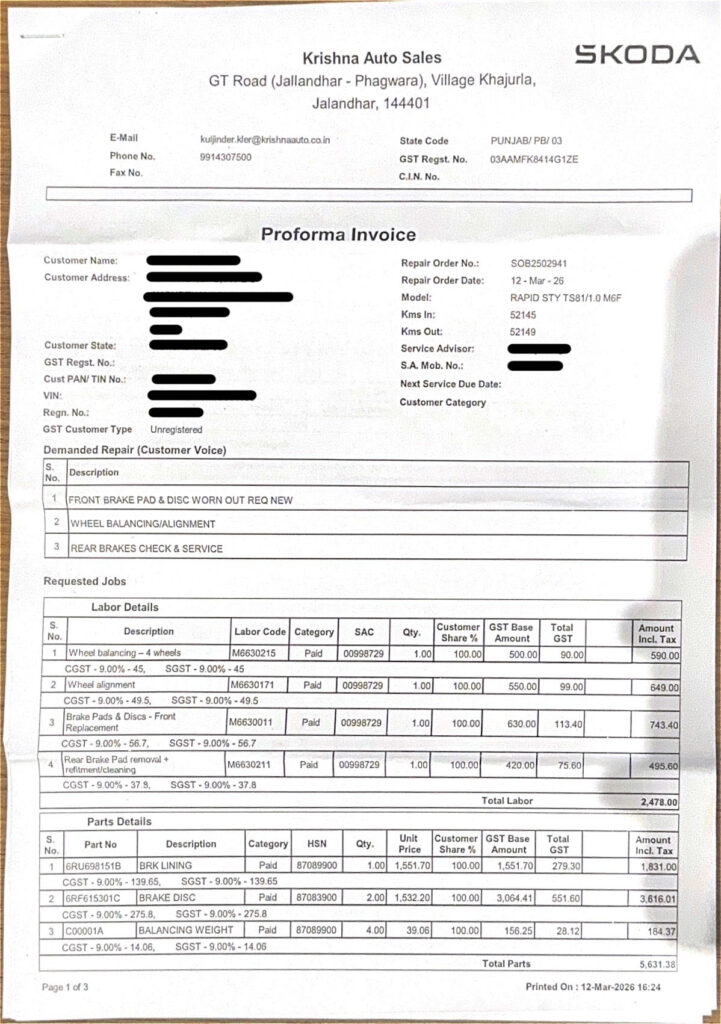
This is the actual invoice from Skoda for the disc and brake pad replacement on my Rapid. The tyres were changed separately at a local tyre shop.
Is It Safe to Drive With This?
This depends on how bad the wobble is and what’s causing it.
If the shaking is mild and only happens when braking gently at low speeds, you likely have some time, but don’t ignore it. Get it inspected soon.
If the wobble is strong, happens during normal braking at any speed, or the car pulls to one side when braking, do not delay. That level of symptom suggests your braking efficiency is already compromised, which is a safety issue.
If the wobble is accompanied by a grinding or metallic noise when braking, stop driving and get it checked immediately. That’s the sound of metal-on-metal contact, meaning your pads are completely gone and your discs are being damaged further with every stop.
The honest answer is, steering shaking under braking means something in your braking or suspension system is not working correctly. Your ability to stop the car is involved. Don’t keep driving on it indefinitely hoping it resolves on its own.
When to Stop Driving Immediately
If the shaking suddenly gets much worse without any obvious reason, or if you hear a grinding or scraping noise when you press the brake pedal, pull over as soon as it is safe to do so and don’t continue driving. The same applies if the car starts pulling sharply to one side under braking, or if the brake pedal feels soft or spongy and travels closer to the floor than it normally does. A burning smell after braking is another sign that something is seriously wrong, likely a stuck caliper generating excessive heat.
Any one of these signs means your braking system is not functioning as it should. At that point the car is not safe to drive and continuing to do so puts you and others at risk. Call for roadside assistance or have it towed to a mechanic rather than pushing through to the nearest garage.
What You Can Check at Home Before Visiting a Mechanic
You don’t need a lift or special tools for a basic visual check. Here’s what you can look at yourself:
Check your tyres
Look at the tread across the full width of each tyre. If one side is noticeably more worn than the other, or if the tread is very low, that’s a contributing factor. Also check that all four tyres look roughly even compared to each other.
Look through the wheel spokes at your brake disc
Without removing anything, you can often see the disc surface through your alloy wheel spokes. A healthy disc looks relatively smooth. If you can see deep grooves or score marks running around the disc surface, that’s wear worth getting looked at.
Check your brake pad thickness
Also visible through the wheel spokes on most cars. The pad sits against the disc inside the caliper. If the pad material looks very thin — less than a few millimeters — it needs replacing.
Feel the steering wheel response
Note exactly when the wobble occurs. Only under braking? At specific speeds? All the time? That information is useful for the mechanic and helps narrow down whether it’s brake-related or suspension-related before you even get there.
Check for brake dust or debris buildup
Sometimes uneven braking is caused by a stone or debris caught between the pad and disc. You can sometimes spot this visually. A mechanic can clear it quickly and it’s an easy fix if that’s all it is.
Final Thought
Steering shaking under braking is one of those symptoms that’s easy to keep putting off because the car still drives and stops. But your braking system is the most safety-critical part of the car. In my case it was grooved discs and worn tyres — not the most alarming diagnosis, but left long enough it would have continued deteriorating.
Get it on a lift, have everything inspected properly, and don’t guess at the cause. A proper inspection told me clearly what needed replacing and what didn’t. That’s worth more than replacing parts blindly.
Last Updated: March 2026
FAQs
It depends on severity. Mild wobble at low speeds gives you some time to get it inspected, but don’t ignore it. If the shaking is strong, happens at any speed, or is accompanied by noise or pulling to one side, stop driving and get it checked immediately. Your braking system is involved and that’s not something to delay on.
Most commonly it’s grooved or warped brake discs, worn tyres, or a combination of both. When the disc surface is uneven or tyres are worn unevenly, braking force becomes inconsistent across all four corners and that inconsistency travels up through the steering column as vibration.
Get the car on a lift and have the discs, pads, tyres, tie rods, ball joints and suspension bushings inspected first before replacing anything. In my case the fix was new OEM brake discs, pads and four new tyres. Everything else was clean.
High speed braking amplifies any existing imbalance in your braking system. Grooved discs or uneven tyres that produce a barely noticeable wobble at low speeds become much more pronounced at higher speeds because the braking forces involved are greater.
This is usually a sign that the issue is more advanced. At low speeds braking forces are lighter, so if the wobble is still present it means the disc wear or tyre condition has deteriorated enough to affect even gentle braking. Worth prioritising the inspection.

Founder of TheCarLane | Automotive Enthusiast
Ayush shares practical automotive knowledge based on real-world ownership and hands-on experience. His work focuses on diagnostics, engine systems, common car problems, and clear explanations that help everyday drivers understand their vehicles better.