

If you’ve ever driven a car that accelerates smoothly without any noticeable gear changes — engine holding steady while speed builds quietly — you’ve experienced a CVT. They’re increasingly common in compact cars, hybrids, and city-focused vehicles, yet most drivers have only a vague sense of what’s actually happening inside one. This guide explains it properly.
What Is a CVT?
A Continuously Variable Transmission (CVT) is a type of automatic gearbox that doesn’t use fixed gears. Where a traditional automatic steps through first, second, third, and so on, a CVT shifts through an infinite range of ratios smoothly and continuously — no steps, no shifts, no interruptions in power delivery.
The result is an engine that holds its most efficient RPM while the car accelerates, rather than climbing and dropping through gear changes. That’s the core idea, and everything else about CVT behaviour follows from it.
How does a CVT actually work?

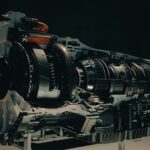
The mechanism is simpler than most people expect. A CVT uses two cone-shaped pulleys connected by a steel belt or chain — not a rubber belt, which is a common misconception. One pulley connects to the engine, the other to the wheels. Each pulley can change its effective diameter by moving its two halves closer together or further apart.
When the engine-side pulley widens, the belt rides lower and the ratio favours torque — useful for pulling away from a stop. As speed builds, that pulley narrows while the wheel-side pulley widens, shifting the ratio toward efficiency. The transition between any two points happens continuously rather than in steps, which is where the “continuously variable” name comes from.
A hydraulic or electronic control system manages the pulley positions in real time, responding to throttle input, vehicle speed, and engine load. The driver experiences none of this — it just feels like the car accelerates without shifting.
Why Does a CVT Feel Different to Drive?
The driving feel of a CVT is genuinely unlike any other transmission type, and understanding why makes it far less disconcerting.
In a conventional automatic, RPM rises, a gear change drops it back down, it rises again, and so on. You feel and hear that rhythm. In a CVT, RPM climbs to the optimal point for the current demand and stays there while speed increases underneath it. The engine holds a plateau while the car pulls forward — which is efficient and mechanically sensible, but feels odd if you’re used to traditional gearboxes.
This is what drivers describe as the “rubber band effect” — the sensation that engine speed and road speed aren’t tracking together the way you’d expect. It’s not a fault. It’s the transmission doing exactly what it was designed to do. Once you understand that, it becomes easy to ignore.
The other thing drivers notice is engine noise under hard acceleration. Because the CVT holds RPM high to maintain peak power output, the engine sounds more strained than it actually is. The noise is sustained rather than rising and falling, which reads as stress to a driver used to gear changes punctuating their acceleration. Again — normal behaviour, not a warning sign.
What Are Simulated Gears on a CVT?
You’ll see marketing terms like “7-speed CVT” or “8-step CVT” on modern cars. These aren’t real gears — they’re programmed ratio steps that the CVT holds briefly before moving to the next, mimicking the feel of a conventional gearbox shift. Manufacturers added them because many drivers found pure CVT behaviour unsatisfying, particularly under spirited acceleration.
Some CVTs also offer paddle shifters that let you select these simulated steps manually. It gives you a degree of driver engagement without the mechanical complexity of a real multi-speed gearbox. Whether you find it convincing depends on how attuned you are to gearbox feel — some people appreciate it, others find it an unnecessary compromise in both directions.
CVT vs Other Transmission Types
CVT vs Traditional Automatic A traditional torque-converter automatic uses a fixed set of planetary gears — typically six to ten on modern units. Shifts are noticeable, gear ratios are predetermined, and the RPM pattern rises and falls rhythmically. The driving feel is familiar and predictable. A CVT is smoother and generally more fuel efficient in urban driving, but the feel is less conventional. Traditional automatics tend to feel more responsive under aggressive throttle inputs.
CVT vs Manual A manual gives you complete control over gear selection and a direct mechanical connection between engine and wheels that enthusiasts value. It requires more driver involvement and has a learning curve. A CVT demands nothing from the driver and is genuinely easier in stop-and-go traffic — but it offers none of the engagement a manual does.
CVT vs DCT (Dual-Clutch Transmission) A DCT pre-selects the next gear using a second clutch, making shifts extremely fast — faster than most manual drivers can manage. It suits performance driving and feels more mechanical and sporty than a CVT. In low-speed urban traffic, however, DCTs can feel hesitant and jerky because they’re optimised for speed rather than smoothness. A CVT is more comfortable in the city; a DCT is more satisfying on an open road.
Where CVTs Work Best — and Where They Don’t
CVTs are genuinely well-suited to urban and suburban driving. Smooth stop-and-go traffic, constant speed changes, and long idle periods are all conditions where the CVT’s ability to hold optimal RPM saves fuel and reduces drivetrain stress. Hybrids use CVT-style systems for exactly this reason — the efficiency gains in low-speed driving are real and measurable.
On motorways and open roads, a CVT performs perfectly well. Cruising at steady speed is where any transmission is at its least stressed, and the CVT holds a clean, efficient ratio at highway speeds without issue.
Where CVTs genuinely struggle is under sustained heavy load. Towing is the clearest example — continuous high torque demand generates heat in the belt and pulleys, and CVTs are more heat-sensitive than traditional automatics. Manufacturers set towing limits for CVT-equipped vehicles below what the same vehicle with a conventional automatic would manage. If you regularly tow, a traditional automatic is the more appropriate choice.
Aggressive driving — repeated hard launches, track use, or sustained high-performance driving — also puts more stress on a CVT than it was designed to handle. This isn’t a daily driving concern, but it’s worth understanding.
CVT Reliability and How Long They Last
Modern CVTs are significantly more reliable than early units from the late 1990s and early 2000s, whose reputation for premature failure still colours public perception unfairly. A well-maintained CVT on a modern car will realistically last 150,000 to 200,000 km or beyond.
The majority of CVT failures trace back to the same causes: skipping fluid changes, aggressive driving on a cold transmission, sustained overheating, or towing beyond the manufacturer’s rated limit. None of these are design flaws — they’re maintenance failures. For a full breakdown of symptoms and warning signs, see our guide on common CVT problems.
CVT fluid deserves specific mention. It is not interchangeable with standard automatic transmission fluid. Using the wrong fluid is one of the fastest ways to damage a CVT, and it happens more often than it should because workshops unfamiliar with CVT-equipped vehicles substitute ATF. Always confirm the correct fluid specification before any service.
Fluid change intervals vary by manufacturer, but most recommend between 40,000 and 60,000 km under normal driving conditions — some specify shorter intervals for severe use. Check your owner’s manual for the exact figure rather than following a generic service schedule.
Common CVT Myths — Addressed Directly
CVTs are weak and unreliable. Early ones had real problems. Modern CVTs in mainstream cars handle normal driving loads without issue. The reputation hasn’t kept up with the engineering.
A loud CVT means something is wrong. High RPM under hard acceleration is by design, not distress. If the engine sounds loud during strong acceleration, that’s the CVT holding peak power RPM — expected behaviour.
CVTs can’t be smooth. Smoothness is the CVT’s primary strength. No other transmission type delivers acceleration as free of interruption as a well-functioning CVT.
You can use regular automatic fluid in a CVT. You cannot. This is a genuine risk and a common mistake. Always use manufacturer-specified CVT fluid.
Who Should Choose a CVT?
A CVT suits you well if you drive primarily in urban or suburban conditions, prioritise fuel efficiency, want a low-effort daily driving experience, or are a new driver who doesn’t want the complexity of gear management. In these contexts a CVT is genuinely the most practical transmission choice.
It’s less suited to you if you want driver engagement and enjoy the feel of gear changes, drive aggressively or on track days, tow regularly, or simply prefer the feel of a conventional automatic. None of these make a CVT a bad transmission — they just mean your driving style would be better served by something else. If you’re still weighing up whether to buy a CVT-equipped car, we’ve covered that decision in full guide on whether you should buy a car with CVT or not?
Last Updated: March 2026
FAQs
For fuel efficiency and smoothness in urban driving, yes. For familiar driving feel, responsiveness under hard acceleration, and towing capacity, a traditional automatic is generally better. Which is “better” depends entirely on how and where you drive.
Because it holds engine RPM at a sustained high level to maintain peak power output, rather than shifting up and dropping RPM as a conventional gearbox would. The noise sounds more intense than the actual mechanical stress involved. It’s normal behaviour.
Minor issues — solenoids, sensors, fluid contamination — can often be repaired. Internal mechanical failures involving the belt, pulleys, or valve body typically require a full rebuild or replacement unit. Preventive maintenance is far cheaper than either option.
Most manufacturers recommend between 40,000 and 60,000 km under normal conditions, shorter under severe use. Always check your specific vehicle’s service schedule and use only the manufacturer-specified CVT fluid — not generic ATF.
No. Paddle shifters are optional on many CVT-equipped cars and allow the driver to select simulated gear steps manually. Some models offer them as standard, others don’t include them at all. Their presence depends on the manufacturer’s positioning of the model.
Yes, with some adjustment in expectation. The CVT automatically adjusts ratios to maintain torque on inclines, though RPM will rise more noticeably than you might expect. Most CVT-equipped cars also offer a manual or low-gear mode specifically useful for sustained descents.
A CVT is a type of automatic transmission. You don’t select gears or operate a clutch — the car manages everything. It differs from a traditional automatic in that it uses no fixed gear steps, but from a driver’s perspective it operates the same way: select D and drive.
For smoothness and refinement, CVT wins clearly. An AMT is essentially a manual gearbox with an automated clutch and gear actuator, which means gear changes are noticeable and sometimes jerky at low speeds. CVTs are smoother, quieter, and more comfortable in stop-and-go traffic. AMTs have one real advantage — lower cost, both to buy and to repair. If budget is the primary concern, AMT makes sense. If driving comfort matters more, CVT is the better choice.