

This article contains affiliate links. As an Amazon Associate TheCarLane earn from qualifying purchases, at no extra cost to you.
The AdBlue warning light comes on when the fluid that controls your diesel car’s emissions is running low. AdBlue is a different liquid from diesel. It is kept in a tank with a blue cap, and every diesel car that was registered after September 2015 uses it. When the light is amber, you usually have about 1,500 miles to fill it up. If the dashboard or light turns red, the tank is almost empty. The engine won’t start again until you fill it up. You can fill up a 10-liter bottle yourself in five minutes for £15 to £20.
If the warning stays on after you refill, though, or if you see fault codes like P20E8, P204F, or P20EE, the problem isn’t the fluid; it’s the AdBlue system itself. This guide talks about both situations and gives you the fixes that work.
What The AdBlue Warning Light Means (And What It Looks Like)
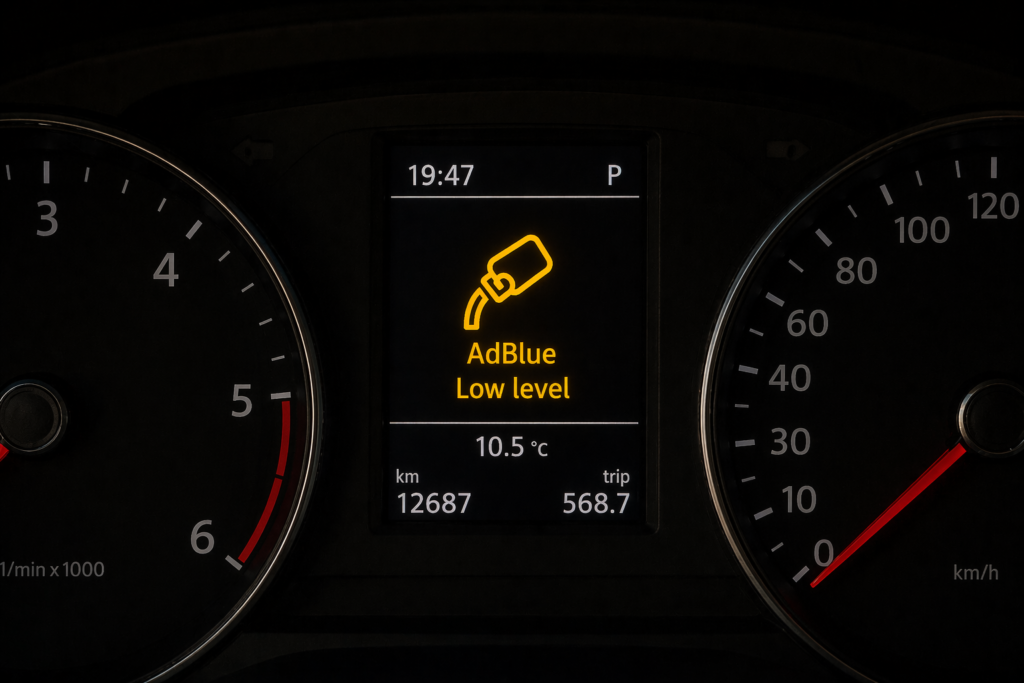
The AdBlue warning is usually an amber symbol showing a bottle or a droplet, often with the letters AdBlue or DEF next to it. On VW Group cars it tends to appear with a message and a mileage countdown. On some models it’s just text: “AdBlue range 1500 miles” or similar. If you’re not sure which symbol you’re looking at, the countdown is the giveaway. No other warning on your dash counts down in miles.
Nine times out of ten, the light means one simple thing: the tank is running low and the car wants a top-up. It is not telling you something is broken. Your car uses AdBlue to clean up its exhaust, injecting small amounts into the system to cut NOx emissions, and it simply gets through the fluid the same way it gets through fuel, just much more slowly.
The reason the warning feels so urgent is the law behind it. A diesel with an empty AdBlue tank is not allowed to run, so the car will refuse to start once the tank hits empty. It will never cut out while you’re driving. But once you switch off with an empty tank, that’s it until you refill. That’s the entire threat, and it’s also why the fix is usually a £12 bottle and five minutes of your time.
How To Tell Which Problem You Actually Have
Run through four quick questions before buying fluid or booking a garage.
Does the dashboard show a mileage countdown? If yes, the fluid is low. Top it up.
Did you recently fill up with AdBlue? If the light came on soon after, the fluid isn’t the problem — it’s either contaminated fluid or a system fault.
Is the engine in limp mode? If yes, the ECU has detected a fault. Read the codes before doing anything.
Can you hear the AdBlue pump whirring when you turn the ignition? A short whirring from the rear for a few seconds means the pump works. Silence or rattling means it’s failing.
If only the first question applies, this is a simple refill. If any of the others apply, skip to “When Topping Up Doesn’t Fix It.”
How To Top Up Your AdBlue Step By Step
Some links on this page are affiliate links: if you buy through them, TheCarLane earns a small commission at no extra cost to you. Recommendations are never influenced by this.
The whole process takes about five minutes and costs between £8 and £20 depending on bottle size. You do not need a garage for this.
You’ll need a bottle of AdBlue with a pouring spout (5L or 10L is standard), a clean cloth, and ideally a pair of disposable gloves. AdBlue itself is non-toxic, but it’s corrosive to paintwork and will irritate skin and eyes, so it’s worth being careful not to spill it which is exactly why the spouted bottles are worth the extra pound.
On most diesel cars, the filler cap sits next to the fuel filler cap behind the fuel flap, look for a blue-topped cap about the same size as your diesel filler. On some cars, particularly Skoda Octavia estates, the Kodiaq, and some Audis, it’s under the boot floor where the spare wheel used to live, or inside the boot near the wheel arch. If you can’t find it, check your owner’s manual under “AdBlue” or “DEF.”
The top-up procedure
- Park on flat ground and turn the engine off
- Open the filler cap, it usually twists off by hand, though some need a coin or wheel brace
- Screw the nozzle of the AdBlue bottle onto the filler, or use a funnel if pouring from an open container
- Pour slowly, most bottles have a pressure-release nozzle that stops automatically when the tank is full
- Don’t force more in once the flow stops, overfilling causes spillage, not better performance
- Screw the filler cap back on until it clicks firmly into place
- Wipe up any spills with the cloth, and rinse the bodywork with water if any fluid touched paint
- Start the engine and drive for 10 to 15 minutes
The warning light should go off during that drive as the system recognises the refill. If it doesn’t, the later section “When the warning light stays on after topping up” explains why.
How much to add
You don’t need to completely fill the tank, and you shouldn’t try to. Refer to your owner’s manual for the exact capacity, but as a rough guide:
- Small VW/Skoda/Audi/SEAT diesels (Polo, Fabia, A1, Ibiza): 8–13 litres
- Larger VW/Skoda/Audi/SEAT models (Passat, Octavia, A4, Superb): 17–20 litres
- Mercedes Sprinter and Vito: 18–24 litres
- Ford Transit, Peugeot Boxer, Fiat Ducato: 22–25 litres
If the tank was nearly empty, even 5 litres will give you several thousand miles of range, you don’t have to fill to the brim unless you want to.
Is It Safe To Drive With The AdBlue Warning Light On?
Yes, but not indefinitely. The light isn’t a safety emergency in the way a brake warning or oil pressure warning is. The car still drives normally in the short term.
However, once the AdBlue tank runs completely empty, the ECU will prevent the engine from starting again. You’ll finish your current journey without incident, but the next time you turn the ignition, the car simply won’t fire up.
For a VW Group diesel — Skoda, VW, Audi, or SEAT — the typical sequence runs like this. With 1,500 miles of range remaining, an amber message appears and repeats every 62 miles. The message is still amber at 1,000 miles, but it repeats more often, every 31 miles. The warning turns red and stays on for about 600 miles. When you reach zero miles, the engine keeps running until you turn it off, but it won’t start again after that. Other brands follow similar logic with slightly different mileage thresholds.
The practical advice is simple: top up before you hit zero. Once the countdown reaches zero, even adding AdBlue may require a dealer visit to reset the system on some models, which turns a £15 fluid top-up into a £150+ diagnostic appointment.
What To Do When The AdBlue Light Turns Red
A red AdBlue warning is different from amber. You don’t have 1,500 miles — you have hours of driving before the engine refuses to restart.
Act within the next hour
Check the dashboard countdown. Your car shows exactly how many miles (or starts) you have left. Treat it as a deadline.
Drive to buy AdBlue. Halfords, Euro Car Parts, a supermarket, or any petrol station with an AdBlue pump. Skip this step if you have a bottle at home.
Add at least 5 litres. Adding 1–2 litres won’t reset the system at the red stage. If your tank is small, fill it.
Drive for 15–20 minutes at road speed. The sensor needs time to recalibrate, and some cars require over 20 mph to clear the countdown. A short trip around the block won’t work.
Look at the warning. You’re safe if it turns yellow or clears. Go to the next section if it stays red.
If the red warning stays on after topping up
You didn’t add enough, the fluid is contaminated, or there’s a system fault. Read the fault codes with an OBD2 scanner — the codes will tell you which.
If the engine won’t start
Don’t keep cranking. Add 5 litres of fresh AdBlue, wait 2–3 minutes, try again. If it still won’t start, the ECU has locked the system and needs a dealer or mobile specialist to reset it with diagnostic software. This is fixable, just not DIY on every model.
When The Adblue Warning Light Stays On After Topping Up
Five possible reasons the light stays on after a refill.
The system hasn’t registered the refill yet. Level sensors need a few minutes to update, and some systems need 10 minutes of driving above 20 mph to recalibrate. A proper journey should clear it.
You added less than the minimum. Many cars need at least 3–5 litres added to register a refill. Add more if you only topped up with 1–2 litres.
The AdBlue is contaminated. Cheap, old, or frost-damaged AdBlue can fall below the required 32.5% urea concentration. The ECU detects this and throws code P207F. Fresh fluid from Halfords, a main dealer, or sealed supermarket bottles should be fine.
The level sensor has failed. On VAG vehicles particularly, the sensor sits inside the tank. When it fails, the car thinks the tank is empty even when full — codes P203B, P203C, or P203D. Sensor itself is £60–£120, but labour jumps if the tank has to come out.
A deeper SCR fault. Something mechanical or electronic has broken. That’s what the fault code section covers next.
AdBlue Fault Codes and How To Read Them
If the warning stays on after a proper top-up and a decent drive, the system has logged a fault code, and reading it turns guesswork into a diagnosis. These are the ones that matter:
P20E8: Reductant Pressure Too Low. The pump can’t build the required pressure. Weak pump, blocked filter, or a leak. Extremely common on 2016–2020 Skoda Octavia and VW Caddy, plus Ford Transit, Fiat Ducato, and PSA vans. Leads to no-start countdown if ignored. Fix: pump or filter replacement. Main dealer £400–£700, independent specialist £200–£400.
P204F: Reductant System Performance. A general “something’s off with the injection system” code. On VW Group diesels, P204F commonly pairs with P20EE — when you see both together, it’s usually an SCR catalyst issue, not the pump. Often intermittent. Diagnostic £150, repair £300–£1,200 depending on cause.
P207F: Reductant Quality Performance. The ECU thinks the AdBlue itself is contaminated or wrong concentration. Common causes: cheap or counterfeit fluid, water added by mistake, or NOx sensor feedback issues. Drain and refill with proper AdBlue first (£30–£60). If the code returns, it’s likely a NOx sensor fault.
P20EE: SCR NOx Catalyst Efficiency Below Threshold. The expensive one. The SCR catalyst isn’t reducing NOx enough, or the NOx sensors are feeding bad data. Replace the NOx sensor first — it’s the common failure (£150–£300). If P20EE returns within 500 miles, the catalyst itself is failing. SCR catalyst replacement on a Skoda Octavia or VW Passat runs £800–£2,000.
P203B, P203C, P203D. All relate to the reductant level sensor. Part is £60–£150, labour varies by model because some tanks have to come out.
Other common fault codes on VAG diesel vehicles include P2015 (intake manifold runner control), which affects VW, Audi, and Skoda 2.0 TDI engines specifically.
Reading the codes yourself takes a £20 adapter and five minutes and a free phone app, and it’s genuinely worth doing before you ring anyone. Walking into a garage saying “it’s showing P204F” instead of “the AdBlue light won’t go off” changes the conversation and usually the quote.
One honest note on what the codes can and can’t tell you. They name the circuit that complained, not always the part that failed. P20E8 points at pressure, which might be the pump or might be a crystallised line. Treat the code as the starting point for the garage conversation, not a shopping list.
How Often Do You Need To Top Up AdBlue?
Consumption varies dramatically based on your driving style and the specific engine. A typical passenger diesel uses around 1 litre of AdBlue every 350 to 600 miles. Larger diesel SUVs and vans burn through it faster — about 1 litre every 250 to 500 miles. Heavy motorway driving produces more NOx, which means the SCR system doses more AdBlue, and consumption rises accordingly. Short urban journeys have lower per-mile consumption but often trigger warnings more frequently because regeneration cycles can’t complete properly.
For most Skoda, VW, and Audi drivers, expect to refill every 3,000 to 8,000 miles. You’ll typically need one top-up between services, which is why main dealers don’t usually include it in a standard service package.
Where To Buy AdBlue
Prices below covers UK, US and India. European retail is broadly similar, the product itself is the same standardised 32.5% urea solution everywhere, only the retailer names change. Common European equivalents: Norauto and Feu Vert (France), ATU (Germany), Praxis and Kruidvat (Netherlands), Halfords Ireland (Ireland), Biltema (Scandinavia).
| Where to buy | UK | US | India |
|---|---|---|---|
| Supermarket / big-box shelf | £8–15 / 10L | $10–15 / 2.5 gal | — |
| Amazon: [Redex 10L] · [Carlube 10L] — easiest online | £10–17 / 10L | $12–20 / 2.5 gal | ₹800–1,500 / 10L |
| Auto parts store (Halfords · AutoZone/O’Reilly · local spares) | £10–19 / 10L | $12–18 / 2.5 gal | ₹700–1,200 / 10L |
| Fuel station pump | £0.70–1.55 / litre | $3–6 / gal (truck stops) | rare, truck stops only |
| Fuel station bottle (forecourt) | £20–30 / 10L | $18–30 / 2.5 gal | ₹1,200–2,000 |
| Main dealer top-up | £1.50–4 / litre | $8–15 / gal equivalent | ₹300–600 / litre |
UK: Costco’s Redex deals (£9.99–12 per 10L when on offer) are repeatedly the cheapest branded route if you have a card, and only a few hundred stations have car-sized pumps. US: the fluid is sold as DEF, not AdBlue, same ISO 22241 spec, BlueDEF is the shelf-dominant name, and truck-stop pumps (Pilot, Love’s) are the cheapest per-gallon fill if your filler neck is accessible. India: sold as both AdBlue and DEF (Tata Motors Genuine, Gulf, BharatBenz brands), with doorstep delivery through Amazon and spares shops being the practical route since forecourt availability is patchy outside truck corridors.
Avoid unbranded AdBlue from unknown sellers, substandard fluid causes P207F faults that cost more than any saving. AdBlue has a 12-month shelf life at room temperature, so don’t stockpile.
Will An AdBlue Warning Fail An MOT Or Equivalent Inspection?
If you’re in the UK, an AdBlue warning on its own doesn’t fail an MOT. Three situations that are related do, however. If the AdBlue warning light and the emissions warning light (MIL or check engine light) are both on, the test is an automatic fail. The tailpipe test fails if the engine is in limp mode during the emissions test. It can’t pass if the car won’t start because the AdBlue countdown reached zero.
European readers: your local equivalent, TÜV in Germany, APK in the Netherlands, Kontrollbesiktning in Sweden, NCT in Ireland, Besiktning in Norway, CT in France, applies the same emissions logic. A stored emissions DTC or a vehicle that won’t start fails the inspection everywhere.
The actual risk in all markets is that if you ignore an AdBlue warning, your car may not start, and that could happen right before your inspection date.
Model-Specific Adblue Warning Light
VAG group (Skoda, VW, Audi, SEAT). The 2.0 TDI across Octavia, Superb, Passat, Golf, Tiguan, A4, A6 all share the same AdBlue architecture and faults. P20EE + P204F combinations on 2016–2020 models are heavily documented on Briskoda and VW Audi Forum UK. The AdBlue tank heater can fail in very cold winters, causing false low-level warnings — VW has covered this under extended warranty on some models, worth checking. AdBlue faults often appear alongside DPF regeneration problems on the same VAG diesels, if your DPF warning light is on too, the two systems may be interacting.
Ford Transit. The 2.0 EcoBlue is notorious for AdBlue pump failures at 70,000–90,000 miles, code P20E8. If you’re approaching that mileage, get the pump checked proactively.
Peugeot and Citroen (PSA). Boxer and Ducato platforms (including motorhomes) have frequent level sensor failures. Persistent “empty” warnings on a full tank point to the sensor.
Mercedes Sprinter and Vito. Older models suffer AdBlue heater element failures — look for white crystallised AdBlue around the tank, which signals a leak dripping onto the wiring loom. Left alone it causes electrical faults that cost much more than the heater itself.
For other warning lights specific to VAG diesels, see our detailed guide on skoda warning lights.
When To Call A Professional
Top up yourself if: amber light with mileage countdown, or first-time top-up on this car, or the warning cleared after a previous refill.
Call an independent garage or mobile specialist if: the warning stays on after a full refill and proper drive, you have codes P20E8, P204F, P20EE, or P207F, the car is in limp mode, or you hear unusual noises from the rear at startup.
Go to a main dealer only if: the car is under warranty, an independent has diagnosed SCR catalyst failure and you want a second opinion, or you want to verify a high quote.
A mobile AdBlue specialist charges £60–£120 for diagnostic and £200–£500 for most repairs. A main dealer charges £100–£200 for diagnostic and £500–£2,000 for repairs. Independents are almost always cheaper and faster for common faults.
FAQs
Yes, you can refill AdBlue yourself in about five minutes. The filler cap is usually next to your diesel filler — unscrew it, attach the bottle’s pouring spout, and pour slowly until the flow stops. Add at least 3–5 litres for the system to register the refill, then drive for 10–15 minutes to let the warning clear.
First, top up the tank with fresh AdBlue — this resolves the warning in about 90% of cases. Add at least 3–5 litres and drive for 10–15 minutes. If the warning stays on after a proper drive, read the fault codes with an OBD2 scanner. Codes like P20E8, P204F, P20EE, or P207F point to a sensor, pump, or SCR catalyst fault that needs a garage, typically costing £200–£700 depending on the specific issue.
A 10-litre bottle of AdBlue typically lasts between 3,500 and 6,000 miles in a passenger diesel car, or between 2,500 and 5,000 miles in a larger diesel SUV or van. Consumption is roughly 1 litre every 350–600 miles for cars and 1 litre every 250–500 miles for vans. Heavy motorway driving increases consumption because the SCR system doses more AdBlue to treat higher NOx output.
Between 500 and 2,000 miles depending on make and model. Your dashboard countdown is more accurate than any general rule — trust what it tells you. VW Group diesels (Skoda, VW, Audi, SEAT) typically show the first warning at 1,500 miles remaining, then ramp up urgency at 1,000 miles, 600 miles, and finally refuse to start at zero.
An AdBlue delete is a software modification that disables the SCR monitoring entirely. It’s occasionally used on export vehicles or off-road applications, but it’s not legal on public roads in the UK. It’s an automatic MOT fail and will invalidate your insurance. Don’t do it on a daily-driver UK car.
Last Updated: August 2026

Founder of TheCarLane | Automotive Enthusiast
Ayush shares practical automotive knowledge based on real-world ownership and hands-on experience. His work focuses on diagnostics, engine systems, common car problems, and clear explanations that help everyday drivers understand their vehicles better.