
What is ABS? Complete Guide to Anti-Lock Braking System (ABS) for Cars
ABS — Anti-lock Braking System — is one of the most important safety technologies ever built into a car. It prevents your wheels from locking up during hard braking, which keeps you in steering control at the moment you need it most. This guide covers how ABS actually works, what the warning light means, how to test it, and what happens when it fails — with real-world context for both Indian and international driving conditions.
What ABS Does and Why It Exists
Before ABS existed, hard braking in an emergency often caused the wheels to lock completely. Locked wheels don’t roll — they slide. Sliding tyres lose grip, which means the car keeps moving in whatever direction it was going regardless of what you do with the steering wheel. The result is a skid you cannot control and a stopping distance that increases rather than decreases.
ABS solves this by keeping the wheels rotating even during maximum brake pressure. It does this by rapidly pulsing the brake pressure — releasing and reapplying it many times per second — so the tyre maintains contact and grip with the road surface. The wheel never fully locks, which means you can steer while braking. In an emergency where something appears suddenly in front of you, the ability to steer around it while braking is the difference between avoiding the obstacle and hitting it.
ABS is also the foundation of every other active safety system on a modern car. Electronic Stability Control, Traction Control, Brake Assist, and Electronic Brakeforce Distribution all rely on the wheel speed sensors and hydraulic control that ABS provides. A car without ABS cannot have any of these systems functioning properly.
How Does ABS Work?
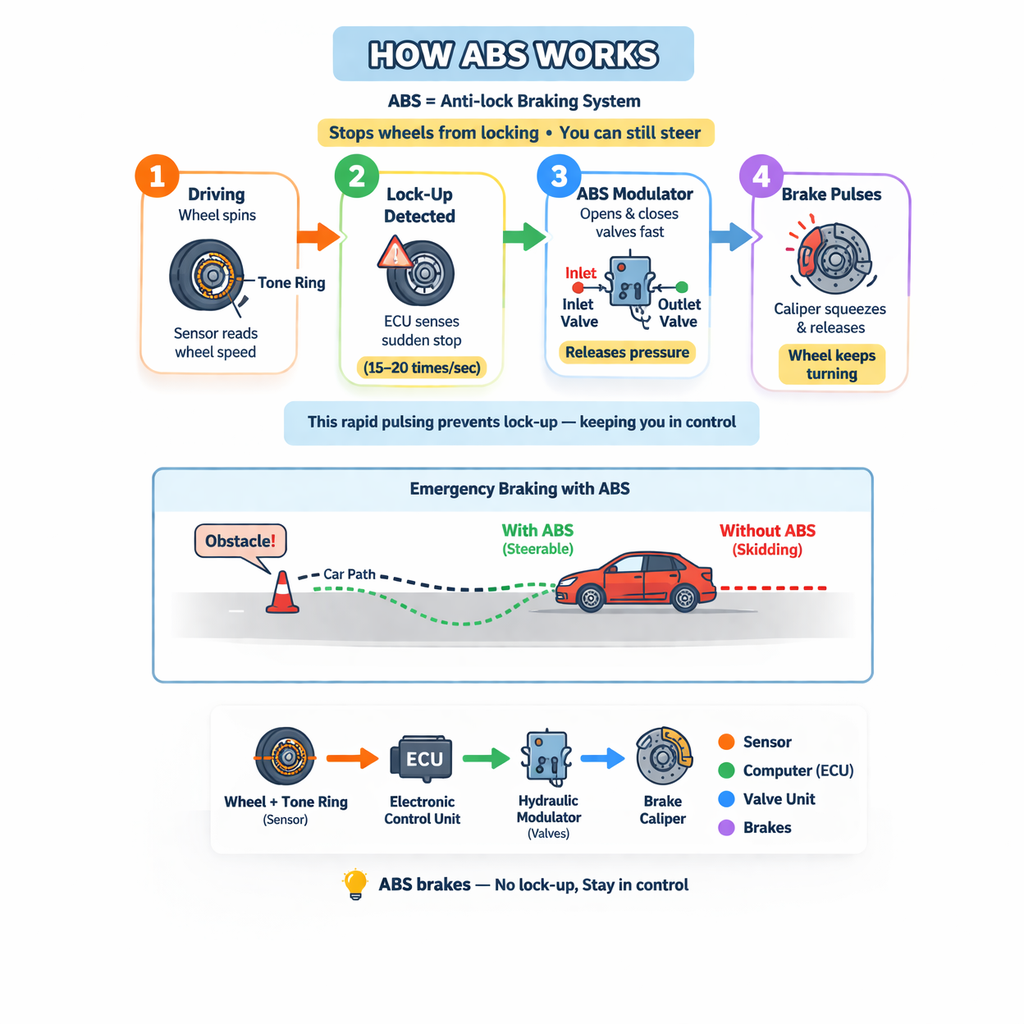
ABS uses four components working together — a wheel speed sensor at each wheel, an ABS control module, a hydraulic modulator, and the brake lines and valves connecting everything.
The wheel speed sensors continuously measure how fast each wheel is rotating and send that data to the ABS control module. During normal braking this data is unremarkable. During hard braking, if one wheel begins decelerating significantly faster than the others, the control module recognises this as the early stage of wheel lock. It responds by signalling the hydraulic modulator to reduce brake pressure to that specific wheel. The wheel regains rotation. The modulator then reapplies pressure. This cycle repeats between 15 and 30 times per second, far faster than any driver could manually pump the brakes.
What you feel when ABS activates is a rapid pulsing or vibration through the brake pedal. This is normal and is the system working correctly. The important thing to know is that when ABS activates you should keep your foot pressed firmly on the brake — do not lift off and do not pump the pedal manually. ABS is doing the pumping for you. Lifting off or pumping manually interrupts the system.
ABS on Indian Roads vs International Conditions
ABS became mandatory on all new cars sold in India in 2019. Before that date many budget cars were sold without it, which is worth knowing if you’re buying a used car.
Indian driving conditions make ABS particularly valuable. Sudden braking for animals, two-wheelers, and pedestrians entering traffic unexpectedly, combined with dusty or wet monsoon road surfaces, means the situations where ABS activates are common rather than rare. Wheel lock on a dusty or wet road during an unexpected stop is exactly what ABS is designed to prevent.
In countries with consistent high-quality road surfaces the primary ABS benefit shifts toward wet weather, snow, and high-speed emergency braking. In the US, stability control became mandatory on all new cars in 2012 — a regulation that required ABS as its foundation.
Types of ABS Systems
4-channel ABS is the standard on all modern cars. Each wheel has its own sensor and its own independent control, allowing the system to manage each wheel individually based on its specific grip conditions. This is the most effective configuration.
3-channel ABS was common on older cars where the two front wheels were controlled independently but the rear wheels shared a single channel. Less precise than 4-channel but still significantly better than no ABS.
1-channel ABS controlled only the rear wheels together and was common on older pickup trucks and some older two-wheelers. Largely obsolete on modern cars.
Does ABS Reduce Stopping Distance?
This is one of the most misunderstood aspects of ABS. The answer depends entirely on the surface.
On wet roads, snow, gravel, mud, or any low-grip surface, ABS reduces stopping distance because it maintains tyre grip throughout the braking event. A locked wheel on a slippery surface slides and loses grip — a rolling wheel maintains it.
On dry tarmac or high-grip surfaces, ABS may result in a marginally longer stopping distance compared to a skilled driver who can modulate brake pressure manually right at the threshold of lock-up. However this comparison is theoretical. In a real emergency most drivers apply maximum brake pressure — ABS ensures that pressure doesn’t cause a lock regardless of surface conditions, which is the practical benefit that matters.
The primary purpose of ABS is to maintain steering control during emergency braking, not to guarantee the shortest possible stopping distance on every surface.
ABS on Indian Roads vs International Conditions
ABS became mandatory on all new cars sold in India in 2019. Before that date many budget cars were sold without it, which is worth knowing if you’re buying a used car.
Indian driving conditions make ABS particularly valuable. Sudden braking for animals, two-wheelers, and pedestrians entering traffic unexpectedly, combined with dusty or wet monsoon road surfaces, means the situations where ABS activates are common rather than rare. Wheel lock on a dusty or wet road during an unexpected stop is exactly what ABS is designed to prevent.
In countries with consistent high-quality road surfaces the primary ABS benefit shifts toward wet weather, snow, and high-speed emergency braking. In the US, stability control became mandatory on all new cars in 2012 — a regulation that required ABS as its foundation.
When ABS Became Mandatory
In India ABS became mandatory for all new passenger cars in April 2019. Before this date it was standard on higher variants of most models but absent on entry-level trims.
In the United States Electronic Stability Control — which requires ABS — became mandatory on all new passenger vehicles from the 2012 model year onward, effectively making ABS universal on new cars sold from that point.
In the European Union ABS has been mandatory on all new cars since 2004 and ESC since 2014.
ABS Warning Light — What It Means
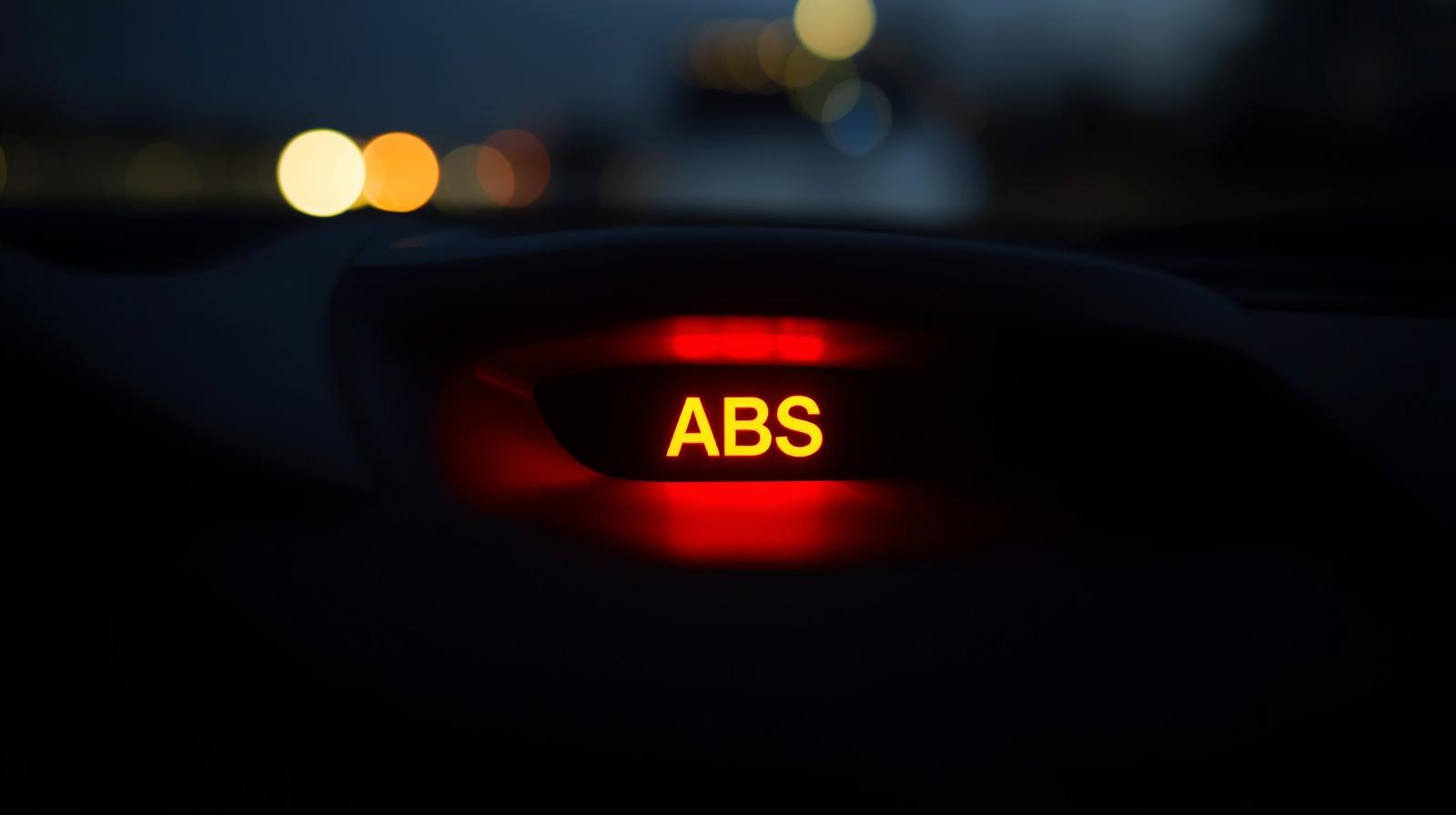
When you start the car the ABS warning light illuminates briefly then goes off. This is a self-check — the light going off confirms ABS is ready and working.
If the light stays on while driving, the system has detected a fault and disabled itself. Your normal brakes still work — you haven’t lost the ability to stop. What you’ve lost is the anti-lock function, meaning hard braking can now cause wheel lock.
Common causes:
Wheel speed sensor failure — the most frequent cause. Sensors on dusty or salted roads are particularly vulnerable to debris and corrosion. Usually inexpensive to fix.
Low brake fluid — some cars monitor fluid level as part of the ABS self-check. Check the reservoir first before assuming anything more serious.
Blown ABS fuse — cuts power to the control module. Located either in the engine bay fuse box near the ABS pump relay or in the dashboard fuse box on the driver’s side. Replace only with the correct amp rating.
Faulty ABS pump or hydraulic modulator — less common but more expensive. Requires professional diagnosis.
Worn wheel bearing — the tone ring the sensor reads is integrated into the bearing on most modern cars. A worn bearing produces erratic sensor signals and triggers the warning.
ABS light after a battery change — usually resolves on its own. Drive normally for 5 to 10 minutes and the light typically resets. If it doesn’t, use an OBD2 scanner to check for stored fault codes.
ABS Sensor — Symptoms of Failure
The ABS warning light staying on is the most direct signal. A speedometer that drops or reads incorrectly at certain speeds often indicates a front wheel speed sensor issue since many cars use the same sensor data for the speedometer. Traction control or stability control warning lights appearing alongside the ABS light confirm the fault has affected the systems that rely on ABS sensor data. ABS activating at low speeds during gentle braking — when it normally wouldn’t — suggests a sensor is sending false lock signals to the control module.
Sensor replacement costs vary significantly. In India expect to pay between INR 1,500 and INR 6,000 per sensor including labour. Internationally the sensor itself typically costs between $40 and $120 with labour on top.
Before replacing a sensor, clean the sensor and its mounting area — dust, mud, and corrosion on the sensor tip are a common cause of fault codes that clear once the sensor is cleaned.
Does ABS Work at Low Speeds?
ABS does not activate below approximately 10 to 15 km/h. At very low speeds the wheels are rotating slowly enough that the sensor data doesn’t give the control module sufficient information to detect wheel lock reliably. Below this threshold normal hydraulic braking takes over completely.
If you notice ABS activating during slow speed gentle braking where it normally wouldn’t, this is usually a sign of a dirty or corroded tone ring, a weak sensor signal, or a worn wheel bearing affecting sensor accuracy — not the system working correctly.
How to Test Whether Your ABS Is Working
The simplest test requires an empty road and a few seconds. Accelerate to around 40 to 50 km/h and apply the brakes firmly and fully. If ABS is working correctly you will feel rapid pulsing through the brake pedal and the car will continue to steer normally. If the wheels lock and the car skids without pedal pulsation, ABS is not functioning.
For a more detailed check, an OBD2 scanner can read ABS specific fault codes. Common codes to look for are C0035, C0040, C0045 for wheel speed sensor faults, C0265 for the ABS pump motor, and C0110 for the hydraulic unit. Some apps also allow you to view live wheel speed data from each sensor which can identify a sensor that’s reading incorrectly even when no fault code has been stored yet.
ABS in Different Road Conditions
On wet roads ABS prevents the hydroplaning and skidding that locked wheels cause. Stopping distance is shorter and steering control is maintained throughout the braking event.
Snow and ice present a different challenge — ABS maintains steering control but stopping distances are longer than on dry roads regardless of which braking system the car has. Reducing speed gradually and leaving more following distance matters more on these surfaces than any technology can compensate for.
Gravel and loose surfaces are where ABS occasionally works against you. Locked wheels can dig into loose material and create a wedge effect that shortens stopping distance, meaning ABS may result in marginally longer stops on these surfaces. The steering control benefit almost always outweighs that marginal distance difference in a real emergency.
At highway speeds of 80 to 120 km/h ABS is at its most valuable. A wheel lock at these speeds causes immediate loss of directional control. ABS keeps the car pointed where you’re steering it throughout the emergency stop.
ABS in Electric Vehicles
Electric cars use ABS in the same way as petrol and diesel cars, but with an additional layer of complexity. EVs use regenerative braking as the primary deceleration method — the motor acts as a generator and slows the car while recovering energy to the battery. If wheel slip is detected during regenerative braking, the system switches from regenerative to hydraulic braking and ABS activates in the same way it would on a conventional car. The ABS system coordinates between the two braking modes transparently — from the driver’s perspective it functions identically.
ABS vs Related Safety Systems
| System | Purpose |
|---|---|
| ABS | Prevents wheel lock during braking |
| EBD | Distributes braking force between front/rear |
| ESC/ESP | Prevents skidding or spinning |
| Traction Control | Stops wheel-spin during acceleration |
ABS Myths vs Facts
Myth: ABS always reduces stopping distance ABS reduces stopping distance on slippery surfaces. On dry high-grip roads a skilled driver braking at the threshold of lock-up can match or slightly beat ABS stopping distance. In normal driving conditions ABS is consistently beneficial.
Myth: ABS only activates at high speeds ABS activates at any speed above approximately 10 to 15 km/h where wheel lock is detected. It is equally relevant at 30 km/h in city traffic as it is at 100 km/h on a highway.
Myth: If ABS fails your brakes stop working ABS failure disables the anti-lock function only. The underlying hydraulic brake system continues to function normally. You can still stop the car — you just lose the protection against wheel lock.
Maintenance
ABS requires minimal dedicated maintenance but a few things affect its long-term reliability.
Brake fluid should be replaced every two years regardless of mileage. Brake fluid absorbs moisture over time which lowers its boiling point and can cause corrosion inside the ABS hydraulic unit.
Wheel speed sensors should be cleaned periodically, particularly on cars driven on dusty roads or in areas where roads are salted in winter. A build-up of debris on the sensor tip causes erratic readings and false fault codes.
Wheel bearings should be replaced at the first sign of wear. A worn bearing affects sensor accuracy because the tone ring that the sensor reads is integrated into the bearing on most modern cars.
Avoid pressure washing directly at wheel speed sensors — the wiring connector is exposed and high-pressure water can damage it or force moisture into the connection.
Last Updated: March 2026
FAQs
ABS prevents your wheels from locking during hard braking, which keeps you in steering control. It works by rapidly pulsing the brake pressure to keep each wheel rotating rather than sliding.
On slippery surfaces yes. On dry roads the difference is marginal and depends on driving skill. The more important benefit is maintaining steering control during emergency braking regardless of surface.
Yes: India (2019), USA (2012).
Yes, your normal brakes still work. However you’ve lost anti-lock protection which means hard braking can now cause wheel lock. Get it diagnosed soon rather than driving on it indefinitely.
This is ABS activating and is completely normal. Keep your foot pressed firmly on the pedal and do not pump it. The vibration confirms the system is working.
Particularly useful. Unpredictable traffic, sudden stops, dusty and wet monsoon road surfaces all create exactly the conditions where wheel lock during emergency braking is most likely. ABS became mandatory on Indian cars in 2019 for this reason.
The ABS module loses stored data during a power interruption. Drive normally for 5 to 10 minutes and it usually resets. If it doesn’t, check for stored fault codes with an OBD2 scanner.

Founder of TheCarLane | Automotive Enthusiast
Ayush shares practical automotive knowledge based on real-world ownership and hands-on experience. His work focuses on diagnostics, engine systems, common car problems, and clear explanations that help everyday drivers understand their vehicles better.