
Short term fuel trim (STFT) is the percentage your car’s computer (the ECU) adjusts fuel delivery in real time, based on what the oxygen sensor reads. A normal reading at warm idle sits between -5% and +5%. Large positive means it’s adding fuel. Large negative means it’s removing it.
If you’ve just seen a number like -12.5% or +8% and don’t know whether to panic: a big negative in the first minute after a cold start is normal, and on a warm engine you only need to act when STFT and LTFT, the two trim numbers on your scanner, add up beyond ±10%. This article explains exactly what your reading means. Every reading here is real OBD2 data I logged for TheCarLane on my own Skoda Rapid 1.0 TSI 110ps, stage 1 remap, using the Car Scanner app, across three conditions: cold start, warm idle at 90°C, and a 2nd gear pull under boost.
What is Short Term Fuel Trim (STFT)?
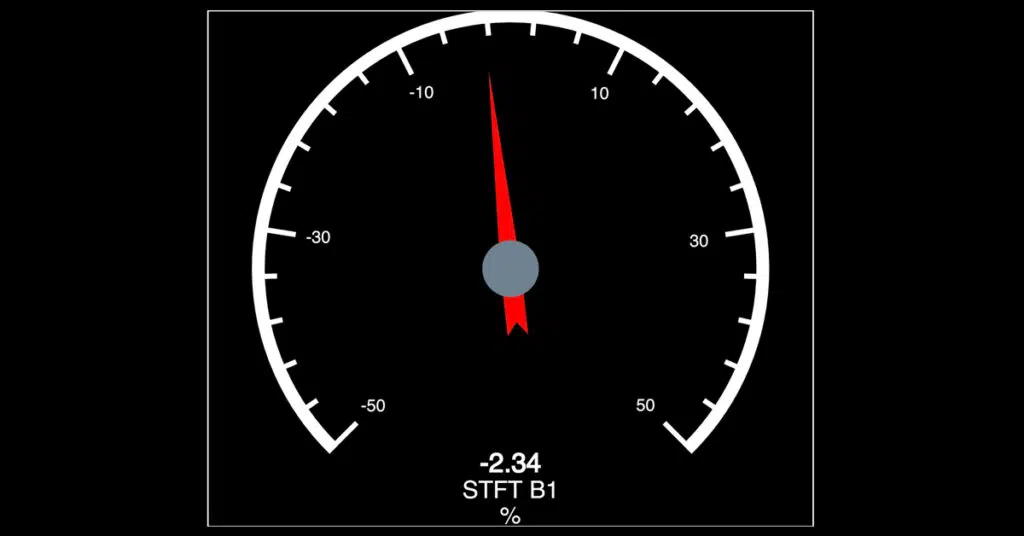
The ECU is constantly trying to keep the air-fuel mixture perfect. It has a base recipe, a fuel map, that tells it how much fuel to inject at any given moment. But conditions change. The weather changes. The engine wears slightly. So the ECU doesn’t just follow the recipe blindly. It watches the result of each combustion event through an oxygen sensor in the exhaust, and keeps adjusting.
Short term fuel trim is that live adjustment, expressed as a percentage.
Simple version: Think of STFT like a chef tasting soup while cooking. The recipe says one teaspoon of salt, but they taste it and add a pinch more, or hold back slightly. STFT is that pinch.
One quick note on the “B1” you keep seeing: it means Bank 1. Engines with cylinders in one line – like the 1.0 TSI here, have only one bank, so B1 is the only trim you’ll see. V6 and V8 engines have two cylinder banks with separate sensors, so their scanners show B1 and B2. Everything in this article applies to both banks, read each bank’s trims the same way, and if one bank shows a problem while the other is healthy, that itself is a clue the cause is physical (an injector, a leak on one side) rather than shared (fuel pressure, MAF).
The ECU reads a sensor called the upstream oxygen sensor (O2S1), positioned in the exhaust before the catalytic converter, to make these adjustments. When that sensor detects too much oxygen in the exhaust (meaning not enough fuel was burned), STFT goes positive. When it detects too little oxygen (too much fuel burned), STFT goes negative.
This loop runs dozens of times per second while the engine is at normal operating temperature.
What STFT B1, SHRTFT1 and LONGFT1 Mean on Your Scanner
STFT B1 on an OBD2 scanner is the live fuel correction for Bank 1, the same reading this whole guide is about. Apps just label it differently. This table decodes the common ones:
| Label on your screen | Where you’ll see it | What it is | Normal at warm idle |
|---|---|---|---|
| STFT B1 / Short Term Fuel Trim Bank 1 | Car Scanner, OBDeleven, most apps | Live trim, bank 1 | -5% to +5% |
| SHRTFT1 | Torque and many basic scanners | The same live trim, bank 1 | -5% to +5% |
| LONGFT1 / LTFT B1 (sometimes shortened to LNGFT1) | Torque / Car Scanner | Learned trim, bank 1 | Add it to STFT; its own ranges are in the LTFT guide |
| STFT B1 S1 | Apps that name the sensor | Live trim fed by the upstream sensor, before the cat. Same number as STFT B1 | -5% to +5% |
| STFT B1 S2 | Apps that name the sensor | A separate figure tied to the downstream sensor. It often reads 0% or a fixed value, and that is normal | At or near 0% |
If your screen says S2, don’t judge the mixture by it. The ECU fuels the engine from Sensor 1; Sensor 2 watches the catalytic converter. Every reading in this guide is the Sensor 1 trim.
STFT vs LTFT: Why You Add Them Together
On your OBD scanner you’ll almost always see two fuel trim numbers: STFT (Short Term Fuel Trim) and LTFT (Long Term Fuel Trim). Different apps spell them differently: Torque shows SHRTFT1 and LONGFT1, some apps write STFT B1S1 or Short FT, but it’s the same pair of readings under every name.
STFT reacts instantly.
LTFT is slower and smarter. It’s the ECU’s memory. If STFT keeps being pushed in the same direction for days on end, the ECU thinks “something has changed permanently, I need to adjust my baseline.” It shifts LTFT to absorb that correction, freeing STFT to return closer to zero.
Analogy: STFT is turning the heating up because the room feels cold right now. LTFT is calling a plumber and adjusting the boiler setpoint because the room is always cold. STFT reacts to the moment. LTFT adapts to the pattern.
For diagnosis, the number that matters most is STFT + LTFT combined. If both are positive and add up to more than +10%, your engine is running lean and something needs attention. If both are negative and add up past -10%, it’s running rich. LTFT’s own normal range by condition, what high and negative learned trims mean, and how to reset it are in the long term fuel trim guide.
| Combined STFT + LTFT | What it means | Action |
|---|---|---|
| 0% to ±5% | Healthy – normal range | Nothing needed |
| ±5% to ±10% | Borderline – worth monitoring | Keep an eye on it |
| ±10% to ±25% | Problem present | Investigate the cause |
| Above ±25% | ECU at its limit | Fault code likely set or imminent |
What Should Short Term Fuel Trim Be at Idle?
At warm idle, short term fuel trim should sit between -5% and +5%, with STFT + LTFT combined inside ±10%. Here is the full range by condition:
| Condition | Normal STFT range |
|---|---|
| Cold start (first 60 seconds) | -15% to -5% – open loop, normal |
| Warm idle (closed loop) | -5% to +5% |
| Light cruise 30–50 mph | -5% to +5% |
| Hard acceleration / WOT | Variable – partially open loop |
Judge the combined STFT + LTFT figure only on a warm engine, against the combined-trim table in the STFT vs LTFT section above.
Open Loop vs Closed Loop – Why STFT Sometimes Stops Working
STFT doesn’t always work. There are situations where the ECU stops using oxygen sensor feedback entirely and just follows the fuel map on its own. This is called open-loop mode.
When the ECU is actively using the oxygen sensor to fine-tune fuelling in real time, that’s closed-loop mode, this is when STFT is active and meaningful.
Analogy: Closed loop is driving with your eyes open, you see the road and adjust constantly. Open loop is driving with a blindfold, following a pre-memorised route. You’re still moving, but you can’t react to what’s actually happening.
Your engine runs in open loop in two main situations:
- Cold start – the oxygen sensor needs to reach around 300°C before it gives accurate readings. Until then, the ECU follows the fuel map and enriches the mixture heavily to help the cold engine fire reliably.
- Hard acceleration / wide-open throttle – under heavy load, the ECU switches to open loop to prioritise power and protect the engine from knocking. It follows a pre-set rich target rather than chasing the oxygen sensor signal.
STFT during cold start or wide-open throttle tells you far less than STFT at warm, steady idle.
Real OBD Data – What Normal Actually Looks Like on a 1.0 TSI
Here’s what healthy actually reads: the same car and three conditions from the intro.
Cold Start – Why -12.5% STFT Is Not a Problem
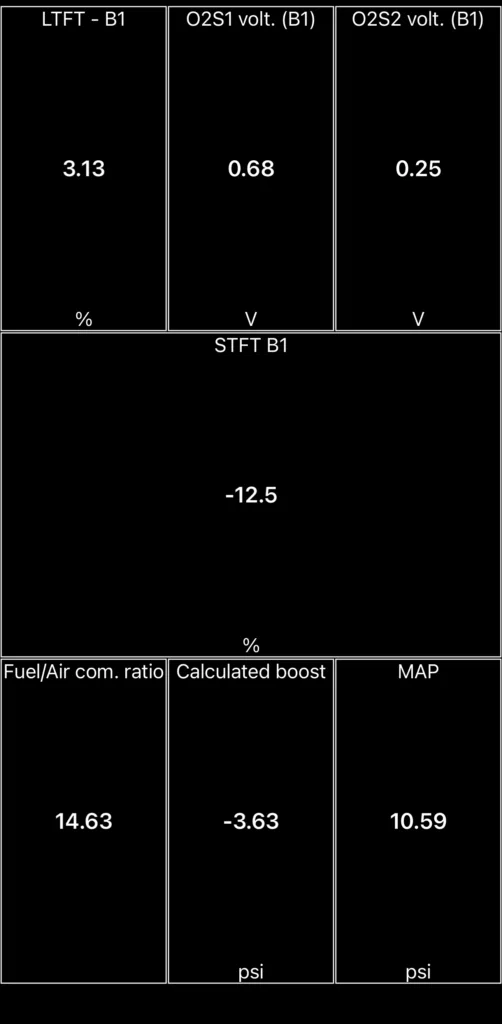
| Parameter | Reading | What it means |
|---|---|---|
| STFT B1 | -12.5% | ECU cutting fuel, engine running rich deliberately |
| LTFT B1 | +3.13% | Long-term correction carried over from previous drives |
| O2S1 voltage | 0.68V | Upstream sensor active, already reading rich exhaust |
| O2S2 voltage | 0.25V | Downstream sensor – catalyst still warming up |
| Calculated boost | -3.63 psi | Slight vacuum – very low load at startup |
| MAP | 10.59 psi | Normal manifold pressure for cold idle |
Readings: TheCarLane, Skoda Rapid 1.0 TSI, Car Scanner App, September 2026
A -12.5% STFT at cold start is completely normal, and one of the most misunderstood readings people find on their scanners.
Here’s what’s happening: petrol doesn’t vaporise well when it’s cold. Some of it clings to the cold metal walls of the intake instead of reaching the combustion chamber as a proper mist. To compensate, the ECU deliberately injects extra fuel, knowing some will be wasted, so there’s enough in the right form to ignite reliably.
Key point: If you see a large negative STFT within the first minute of starting a cold engine, that is the system working correctly, not a fault. Only worry if that large negative STFT is still present 10+ minutes into driving with a fully warm engine.
Warm Idle at 90°C – The Reading That Actually Matters
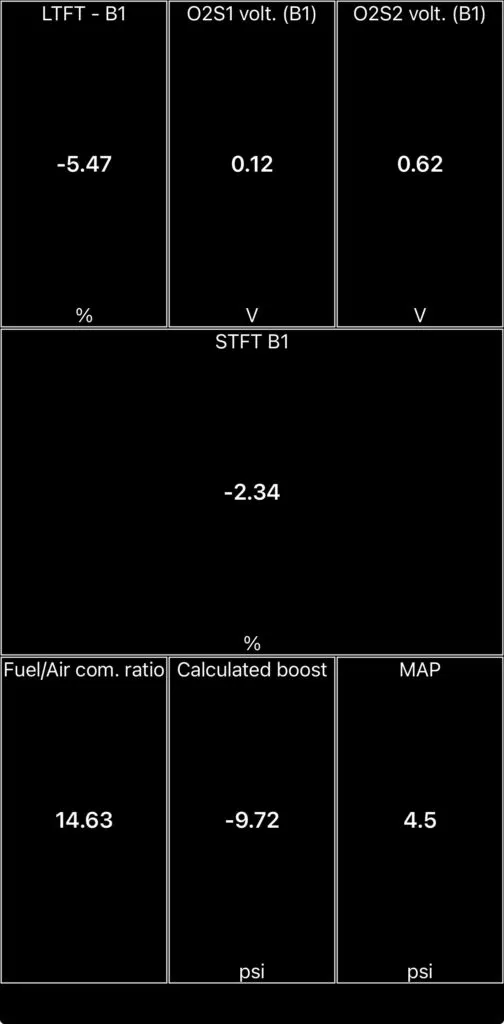
| Parameter | Reading | What it means |
|---|---|---|
| STFT B1 | -2.34% | Small active correction – engine slightly rich at idle |
| LTFT B1 | -5.47% | ECU has learned this engine runs rich at idle; permanently trimming |
| O2S1 voltage | 0.12V | Pre-cat sensor just read lean after the ECU corrected rich |
| O2S2 voltage | 0.62V | Post-cat at working temp -catalyst functioning normally |
| Calculated boost | -9.72 psi | Healthy vacuum at closed-throttle idle |
| MAP | 4.5 psi | Low manifold pressure – correct for warm idle |
Readings: TheCarLane, Skoda Rapid 1.0 TSI, Car Scanner App, September 2026
Both trims negative gives a combined -7.81%: inside the healthy zone, on the rich side of it.
The LTFT is -5.47% here at idle but +3.13% in the other two logs, and that’s normal: the ECU stores separate learned corrections for different load and RPM points, not one number. Why, and what the idle-versus-cruise difference tells you, is in the LTFT guide.
The downstream O2S2 at 0.62V is also reassuring, it shows the catalytic converter is at working temperature and processing exhaust properly.
What to watch for: Combined figure out of range at warm idle? The causes section below is the map.
2nd Gear Acceleration Under Boost – Why STFT Behaves Differently
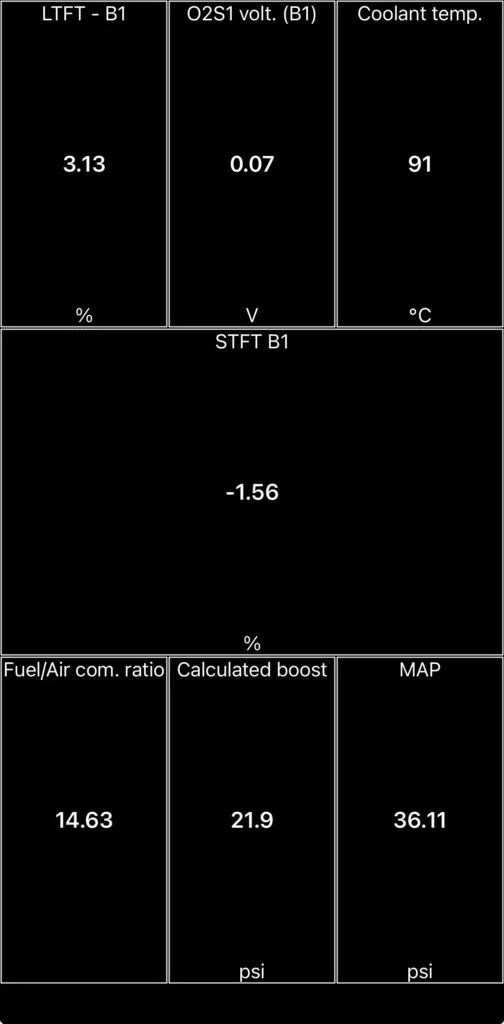
| Parameter | Reading | What it means |
|---|---|---|
| STFT B1 | -1.56% | Small correction – ECU still managing mixture under boost |
| LTFT B1 | +3.13% | Load-cell correction for this RPM/load combination |
| O2S1 voltage | 0.07V | Very low – sensor reading lean momentarily under hard pull |
| Calculated boost | +21.9 psi | Turbocharger on boost – significant positive pressure |
| MAP | 36.11 psi | High manifold pressure under acceleration |
| Fuel/Air ratio | 14.63 | Very close to ideal (14.7:1 is stoichiometric) |
Readings: TheCarLane, Skoda Rapid 1.0 TSI, Car Scanner App, September 2026
Under hard acceleration the engine runs in partial open loop, as covered above: the ECU holds a safe pre-set mixture rather than chasing the sensor, protecting the engine from knock.
Even so, STFT of -1.56% and a fuel/air ratio of 14.63 against the 14.7:1 ideal, at 21.9 psi, means the Stage 1 map’s fuelling is set up well.
Stage 1 Remap and STFT – What to Expect
If you’ve had your car remapped, this section is for you. Every reading above came from my own remapped car, so you’ve already seen what healthy looks like.
Here’s what typically changes:
- LTFT will reset and relearn. after a remap, so expect STFT to be more active for the first few hundred miles while it does; the relearn itself is covered on the LTFT page.
- STFT under boost should be tight on a good remap. A well-calibrated remap has accurate fuelling for your specific engine build. STFT should stay close to zero under boost.
If you’ve recently been remapped and STFT is consistently above ±5% under boost: log the data and share it with your tuner. It may mean the fuelling targets need a small correction, or a hardware issue like a boost leak has appeared since the remap.
What Causes Abnormal STFT Readings?
If your warm-idle combined STFT + LTFT is outside the ±10% zone, here’s how to think about what’s causing it.
Large positive STFT/LTFT (engine running lean)
The ECU is adding fuel because something is causing a lean condition, not enough fuel reaching combustion, or too much unmetered air getting in.
| Symptom pattern | Most likely cause | Check this first |
|---|---|---|
| High at idle only, normal at cruise | Small vacuum leak near idle circuit | Inspect intake hoses and PCV system |
| High at all loads and RPMs | MAF sensor underreporting or fuel delivery issue | Clean or replace MAF; check fuel pressure |
| High under boost only | Boost leak after the MAF sensor | Inspect intercooler pipes, couplers and clamps |
| Appeared suddenly | Intake hose split or disconnected | Visual inspection of all intake pipes |
Large negative STFT/LTFT (engine running rich)
The ECU is removing fuel because something is adding fuel beyond what it commanded, or a sensor is giving it false information.
| Symptom pattern | Most likely cause | Check this first |
|---|---|---|
| Negative at idle, normal at cruise | EVAP purge valve passing vapour at idle | Pinch the purge hose shut briefly and retest |
| Negative at all loads | Leaking injector or high fuel pressure | Check injector leak-off, fuel pressure at idle |
| Negative since engine work | Coolant temp sensor fault – ECU thinks it’s colder | Check coolant sensor reading vs actual temp |
| Gradual drift negative over months | Oil consumption via PCV into intake | Check PCV system, look for oil residue in intake |
A faulty or clogged EGR valve can also push trims out of range; if trims are off alongside a check engine light, rule it out with the EGR valve cleaning guide before replacing sensors.
The EVAP Purge Valve – The Most Missed Cause of Rich Idle Trim
Your car has an evaporative emissions system (EVAP) that captures fuel vapour from the fuel tank instead of letting it vent to the atmosphere. That vapour gets stored in a charcoal canister and then purged into the intake to be burned during normal driving. This is controlled by a valve called the EVAP purge solenoid.
At idle, this valve should be mostly closed. If it sticks open or passes too much vapour at idle, the engine gets a dose of extra fuel it didn’t ask for. The ECU sees the oxygen sensor go rich and immediately pulls STFT negative. You’ll see a large negative STFT at idle that improves as RPM rises, because at higher loads, the extra vapour is a smaller proportion of the total fuel being burned. A purge valve passing vapour like this is also the most common cause of a P0441 code on VAG cars. If you’ve got a P0441 incorrect purge flow code stored alongside a negative trim, this valve is the first thing to check.
Quick DIY test: With the engine at warm idle and STFT reading negative, locate the EVAP purge hose (usually runs from the charcoal canister to the intake) and briefly pinch it closed. If STFT immediately moves toward zero, the EVAP purge valve is your culprit.
Don’t drive with the hose pinched or disconnected, this is a diagnostic test only.
Watch STFT After a Repair
After any repair that could affect fuelling, a new MAF, a fixed vacuum leak, a replaced injector, clear the adaptations with a scanner and watch STFT for the next 20 minutes. Use the scanner’s reset function, not a battery disconnect: on most modern cars that also wipes the throttle and idle adaptations and creates a fault you did not have. If STFT settles near zero, the fix worked. If it pulls hard in one direction straight away, keep looking. The reset procedure itself, and how long LTFT takes to relearn, is in the LTFT guide.
How to Read Short Term Fuel Trim Properly – Step by Step
Most people check STFT the wrong way. They glance at whatever number is showing and either panic or shrug. Here’s the right process:
- Warm the engine fully. Drive for at least 10 minutes; nothing read in the first couple of minutes after a cold start is diagnostic, that’s open loop.
- Sit at warm idle for 2–3 minutes. Watch STFT, don’t just glance at one number. A healthy engine will have STFT hovering between -5% and +5%, switching direction regularly as the oxygen sensor cycles.
- Note LTFT at the same time and add the two together, that combined figure is your real health indicator. Also watch O2S1 switching: a healthy sensor alternates between 0.1V and 0.9V multiple times per second. Stuck at one value? The sensor itself may be faulty.
- Take a cruise reading. Drive at steady 40–50 mph and check again. Idle fine but cruise goes large-positive? Think load-related issues like a boost leak. Large-positive at idle but fine at cruise? Think small vacuum leak near the idle circuit.
Fault Codes Linked to Fuel Trim Problems
If trims have been out of range long enough, the ECU will set a fault code. Here are the most common:
| Fault code | Description | Direction |
|---|---|---|
| P0171 | System too lean – Bank 1 | LTFT pushed too positive |
| P0172 | System too rich – Bank 1 | LTFT pushed too negative |
| P0174 | System too lean – Bank 2 | LTFT too positive on Bank 2 |
| P0175 | System too rich – Bank 2 | LTFT too negative on Bank 2 |
These codes tell you the direction and which bank, not the cause. Always read live STFT/LTFT data alongside any of these codes before replacing parts. If the code on your screen is P0171, the likely cause depends on which engine you have, I’ve broken it down engine by engine in my P0171 fault code guide for VW, Audi and Skoda.
Next Steps – Check Your Fuel Trims Today
Check your fuel trims before your next drive. All you need is a Bluetooth OBD2 adapter and a free app. I use the Vgate iCar Pro (about ₹2,000/£30) with Car Scanner, the exact combo behind every screenshot above. Warm the car up fully, idle for two minutes, and watch the combined STFT + LTFT number. Within ±10%, you’re fine. Outside it, you now know where to look.
If you’re remapped and seeing unusual trims under boost, read our Stage 1 Remap Before and After guide.
If you have a P0171 or P0172 code alongside bad trims, don’t clear it without fixing the cause first, the trim data is your roadmap.
FAQs
At warm idle, STFT should sit between -5% and +5%. What matters more is STFT + LTFT combined, keep that within ±10% and your fuelling system is healthy.
That’s normal. STFT is supposed to oscillate as the oxygen sensor cycles. The concern is if it’s consistently pushed to one side, hovering between +7% and +12% without crossing zero means lean. Bouncing between -8% and -12% means rich.
If combined trims are between ±10% and ±20%, the car will drive but fuel economy suffers. Beyond ±25% you risk rough running and catalytic converter damage. Get it diagnosed before any long journey.
Nothing bad. The ECU deliberately enriches the mixture when the engine is cold because petrol doesn’t atomise well at low temperatures. It self-corrects within the first minute or two as the oxygen sensor warms up. Only worry if it’s still large negative after 10 minutes of warm driving.
Because the ECU switches to open loop at wide-open throttle and follows a pre-set rich map instead of the oxygen sensor, so the live correction stops. Judge STFT at warm idle and light cruise, not under full load.
Usually nothing, the two often pull in opposite directions while balancing each other out. Just add them together: if the total stays within ±10%, your engine is fine.
Last Updated: September 2026

Founder of TheCarLane | Automotive Enthusiast
Ayush shares practical automotive knowledge based on real-world ownership and hands-on experience. His work focuses on diagnostics, engine systems, common car problems, and clear explanations that help everyday drivers understand their vehicles better.