
A MAF sensor — Mass Air Flow sensor, measures how much air enters your engine. The ECU uses that reading to calculate the correct fuel injection amount, maintain the right air-fuel ratio, and keep the engine running efficiently. If the MAF sends a wrong reading, the ECU injects the wrong amount of fuel, producing rough idle, hesitation, increased fuel consumption, and eventually a check engine light.
That’s the standard explanation. Here’s what most MAF sensor guides skip entirely, many modern turbocharged engines don’t use a MAF sensor at all. My own Skoda Rapid 1.0 TSI is one of them. Understanding whether your car uses MAF or MAP, what the symptoms of each look like, and how to confirm which system your car runs changes how you diagnose airflow-related problems entirely.
How a MAF Sensor Works
Most modern MAF sensors use a hot-wire measurement principle. A thin wire inside the sensor is heated electrically. Incoming air cools that wire and the sensor measures how much current is needed to maintain its temperature. More airflow means more cooling which means more current required and the ECU reads that current draw as the airflow figure.
This system is precise and reliable under steady-state and low-load conditions, which is why naturally aspirated engines rely on it heavily. The limitation is that the hot wire is extremely fragile, physical contact during cleaning or installation destroys it, and the sensor gradually accumulates contamination from dust and oil vapour that affects its accuracy over time.
Where Is the MAF Sensor Located?
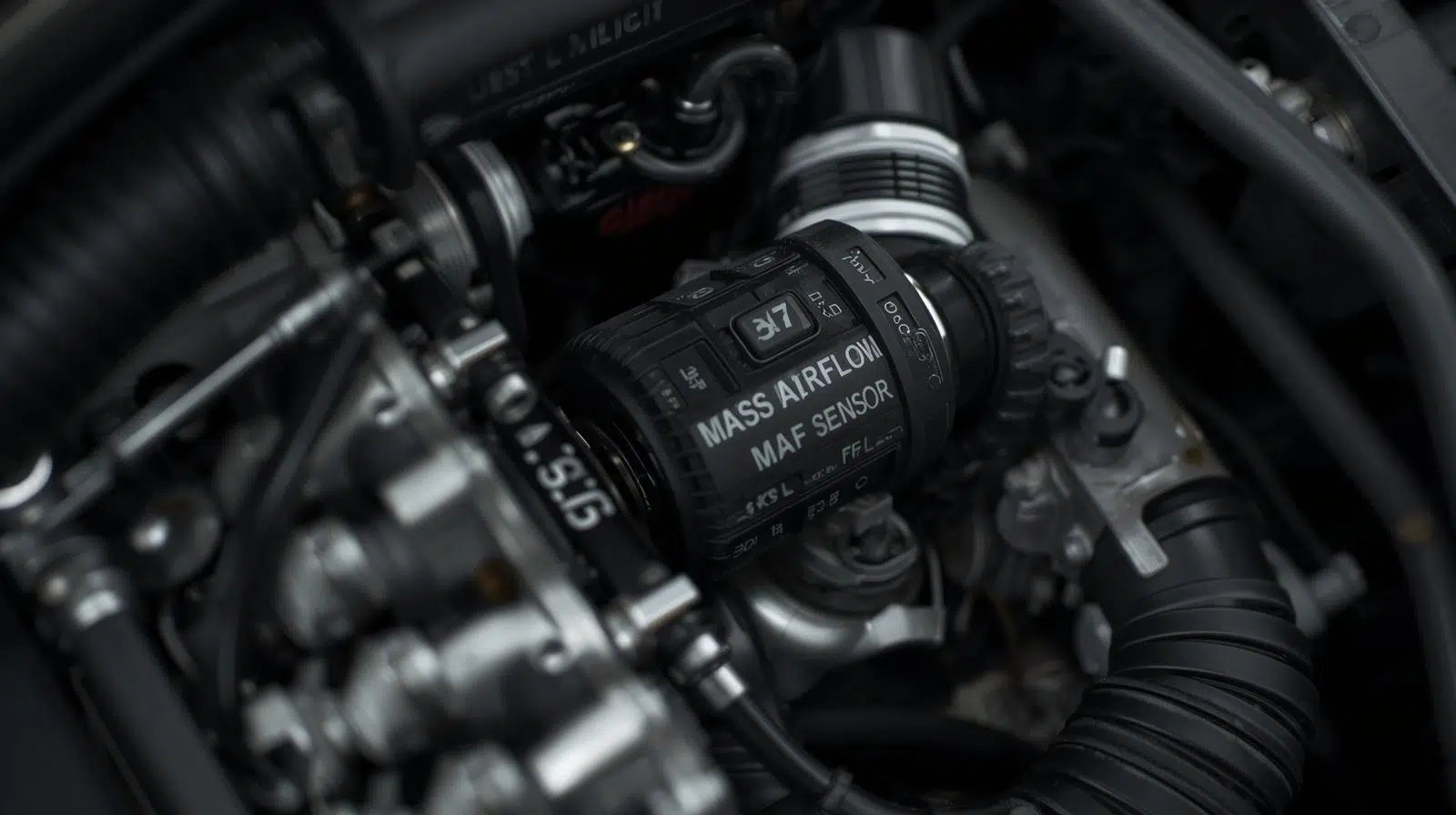
On cars that use one, the MAF sensor sits in the intake pipe directly after the air filter box and before the throttle body. It appears as a small rectangular sensor bolted into the intake tube with a wiring connector. If there’s no sensor in your intake pipe between the air filter and the engine, your car doesn’t use a MAF.
Symptoms of a Failing MAF Sensor
A failing MAF sensor sends inaccurate airflow data to the ECU which responds by adjusting fuel delivery based on wrong information. The result is a range of symptoms that worsen progressively as the sensor deteriorates.
Rough idle and hesitation appear because the ECU can’t maintain the correct fuel mixture at low load. Poor throttle response and sluggish acceleration follow as the inaccuracy worsens under demand. Increased fuel consumption develops when the ECU over-fuels to compensate for what it reads as insufficient airflow. Black exhaust smoke indicates severe rich running caused by excess fuel delivery. A check engine light with codes P0100, P0101, or P0102 confirms the ECU has detected the MAF circuit fault.
The common thread across all these symptoms is incorrect fuelling and because other faults produce similar symptoms, confirming the MAF with live OBD2 data before replacing it is essential.
How to Diagnose a MAF Sensor With an OBD2 Scanner
Before reading further, if you don’t know how to use an OBD2 scanner, here is the complete guide on scanning your car with OBD2 scanner.
Step 1: Scan for fault codes. P0100, P0101, P0102 and P0103 are MAF circuit codes.. These confirm the ECU has detected an issue in the MAF sensor circuit but a code alone doesn’t confirm the sensor itself has failed. Wiring faults and connector issues produce the same codes.
Step 2: Check live MAF data at idle. With the engine warmed up, a healthy MAF sensor on a typical petrol engine reads approximately 2–7 g/s at idle. Values significantly outside that range, or readings that jump erratically without corresponding throttle input, suggest sensor contamination or failure.
Step 3: Check live MAF data under load. Increase engine RPM and watch the MAF reading rise proportionally. A sensor that flatlines, reads abnormally low, or spikes erratically under load is failing even if it reads correctly at idle.
Step 4: Check fuel trims. Short-term fuel trim above +15% or long-term fuel trim consistently positive indicates the ECU is adding fuel to compensate for what it reads as insufficient airflow, a common MAF failure pattern. Negative fuel trims suggest the opposite, the sensor is over-reading airflow and the ECU is pulling fuel.
Step 5: Rule out other causes first. A dirty air filter, intake leak, or wiring fault produces identical symptoms and codes. Inspect the intake system for leaks and check the connector and wiring before condemning the sensor.
How to Clean a MAF Sensor
Cleaning takes approximately ten minutes and resolves mild contamination issues before replacement becomes necessary.
Disconnect the battery and remove the MAF sensor from the intake pipe. Spray only with dedicated MAF sensor cleaner, throttle body cleaner, brake cleaner, and general purpose sprays damage the hot wire element. Allow the sensor to dry completely before reinstalling, never use compressed air or a cloth. Do not touch the hot wire element inside the sensor housing under any circumstances. The wire is thinner than a human hair and physical contact destroys it permanently.
If symptoms persist after cleaning or live data shows the sensor still reads abnormally after cleaning, replacement is the next step.
When to Replace Rather Than Clean
Replace the MAF sensor when fault codes P0100–P0103 appear alongside abnormal live data, when symptoms persist after cleaning, when the sensor shows physical damage to the connector or wiring harness, or when the hot wire element is visibly contaminated or broken.
Cleaning makes sense when symptoms are mild and appeared recently after driving in dusty conditions or following an air filter change, when live data shows readings slightly off rather than erratic, and when a full diagnostic check hasn’t yet ruled out intake leaks or wiring faults. If cleaning resolves the symptoms and they don’t return, the sensor was contaminated rather than failing. If symptoms return within a few weeks, replace the sensor.
Replacement Cost
| Market | Parts | Labour | Total |
|---|---|---|---|
| USA | $50–$300 OEM / $30–$100 aftermarket | $55–$175 | $100–$475 |
| India | ₹1,500–₹8,000 | ₹1,500–₹5,000 | ₹4,000–₹15,000 |
OEM sensors cost more but match the ECU’s expected signal characteristics exactly. Reputable aftermarket brands, Bosch, Denso, perform comparably. Budget sensors from unknown brands produce inconsistent readings that trigger the same fault codes the replacement was meant to fix.
Not Every Car Uses a MAF Sensor
Many modern turbocharged petrol engines don’t use a MAF sensor. Instead they use a MAP sensor, Manifold Absolute Pressure, combined with an IAT sensor, Intake Air Temperature. The ECU calculates airflow mathematically from pressure, temperature, engine displacement, boost level, and volumetric efficiency rather than measuring it directly with a hot wire.
This system works extremely well on turbocharged engines where boost pressure changes rapidly and a MAF sensor would struggle to keep up with the airflow variations. On naturally aspirated engines where airflow is steadier and more predictable, direct MAF measurement remains the more accurate approach.
Real Data – My Skoda Rapid 1.0 TSI Has No MAF Sensor
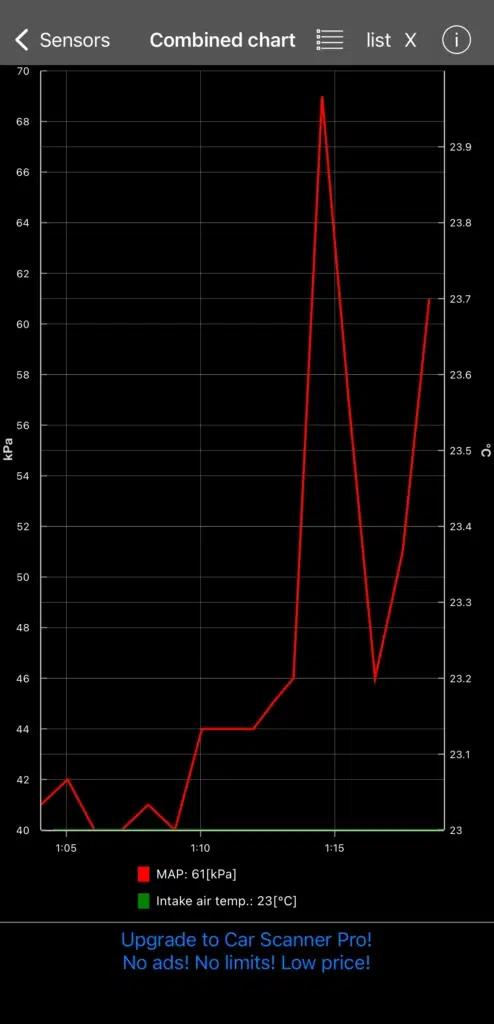
This shows how the ECU measures pressure and temperature instead of using a MAF sensor.
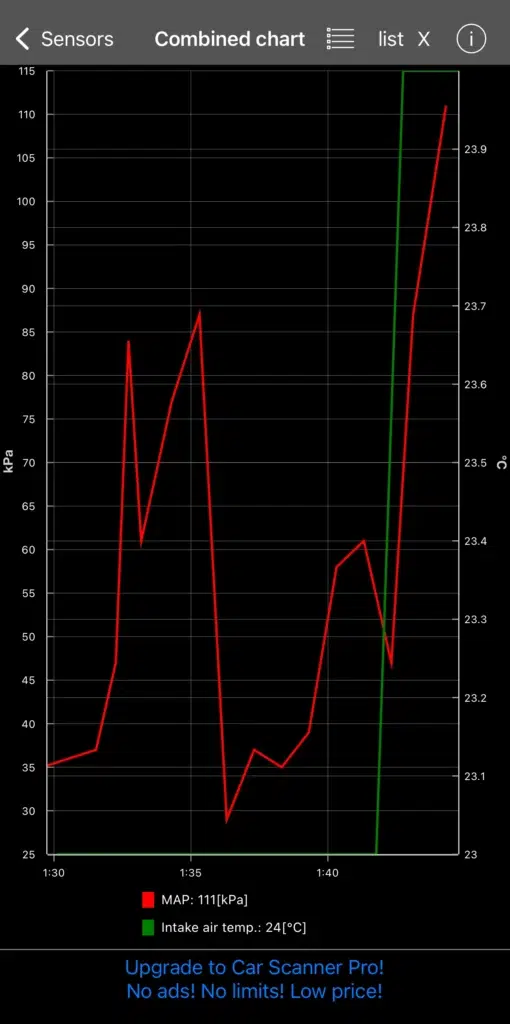
These values change with boost and load, which the ECU uses to calculate airflow.
The 1.0 TSI EA211 engine in my Rapid doesn’t have a MAF sensor from the factory. Searching the intake pipe reveals no sensor housing. Opening an OBD2 scanner and checking live data confirms it, no MAF g/s reading exists because there’s no sensor to read from.
Instead the live data shows MAP – Manifold Absolute Pressure and IAT – Intake Air Temperature. At light throttle the MAP reads approximately 61 kPa with IAT at 23°C. Under harder acceleration MAP climbs to approximately 111 kPa as boost builds. The ECU uses these two values alongside engine speed, displacement, and volumetric efficiency tables to calculate airflow precisely without a physical MAF sensor.
This data matters practically, if your car is a modern turbocharged petrol engine and you’re chasing a suspected MAF fault, checking whether your car actually has a MAF sensor before buying one saves both time and money. Open an OBD2 scanner and check live data. If MAF g/s appears as a live parameter, your car uses MAF. If only MAP and IAT appear with no MAF reading, your car uses the pressure-temperature calculation method.
MAF vs MAP – The Key Differences
| MAF Sensor | MAP Sensor | |
|---|---|---|
| Measures | Airflow directly | Pressure, airflow calculated |
| Best suited for | Naturally aspirated engines | Turbocharged engines |
| Common failure | Contamination, hesitation | Rare failures |
| Location | Intake pipe after air filter | Intake manifold |
| Tuning impact | Requires rescaling for upgraded intakes | Boost-based tuning, no scaling issue |
Does Your Car Use MAF or MAP?
Your car uses a MAF sensor if:
- A sensor sits in the intake pipe between the air filter and throttle body
- OBD2 live data shows “MAF g/s” as an active parameter
- Fault codes P0100–P0103 appear in the ECU
Your car uses MAP instead if:
- No sensor appears in the intake pipe
- OBD2 live data shows only MAP kPa and IAT with no MAF reading
- The engine is a modern turbocharged petrol unit, EA211 1.0 TSI, EA888 Gen 3, most modern TFSI and TSI engines fall into this category
Last Updated: July 2026
FAQs
It measures the exact mass of air entering the engine per second, expressed in grams per second, which the ECU uses to calculate the correct fuel injection quantity.
The car will continue running but the ECU falls back on default fuel maps rather than real-time airflow data. Fuel economy drops, performance suffers, and prolonged rich running risks catalytic converter damage over time.
No. Many modern turbocharged petrol engines use a MAP sensor and IAT sensor combination instead. The fastest way to confirm which system your car uses is to check OBD2 live data, if MAF g/s appears as a parameter, your car has a MAF sensor.
P0100 – MAF circuit malfunction. P0101 – MAF circuit range or performance issue. P0102 – MAF circuit low input. P0103 – MAF circuit high input. These codes confirm an issue in the MAF circuit but don’t automatically mean the sensor itself has failed, wiring and connector faults produce identical codes.
Yes, a severely restricted air filter reduces airflow through the MAF sensor and produces readings the ECU interprets as sensor malfunction. Always inspect and replace the air filter before diagnosing or replacing the MAF sensor.

Founder of TheCarLane | Automotive Enthusiast
Ayush shares practical automotive knowledge based on real-world ownership and hands-on experience. His work focuses on diagnostics, engine systems, common car problems, and clear explanations that help everyday drivers understand their vehicles better.