
This article contains affiliate links. As an Amazon Associate TheCarLane earn from qualifying purchases, at no extra cost to you.
The DPF warning light means your diesel particulate filter has collected too much soot and can no longer clean itself through normal driving. For most diesel owners, this is the first sign that short trips, low fuel, or an underlying engine fault is preventing the filter from regenerating properly.
In most cases, you can keep driving for 80-150 km (50-100 miles) safely, but you should act within the next day. A 30-minute highway drive at 100-110 km/h (60-70 mph) clears the warning in 70-80% of cases caught early. Ignoring it leads to limp mode and turns a free fix into a repair costing anywhere from ₹25,000 to ₹2,00,000 / £300 to £2,000 / $400 to $2,500.
This guide explains what the warning actually means, when it’s safe to drive, the exact steps to clear it yourself, and what to do if home methods don’t work.
DPF Warning Light — The 20-Second Verdict
What the DPF Warning Light Actually Means
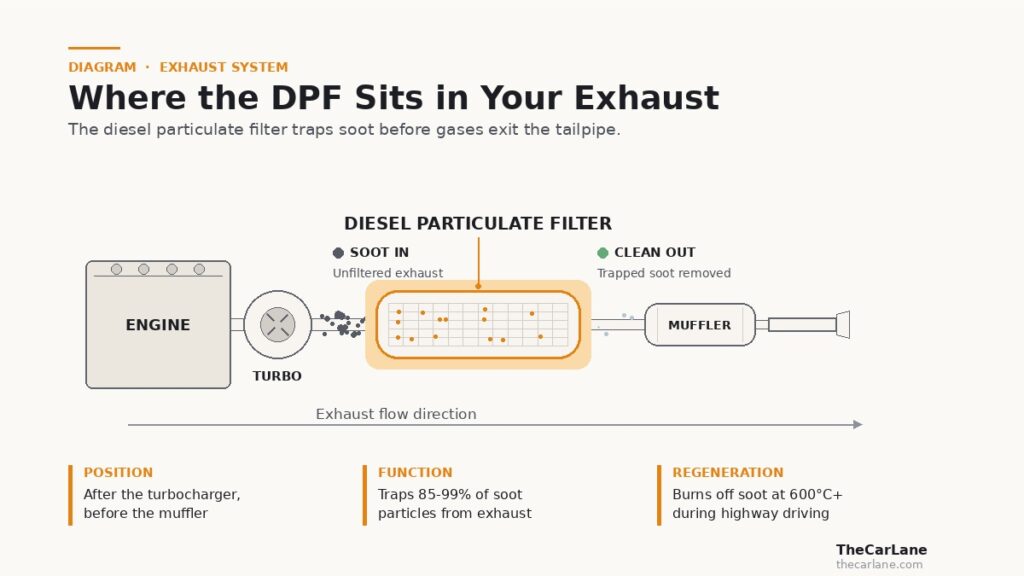
The diesel particulate filter traps soot from diesel combustion before it exits your exhaust. Every diesel built after 2009 has one.
The warning light means soot loading has risen beyond what the car can clean automatically. Your engine has been trying to burn off the soot during normal driving, called regeneration and hasn’t completed the job. The light isn’t a failure. It’s the car asking for help before the problem gets worse.
On VAG cars (VW, Audi, Skoda, SEAT), the light often appears with a text message on the display saying “Particulate Filter: Please refer to owner’s manual.”
Why the Light Appears After Short Trips
Passive regeneration needs sustained exhaust heat, the kind only longer drives at speed produce. Short journeys never get the exhaust hot enough for long enough, so soot accumulates even when the engine feels healthy.
School runs, urban commutes, and cold starts are strongly linked to DPF complaints. The driving pattern matters as much as mileage, a low-mileage diesel used badly clogs faster than a high-mileage diesel used properly. If most of your trips are under 15 minutes, your filter never cleans itself.
Amber vs Red: Which Warning Do You Have?
Solid amber: The filter is around 75-85% full. Your car needs a regeneration cycle to clear it. A 20-30 minute motorway drive usually completes this automatically.
Flashing amber: The filter is critically full. You have maybe 20-30 miles before the car enters limp mode. Stop aggressive driving. Head to a motorway immediately.
Red warning, or DPF light with other warnings: If the engine management light appears alongside the DPF symbol, treat that combination as more urgent. Multiple emissions warnings usually mean the car has moved beyond a simple soot-loading event and needs fault-code evidence.
When to Stop Driving Immediately
Stop and get professional help if:
- Car enters limp mode (won’t rev past 3,000 RPM, feels sluggish)
- Red DPF warning appears
- Excessive white or black smoke from the exhaust
- Harsh burning smell develops
- Temperature gauge climbs unusually high
Continuing to drive in these conditions raises thermal stress in the exhaust system and damages expensive components.
My DPF Light Is On But The Car Drives Fine: Is That Ok?
This is the most likely situation and also the most deceptive one. An early DPF warning changes nothing about how the car feels: full power, normal acceleration, no drama. But the soot keeps building underneath it, and you have roughly 80 to 150 km before the car protects itself with limp mode. The fact that it still drives perfectly is not a reason to wait. It is your window to do the motorway drive below while the fix is still free.
How to Clear the DPF Light Yourself
Some links on this page are affiliate links: if you buy through them, TheCarLane earns a small commission at no extra cost to you. Recommendations are never influenced by this.
Before driving off, three quick checks:
Fuel level: Most cars block regeneration below a quarter tank. Fill up first.
Engine behaviour: If power is already reduced, home fixes won’t help.
Other warning lights: If engine management, EPC, or glow plug lights are on too, skip to diagnostics.
The Drive That Clears the Light
This works in 70-80% of cases caught early:
- Fill the tank to at least half-full with good-quality diesel (Shell, BP, Esso)
- Let the engine warm up for 3-4 minutes at idle
- Find a motorway or dual carriageway where you can maintain 60-70 mph for 30 minutes
- Drive in a lower gear than normal — 4th instead of 5th on manual, Sport/manual mode holding 3rd or 4th on DSG/auto
- Keep engine RPM between 2,500-3,000
- Maintain for 20-30 minutes minimum
- Don’t brake harshly or coast — the ECU needs continuous engine load
Optional but genuinely helpful: a DPF cleaner additive in the tank before this drive lowers the soot burn temperature and improves the odds of the regen completing. More on which additives are worth it further down.
Signs regeneration is working: slight fuel consumption increase, faint acrid smell from exhaust, cooling fans running after parking, higher idle RPM (900-1,000), stop-start deactivated.
The light typically clears during the drive or within a few minutes of parking. If it’s still on after this drive, try once more the next day. If it fails twice, home regeneration won’t work — you need diagnostic intervention.
Common Causes Behind a DPF Warning Light
Short urban driving: Most common, prevents DPF reaching 600°C.
Low fuel level blocking regeneration: The ECU needs reserve fuel to run active regeneration safely.
Wrong engine oil: Diesel cars need low-SAPS oil matched to the engine manufacturer’s specification. For VAG cars it’s VW 507.00 or 504.00. Ford uses WSS-M2C934-B. BMW uses LL-04. These specifications are global — the same VAG 507.00 oil is required whether you’re servicing your Skoda in Delhi, Manchester, or Melbourne. Standard motor oil contains ash-producing additives that permanently clog the DPF.
Faulty differential pressure sensor: The car measures filter fullness by pressure. If the sensor fails, the ECU reports a full filter even when clean. Common on VAG diesels after 80,000 miles.
Faulty EGR valve or turbocharger: Faulty EGR valve, turbocharger or intake flaps: A stuck-open EGR valve or an oil-leaking turbo produces excess soot that overwhelms the filter. So do stuck swirl flaps on a 2.0 TDI, which show up as P2015; fix that first, or the filter keeps refilling after every regeneration.
Ignored engine faults: If your check engine light is also on, the car often disables regeneration entirely to prevent damage.
Soot vs Ash
Soot burns off during regeneration. Ash doesn’t.
Ash comes from oil additives and accumulates over time inside the filter. A persistent DPF blockage might reflect normal end-of-life ash loading rather than a failed regeneration. Soot means a reversible operating issue. Ash means off-car cleaning or replacement. No amount of motorway driving creates space for ash.
If the Light Won’t Clear
If two drives fail, the filter needs a forced regeneration: a garage tool commanding the burn while the car sits still. Costs ₹3,000 to ₹8,000, £80 to £250 or $200 to $600, and takes 30 to 60 minutes. VAG owners can do it themselves with VCDS or OBDeleven. Full detail, including when the tool refuses: forced DPF regeneration guide.
Professional Cleaning and Replacement Costs
If highway driving doesn’t clear the light after two attempts, you’ve moved past what you can fix at home. The next step depends on how heavy the soot loading is and how old the filter is. A forced regeneration is usually the cheapest option and resolves many cases where the filter is still healthy but needs a stronger push than a normal drive cycle can deliver. If that fails or the filter is ash-loaded, cleaning or replacement becomes the only path forward.
Prices are estimated ranges based on typical market rates. Actual costs vary by vehicle model, location, and garage. Always get a written quote before authorising work.
Catching the light early genuinely matters. A free highway drive prevents a forced regeneration bill. A forced regeneration prevents the cleaning cost. Cleaning prevents replacement. Each step up the cost ladder is 5-10 times more expensive than the one before it, which is why acting within the first day or two of seeing the warning is the cheapest thing you can do for your car. Decline any garage that suggests cutting the DPF open or “deleting” it, illegal across most countries with emissions regulations, voids insurance, and causes emissions test failures.
DPF Cleaning Additives: What’s Worth It
Additives like Redex, Wynn’s, Forté and JLM’s DPF Cleaner work best preventatively, not as emergency fixes. JLM’s is the one the specialist DPF garages tend to use, and it earns its place in one more situation: poured into a half tank before the motorway regeneration drive above, it lowers the temperature soot burns at, which gives a borderline regen a better chance of completing.
A bottle every 5,000-10,000 miles lowers the regeneration threshold and helps passive regeneration complete more easily. This genuinely helps prevent buildup over time.
But if the warning light is already on, additives alone won’t clear it. The mechanical regeneration is doing the work. Don’t rely on additives to rescue a heavily clogged filter.
VAG-Specific Notes for VW, Audi, Skoda, and SEAT Owners
If you drive a VAG diesel, specific codes and behaviours help you diagnose faster.
Fault codes that confirm it’s a DPF issue:
- P2002: DPF efficiency below threshold
- P244A: Differential pressure too low
- P244B: Differential pressure too high
- P2463: Soot accumulation
- P246D: Regeneration performance
- P2459: Regeneration frequency
Two-stage warning system: The first warning is the amber light plus “refer to owner’s handbook” message. Ignoring it for 200+ miles triggers the second-level message: “Particulate Filter: Vehicle needs servicing.” If other symbols appear alongside it, our Skoda warning lights guide covers the full cluster and what each combination means.
EA288 and EA189 engines (1.6 TDI and 2.0 TDI) are particularly prone to DPF problems with short urban trips. The EA288 is better than the EA189, but both need regular motorway running.
OBDeleven Pro exposes “regeneration request” — a dealer-only value showing when the ECU wants to regenerate. If you see a pending request, a 30-minute motorway drive resolves it before any warning light appears.
Legal and Emissions Test Implications
Will a DPF warning light fail an MOT?
Yes, if the light is on during the test, it’s recorded as a major defect and the car fails, separate from the emissions measurement itself.
DPF removal is illegal in most regions with modern emissions regulations:
- United Kingdom: MOT failure since February 2014. Fines up to £1,000 for cars and £2,500 for vans. Voids insurance.
- European Union: Illegal under Euro 5 and Euro 6 standards. Annual inspection failure.
- United States: Violates EPA Clean Air Act. Fines up to $4,819 per vehicle for tampering. State inspections fail.
- Australia: Illegal modification under ADR (Australian Design Rules). Roadworthy failure.
- India: Illegal under BS-VI emissions standards for vehicles from 2020 onwards. PUC (Pollution Under Control) certification fails.
A missing, modified, or visibly tampered DPF fails emissions testing automatically wherever emissions tests exist. Visible smoke emissions also fail. A blocked but intact DPF may pass if regeneration has cleared recent soot, but sustained driving with the warning light on will fail the emissions check.
Preventing the DPF Warning Light Coming Back
Take a 30-minute motorway drive weekly. One drive is enough to complete passive regeneration naturally.
Avoid short trips where possible. Combine errands. A diesel that only does school runs clogs its DPF within 18 months.
Service every 10,000-12,000 miles with correct-specification oil. VAG needs VW 507.00 or 504.00. Always verify before an oil change.
Don’t run below a quarter tank regularly. Active regeneration needs fuel reserves.
Fix other engine faults immediately. A faulty MAF sensor, EGR valve, or glow plug indirectly kills your DPF by blocking its cleaning cycle.
Get a basic OBD2 scanner. A cheap OBD2 scanner lets you check your soot level yourself. Here’s how to read the numbers.
FAQs
Usually yes if it’s amber and the car drives normally — typically 50-100 miles before limp mode. Stop if the light turns red, flashes, or the car enters limp mode.
Three common causes: a faulty DPF pressure sensor, an underlying engine fault producing excess soot (usually EGR-related), or the filter is ash-loaded. An OBD2 scan identifies which.
No. DPF removal is illegal across many countries. It causes emissions test failure, can invalidate your insurance, and carries heavy fines. Don’t consider it regardless of what tuning garages suggest.
Serious if ignored, usually simple if caught early. An amber warning caught within a day or two is often a free fix. Ignored for weeks, it becomes one of the most expensive diesel repairs possible.
Yes. A missing or tampered DPF fails automatically in every country with emissions testing — UK MOT, Indian PUC, US state inspections, Australian roadworthy. Sustained driving with the light on also fails.
There is no safe fixed distance. An amber warning may leave a short window for a regen drive, but worsening symptoms or escalated warnings mean further driving becomes a risk rather than a solution.
No. Diesel particulate filters are fitted only to diesel vehicles because they trap diesel-specific soot from the combustion process. If you see a similar warning on a petrol car, it’s most likely a GPF (Gasoline Particulate Filter) warning, which is fitted to many Euro 6d petrol cars since 2018. The symptoms, causes, and fixes are broadly similar — short journeys cause soot buildup, and a highway drive often clears the warning.
Last Updated: August 2026

Founder of TheCarLane | Automotive Enthusiast
Ayush shares practical automotive knowledge based on real-world ownership and hands-on experience. His work focuses on diagnostics, engine systems, common car problems, and clear explanations that help everyday drivers understand their vehicles better.