

Before looking at cost, establish one thing first — replacing the wrong O2 sensor is one of the most common and avoidable mistakes in emissions repair. Most cars carry two to four sensors, and symptoms alone never tell you which one has failed. The fault code does. A basic OBD2 scan costs $20–$50 at most independent shops and identifies the exact sensor position before you spend anything on parts or labour. Every competing article skips this and jumps straight to cost ranges. This one doesn’t. Not familiar with what an O2 sensor does or how it works, see what is an O2 sensor first.
Which Sensor Is Failing — and Why It Changes the Cost
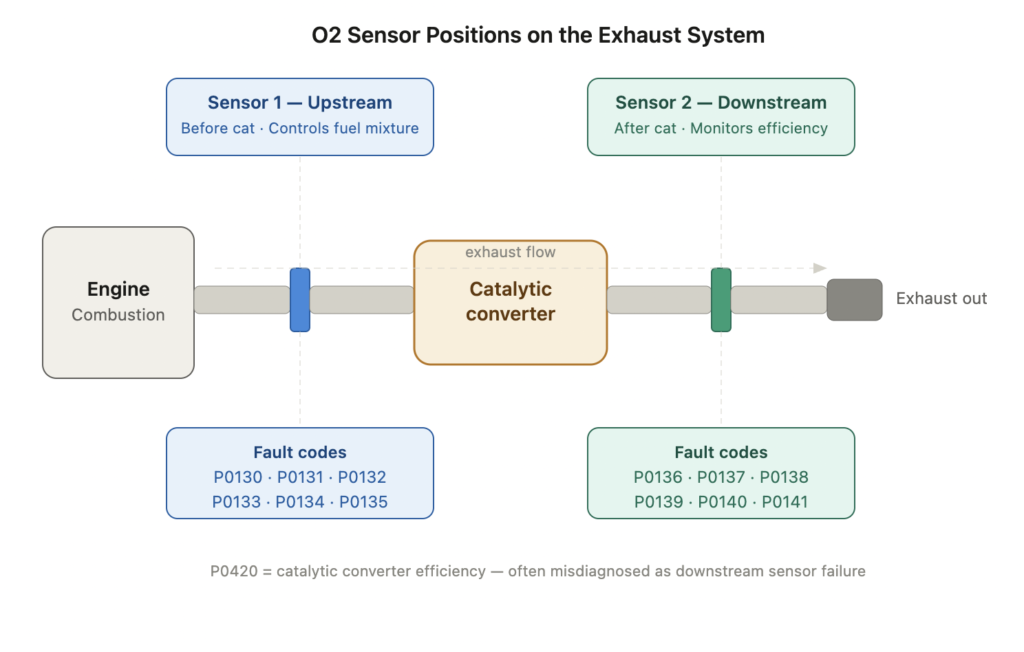
The fault code identifies the bank and position of the failing sensor before any physical inspection begins.
P0130, P0131, P0132, P0133, P0134 — upstream sensor Bank 1. This sensor sits before the catalytic converter on the side of the engine containing cylinder 1. It controls the air-fuel mixture and directly drives engine performance and fuel economy.
P0136, P0137, P0138, P0139, P0140 — downstream sensor Bank 1. This sensor sits after the catalytic converter and monitors catalytic converter efficiency rather than controlling fuel mixture.
P0135, P0141 — heater circuit failure. The sensor itself may still function correctly, but the heater that brings it to operating temperature has failed. Depending on the vehicle, heater circuit repairs sometimes cost less than full sensor replacement.
P0420 — catalytic converter efficiency below threshold. Mechanics frequently misdiagnose this code as a failing downstream sensor when a deteriorating catalytic converter is actually causing it. Replacing the downstream sensor won’t fix a P0420 that originates from a failing cat — so confirm which component is at fault before spending anything.
On V6 and V8 engines with two exhaust banks, Bank 2 sensors produce P015X and P017X codes. On three-cylinder engines like the 1.0 TSI, only one bank exists, so all codes reference Bank 1.
Why this matters for cost: Upstream sensors on most vehicles sit in more accessible positions and involve less labour. Downstream sensors after the catalytic converter sometimes require more access work, particularly on AWD vehicles or those with tight exhaust routing. Identifying the correct sensor before the workshop visit prevents paying for the wrong replacement — and doubles down on the money you’ve already spent on diagnosis.
How Much Does O2 Sensor Replacement Actually Cost
Prices reflect approximate US market rates. Costs will vary by region, service centre, and vehicle make.
Total cost depends on four things — which sensor is failing, the vehicle make, OEM versus aftermarket parts, and whether you choose a dealership or independent shop.
| Vehicle Type | Parts (Aftermarket) | Parts (OEM) | Labour | Total Range |
|---|---|---|---|---|
| Economy / compact | $50 – $80 | $100 – $180 | $100 – $200 | $150 – $380 |
| Mid-size sedan / SUV | $60 – $100 | $120 – $220 | $120 – $250 | $180 – $470 |
| Luxury / European | $100 – $200 | $200 – $400 | $150 – $350 | $250 – $750 |
| Truck / large SUV | $60 – $120 | $130 – $250 | $150 – $300 | $210 – $550 |
These figures cover a single sensor. When multiple sensors are failing simultaneously, many shops offer package pricing that reduces the per-sensor cost — worth asking about before approving individual replacements.
Upstream vs Downstream — Does Position Affect Cost
Yes — and knowing this before approving a quote saves you from paying unnecessarily.
Upstream sensors sit closer to the engine, usually in an accessible position on the exhaust manifold or downpipe. On most mainstream vehicles, a technician can remove and replace the upstream sensor in 1 to 1.5 hours.
Downstream sensors sit after the catalytic converter, which on some vehicles tucks under the floor or occupies a tight position requiring more disassembly. On AWD vehicles or those with complex exhaust routing, downstream sensor replacement can add 30–60 minutes of labour over upstream work.
Before approving the quote, ask the workshop whether the sensor position affects labour time on your specific vehicle. The difference rarely proves dramatic on mainstream cars, but confirming it upfront prevents billing surprises.
OEM vs Aftermarket — Which One to Buy
OEM sensors come from the same manufacturer as the original — Denso supplies Toyota and Honda, Bosch supplies most European and VAG vehicles, and NGK/NTK covers a wide range of mainstream cars. They cost more but match the ECU’s expected voltage range and switching characteristics exactly.
Reputable aftermarket brands — Bosch, Denso, NGK, Delphi — perform comparably to OEM at significantly lower cost for most mainstream vehicles. Budget sensors from unknown brands, however, produce inconsistent voltage output that triggers the check engine light again even after replacement — wasting both the part cost and the labour.
For most owners, a reputable aftermarket brand at OEM-equivalent spec hits the right balance. Bosch sensors in particular supply OEM parts to many European manufacturers — you’re often buying the same manufacturer at a lower price point. For vehicles under three years old or still under powertrain warranty, spend the extra on OEM to avoid any warranty complications.
Is It Safe to Drive With a Failing O2 Sensor
The answer depends on which sensor has failed and what the car is doing.
Drive cautiously for a short period if the check engine light stays on steadily without flashing, the car starts and drives normally, fuel economy has dropped but the engine runs smoothly, and the fault code points to a downstream sensor or heater circuit. These faults affect emissions monitoring rather than active fuel control, so they create less immediate urgency — but don’t stretch beyond a few days.
Address it within a few days if the upstream sensor has failed and the engine is running noticeably rich — fuel consumption climbing above 15–20%, rough idle developing, or hesitation appearing under acceleration. Rich running deposits unburned fuel into the catalytic converter over time, and that damage compounds into a significantly more expensive repair if you leave it.
Stop driving and get it inspected same day if the check engine light is flashing, the engine is misfiring alongside the O2 fault, a rotten egg smell from the exhaust suggests catalytic converter damage is already underway, or black smoke from the exhaust indicates severely rich running. A flashing check engine light signals active misfiring — continuing to drive risks catalytic converter damage regardless of which code the scanner shows.
When Not to Replace the O2 Sensor
Don’t replace based on symptoms alone without a fault code. Poor fuel economy, rough idle, and hesitation all appear with multiple different faults — a failing MAF sensor, a vacuum leak, or a misfiring coil all produce identical symptoms to a failing O2 sensor. The fault code narrows it down. Symptoms alone never do. For a full breakdown of which symptoms actually confirm sensor failure versus other causes, see symptoms of a faulty O2 sensor.
Don’t replace a sensor to fix a P0420. This code almost always points to a deteriorating catalytic converter, not a failing downstream sensor. Replacing the downstream sensor on a P0420 is one of the most common and expensive O2 sensor mistakes in circulation. A mechanic can test whether the catalytic converter or the sensor is actually responsible — insist on that test before any parts go on order.
Don’t replace a sensor showing correct live data. If an OBD2 scanner shows the sensor switching normally between 0.1V and 0.9V, it’s functioning. A fault code that appears during a cold start and clears once the engine warms up typically points to a heater circuit issue rather than sensor failure — check live data first and confirm before ordering a replacement.
Don’t replace both sensors when only one code appears. Some workshops recommend replacing both simultaneously to save future labour. If only one code is stored and live data confirms the other sensor switches normally, no evidence supports replacing it. The labour cost is already being paid — but the second sensor cost isn’t justified without abnormal data to back it up.
The Real Cost of Ignoring a Failing O2 Sensor
Here’s the cost calculation most owners never make until they’re already facing a much larger bill.
A single O2 sensor replacement costs $150–$500 depending on the vehicle and sensor position. A catalytic converter replacement, by contrast, costs $800–$2,500 on most mainstream vehicles — and on European or luxury vehicles that figure reaches $3,000–$5,000.
When a failing upstream sensor causes sustained rich running, unburned hydrocarbons accumulate in the catalytic converter. Over weeks to months, this accumulation damages the catalyst substrate inside the converter — producing the P0420 code and eventually requiring full converter replacement.
Put simply, the O2 sensor is the warning. The catalytic converter is the consequence of ignoring it. Spending $200 now versus $1,500 later is the actual decision on the table — and that’s why confirming and replacing a faulty upstream sensor promptly is worth prioritising even when the car still drives normally.
When to Replace Both Sensors at the Same Time
If one sensor has failed at 100,000+ miles and the other currently shows no fault code, replacing both simultaneously is worth considering for one practical reason — you’re already paying for the labour. Both sensors share the same age, and the second one approaching the end of its service life represents a predictable near-term cost. Paying labour once to replace both almost always costs less than paying it twice within six months.
That calculation changes, however, if live data shows the second sensor switching normally and the vehicle sits under 80,000 miles — in that case, replacing a functioning sensor wastes money. Ask the workshop to check live sensor data on the healthy sensor before approving a dual replacement.
What to Tell Your Mechanic Before Saying Yes
Before approving any O2 sensor work, ask these four questions:
What fault code confirmed this sensor is failing — not just that the check engine light is on? Have you checked live sensor voltage data to confirm the sensor is actually switching incorrectly? If this is a P0420 code, how do you know the sensor is causing it rather than the catalytic converter? Does the quote include scanning and clearing the code after replacement to confirm the fault doesn’t return?
A workshop that answers these clearly is worth trusting. One that wants to replace the sensor based on symptoms and a check engine light alone is skipping the steps that could save you the entire repair cost.
How to Avoid Being Overcharged on O2 Sensor Replacement
Most overcharging on O2 sensor work comes down to three situations — replacing the wrong sensor, replacing a functioning sensor alongside the faulty one, or misdiagnosing a P0420 as a sensor fault when the catalytic converter is actually causing it. Knowing these before you walk in prevents all three.
Scan before you go. A basic OBD2 scanner costs $20–$40 and tells you exactly which sensor has failed before any mechanic does. Many auto parts stores — AutoZone, O’Reilly, Advance Auto Parts — scan for free. Walk in knowing the fault code. If the workshop’s recommendation doesn’t match what the code says, ask why before approving anything.
Get the fault code in writing. A legitimate diagnosis references a specific code and sensor position — not “the check engine light is on and it could be the O2 sensor.” That’s a guess, not a diagnosis. If no specific code is referenced, pause before approving work.
Know the rough cost going in. Single O2 sensor replacement on a mainstream vehicle runs $150–$470 at an independent shop. Anything significantly above that range deserves a clear explanation before you agree to it.
Check the second sensor before approving dual replacement. If the workshop recommends replacing both sensors simultaneously, ask them to show you live data on the healthy one first. A sensor switching normally between 0.1V and 0.9V doesn’t need replacing — the labour is already paid but the second part cost isn’t justified without evidence.
Get a second opinion on P0420. If a P0420 code leads to a catalytic converter recommendation, get another opinion before agreeing. The downstream sensor causes this code far more often than the converter itself — and the cost difference between the two repairs is $200 versus $1,500 or more.
The cost figures and repair information in this article are for informational purposes only and should not replace professional advice. Always consult a qualified mechanic before making repair decisions.
Last Updated: April 2026
FAQ’s
Read the fault code with an OBD2 scanner. P013X is upstream Bank 1, P015X is upstream Bank 2, P013X–P014X is downstream. Symptoms alone never identify the correct sensor.
Yes on most mainstream vehicles — upstream sensors in accessible positions are straightforward. Downstream sensors in tight locations or on turbocharged engines are better left to a workshop.
If a failing upstream sensor caused rich running, yes — typically 10–20% improvement. Downstream sensor replacement doesn’t affect fuel economy directly.
100,000 to 150,000 miles under normal conditions. Oil consumption issues, coolant leaks, and short-trip driving all shorten sensor life.
Only if live data shows the second sensor is also performing abnormally. If it’s switching normally, there’s no justification for replacing it — regardless of mileage.