

P0441 means your car’s evaporative emission control system is not moving fuel vapour through the purge valve at the rate the engine computer expects. That is what an EVAP emission system incorrect purge flow fault describes. On VAG petrol cars (Volkswagen, Audi, Skoda and SEAT) the most common cause is the purge valve, which VAG labels the N80. The code is not dangerous. You can drive in the short term, and it will not leave you stranded.
Your scanner may show it as P0441, DTC P0441, or the five-digit VAG version P044100. Older VAG tools show it as 16825. They all point to the same fault.
P0441 — The 20-Second Verdict
Is Your P0441 Active or Stored?
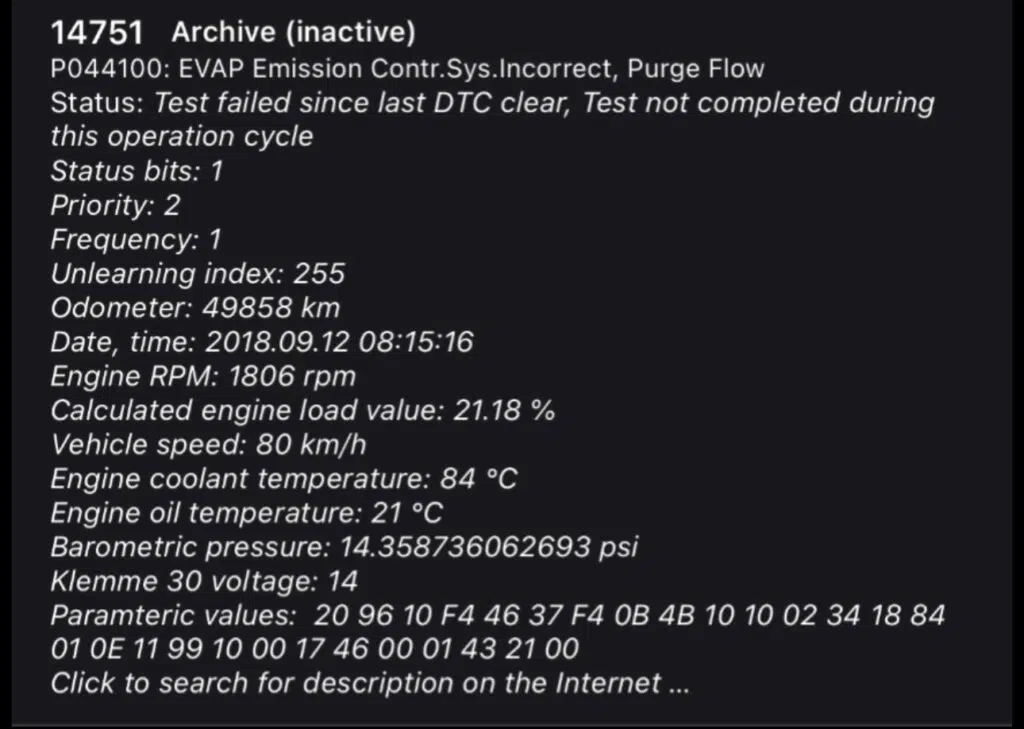
Before spending anything, check the code’s state, it changes everything. Active (light on now): needs diagnosing, keep reading. Pending (logged once, no light): watch it. Stored/archived (light off, fault historical): clear it and drive on; if it returns immediately, treat it as active. My own Rapid carries an archived P044100 that never came back, the full freeze-frame breakdown is later in this article.
What P0441 Fault Code Actually Means
Your car has an evaporative emission control system. Its job is to stop petrol vapour from the fuel tank escaping into the air. The tank vents into a charcoal canister, which traps the vapour and holds it. When conditions are right, the ECU opens the purge valve, and engine vacuum draws that stored vapour into the intake to be burned with the normal fuel.
While the valve is open, the ECU watches the result through the oxygen sensor and the fuel trims. It knows roughly how much vapour should flow. If the flow is wrong, meaning too little, too much, or not at the right time, the ECU sets P0441, the evaporative emission control system incorrect purge flow code.
This is why P0441 is different from a leak code such as P0455. A leak code means the system cannot hold pressure. P0441 means the vapour is not flowing the way the ECU expects. A loose fuel cap is a common cause of leak codes, but a less likely cause of a flow code, so do not assume the cap is the problem here.
What Are The Symptoms Of P0441?
Usually, none. For most owners the check engine light is the only sign. That is normal for this code, the ECU catches a vapour-flow problem in its measurements long before you can feel one, so do not doubt the code just because the car feels fine.
If the purge valve is stuck open, which is the most common failure, you may notice some of these:
- Rough or uneven idle
- Hard starting just after filling the tank
- A faint petrol smell around the car
- Slightly worse fuel economy
If the fault is anywhere else, a hose, a connector, the canister, the wiring, you will usually feel nothing at all.
One useful rule from this: symptoms point to a stuck-open valve, so start at the N80 test in the diagnosis section. No symptoms tells you nothing about the cause, so start the diagnosis from the top.
Can You Drive With P0441 Fault Code?
Yes, for short journeys. P0441 is an emissions fault, not an engine-protection fault, so it will not damage the engine or stop the car.
What it can do, if the purge valve is stuck open, is let extra fuel vapour into the engine when it should not, the symptoms above are what that feels like. On live data you may also see short term fuel trim swing negative at idle as the ECU pulls fuel back to cope. Our guide on short term fuel trim explains how to read that.
Leaving it for weeks is a different matter. A stuck purge valve can keep loading the charcoal canister, and a constant engine light hides any new fault that turns up later. Get it looked at within a few days rather than ignoring it.
Will P0441 Fail An MOT Or PUC Test?
In the UK, the answer comes down to the warning light, not the EVAP system itself. The MOT does not plug in and read your codes. The tester checks that the engine management light (the MIL) comes on with the ignition and then goes out once the engine starts. If the light stays on, that counts as a major defect and an automatic fail. This rule applies to petrol cars first used from 1 July 2003. You can read the official rule in the GOV.UK MOT guidance.
So a P0441 with the light on will fail the MOT, whatever your tailpipe readings look like. A stored or pending P0441 with no light will not fail on that basis, because the EVAP system is not part of the MOT emissions check.
In India, the PUC (Pollution Under Control) test measures what comes out of the exhaust, not your fault codes, so a P0441 will not directly fail it. The light is still worth clearing, both for resale and because it masks anything that follows.
What Causes P0441 On VW, Audi, Skoda and SEAT
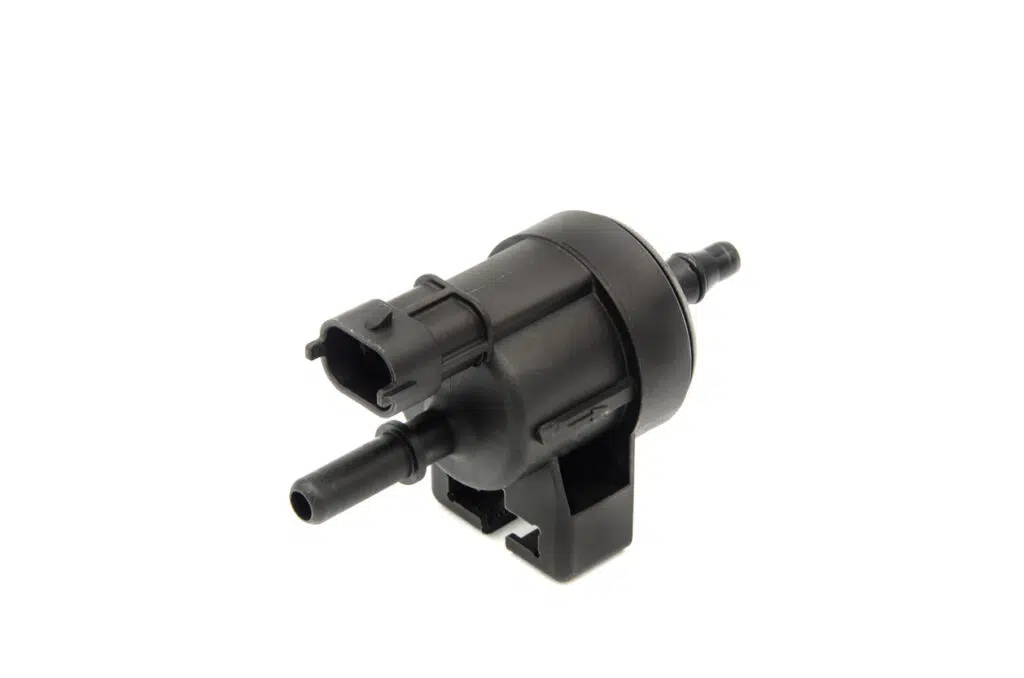
These brands share the same engines and EVAP parts, the causes are the same across all of them. They are listed here in rough order of how often they turn up.
- The N80 purge valve. This is the usual cause on VAG petrol engines. The valve clogs with carbon, sticks open or closed, or its solenoid fails. On some models a failing valve shows as a “Check Gas Cap” message rather than just a check engine light. A valve stuck open is also an unmetered air leak into the intake, which is why a failing N80 sometimes brings the lean-mixture code P0171 along with it.
- A breaking-up charcoal canister. When the canister starts to disintegrate, it sends black charcoal dust down the lines and jams the purge valve. Fit a new valve without checking for this and the new valve fails the same way, so look for black particles in the line first.
- Cracked or loose EVAP hoses and connectors. The plastic connectors on older VAG cars get brittle and split, which changes the flow.
- The fuel filler cap or its seal. Less likely for a flow code than a leak code, but a perished cap O-ring is cheap to check.
- The fuel tank pressure sensor. Less common, but a faulty sensor can give the ECU the wrong picture of the system.
The fault, the causes and the fix stay the same whether the badge says VW, Audi, Skoda, SEAT or Cupra. The only things that change with the engine are where the valve sits and which part number you need. A Golf, an Octavia, an A3 and a Leon on the same engine use the same part. A 1.0 TSI and an older 1.8T do not.
How To Diagnose P0441 Properly
A scanner that only reads the code is a starting point, not an answer. Here is how to find the real cause.
Read it the right way. Note whether the code is active, pending or stored, and read the freeze frame. On VAG cars the purge-flow test usually runs during a steady cruise, so a freeze frame at light load and a moderate speed is normal for this code.
Test the N80 valve. First, find it. On the small TSI engines (EA211) it sits on top of the engine, intake side, two hoses and a plug, no need to lift the car. In the 1.8 and 2.0 TSI (EA888) it is under the engine cover, intake side. On older EA111 cars, check the brittle plastic connectors around it before blaming the valve. Once you have it, with OBDeleven or VCDS you can run an output test and command the valve open and closed. You should hear it click. You can also test it off the car: power it with 12 volts and listen for the click, then check that it holds vacuum when there is no power. Owners commonly report a coil resistance of around 22 to 30 ohms, though it is worth confirming the figure for your engine.
Check the fuel trims. A purge valve stuck open pulls short term fuel trim negative at idle and then improves as the revs rise. If you are not sure how to read live data, start with our guide on scanning your car with an OBD2 scanner.
If P0171 came with it, check the PCV first. This applies to the 1.8 and 2.0 TSI (EA888). That engine’s known PCV diaphragm failure leans the mixture the same way a stuck-open purge valve does, and it sets the same companion code. On an EA888 showing both codes, test the diaphragm before condemning any EVAP part, it is the more common failure of the two.
Smoke-test the system. If the valve checks out, a smoke test fills the EVAP system with smoke so you can see exactly where it escapes: a split hose, a bad connector, or a failing canister.
Do not just fit a new fuel cap and hope. A cap fixes leak codes more often than flow codes.
What You Can Do Yourself And When To See A Mechanic
Most of the early work is safe to do on your own, with no tools beyond a cheap scanner – the £30 Vgate I use.
You can safely: read the code and its state with any OBD2 scanner, check the fuel filler cap and its rubber seal, look over the hoses and connectors around the purge valve with the engine off and cold, listen near the valve at idle for its normal soft ticking, and clear a stored code to see whether it returns. If your scanner shows live data, watching the fuel trims at idle is safe too. None of this can damage anything.
If you are comfortable with basic tools, the valve itself is a realistic DIY job, two hoses and a plug on most engines, off and on in under an hour.
See a mechanic when: the code comes back after a new valve, you find black charcoal dust in the lines (a canister job, and the canister lives near the tank), the wiring needs testing, or a smoke test is the next step, that needs a machine you will not have. And if the car hard-starts after every fill-up with a strong petrol smell, stop tinkering and book it in, because raw vapour where it should not be is the one version of this fault not to sit on.
The honest rule: diagnosis is free or cheap and mostly yours to do. Paying a garage £40–100 to smoke-test before buying parts is money well spent. Paying them to guess is not.
How To Fix P0441 Fault Code?
There is no single guaranteed fix for P0441. It is a flow fault, and several parts can cause it, so the right repair is whatever the diagnosis points to. Replacing the N80 valve without testing it first is a guess, and on a flow code that guess is often wrong.
On VAG petrol engines the N80 purge valve is the most likely cause, so it is the first thing to test. But most likely is not always. Test it before you buy it. The valve may be faulty, it may be stuck or clogged, the wiring to it may be at fault, or the valve may be fine and the problem sits elsewhere.
Fix what the diagnosis actually finds:
- A faulty N80 valve. If it fails its test (it will not open or close on command, the solenoid is dead, or it sticks), replace it. It is a small part, usually two hoses and a plug, fitted in under an hour, so it is a realistic DIY job. The part is cheap, so once it is confirmed faulty, replacing it is the usual choice.
- A cracked, clogged or saturated charcoal canister. Replace the canister. If it has been shedding black charcoal dust into the lines, replace the valve as well, because the dust jams a new one. A canister can also saturate from repeatedly topping off the tank.
- Cracked, split, loose or clogged EVAP hoses and connectors. Repair or replace the affected part. A smoke test shows you which one.
- A wiring or connector fault. A corroded pin, a broken wire, a poor earth or a short in the circuit to the valve can read as incorrect purge flow on its own. Repair the circuit, not the valve.
- A faulty fuel tank pressure sensor. Replace the sensor if it tests bad.
- The fuel cap or its seal. Cheap to rule out, but a less likely cause of a flow code than of a leak code.
In a small number of cases the fault is a software or calibration issue rather than a part, fixed by a dealer ECU update. Ask your dealer, but get the relevant service bulletin confirmed before you pay for it.
After any repair, clear the code and drive a normal mix of town and motorway so the ECU can re-run its checks. If the light stays off after a few drive cycles, the fix worked. If it returns, keep diagnosing rather than fitting another part.
Before you order, match the part family to your engine rather than copying a number from a forum. The small TSI engines (EA211) use the 04E family, 04E 906 517 with a suffix letter you confirm against your engine code. The 1.8 and 2.0 TSI (EA888) use 06H or 06K 906 517 depending on generation. Older EA111 cars use the 03C family. The widely listed 06E number fits none of these, it belongs to the larger Audi engines. Same badge, same fault, wrong valve.
Cost To Fix P0441 Fault Code
There is no single price for fixing P0441, because the cost depends on what caused it. Most of the time the fault is the purge valve, which is the cheapest repair: roughly £15 to £55 for the part in the UK, or about $30 to $90 in the US, fitted in under an hour. The dear end is the charcoal canister, which can run to several hundred pounds or dollars. Some of these jobs are a clean or a repair rather than a new part, so you do not always pay for a replacement.
| Repair | Fix or replace? | Cost (UK) | Cost (US) |
|---|---|---|---|
| Tighten the fuel cap | Fix | Free | Free |
| Clean the purge valve (DIY) | Clean & refit | £5–10 | $6–12 |
| Diagnosis / smoke test | Check | £40–100 | $50–120 |
| Hose, connector or wiring repair | Repair | £10–60 | $10–80 |
| Replace the purge valve (N80) — usual fix | Replace | £15–55 part, ~1 hr to fit | $30–90 part, $180–300 fitted |
| Replace the fuel tank pressure sensor | Replace | £80–250 | $150–400 |
| Replace the charcoal canister | Replace | £150–500+ | $130–880 |
India: aftermarket parts are cheap, the purge valve is around ₹1,500–3,500. Confirm exact prices on Boodmo or through a VW, Skoda or Audi dealer.
Approximate prices. Costs vary by engine, model and garage, so get a quote before any work.
If you are paying a garage, a diagnosis or smoke test up front is money well spent. It points to the actual fault, so you are not paying to replace parts on a guess.
My Own P044100: How To Read An Archived Fault
Here is the real example this article’s advice comes from. My Skoda Rapid 1.0 TSI runs a Stage 1 remap, a full scan with the Vgate iCar Pro turned up P044100 sitting in the fault memory as archived and inactive. No light, no symptoms, no idea it was there until the scanner said so.
The freeze frame is where it gets useful. The fault was logged at 80 km/h, 1,806 rpm and 21% engine load, with the engine warm at 84°C. That is a steady cruise, which is exactly when a VAG car runs its purge-flow test, so the capture conditions are normal for this code rather than a clue to anything.
The frame also carries a lesson in what not to trust. The ECU’s date stamp claimed the fault was years old, but ECU clocks reset whenever the battery is disconnected, so the date field on an archived fault is close to worthless. The odometer field is the honest marker. What actually tells you a fault is settled is neither of those: it is the unlearning index, which on VAG counts clean drive cycles since the fault last appeared. Mine had reached its maximum, and the code has never gone active in any scan since. Maxed index, no recurrence, no light. That is a dead fault, and clearing it cost nothing but a button press.
P0441 On A Remapped Or Stage 1 Car
A remap does not cause P0441. The performance map and the EVAP system are separate, so a Stage 1 tune does not change how the purge valve or canister behave. EVAP faults can still appear on a tuned car, the same as on a stock one, and for the same reasons.
Two points if your car is remapped. First, the dealer software-update note from the fix section still applies here, ask, but confirm the bulletin before paying. Second, a dealer will usually spot a tuned ECU first, so be ready for that conversation.
For what changes under boost on a tuned 1.0 TSI, including how the fuel trims behave, see our Stage 1 remap review. In 51,000 km on a Quantum Red Stage 1 map, my own car has not thrown an active EVAP fault.
FAQs
Yes, for short journeys. It is an emissions fault, not an engine fault, so it will not damage the car. If the valve is stuck open you may notice a rough idle or a hard start after filling up. Sort it within a few days rather than leaving it for weeks.
No, not in the sense of risking the engine. The main downside is a failed MOT in the UK if the light is on, plus the small running issues a stuck purge valve can cause. It is a routine fix, not an expensive one.
If the engine light is on, yes. An illuminated engine management light is a major defect and an automatic MOT fail on petrol cars from 1 July 2003. A stored or pending P0441 with no light will not fail the MOT, because the EVAP system itself is not tested.
Yes, with any OBD2 scanner. Clear the code, then drive a normal mix of roads so the ECU can re-test the system. If it stays clear after a few drive cycles, the fault is gone. If it returns straight away, fix the cause first.
Last Updated: August 2026

Founder of TheCarLane | Automotive Enthusiast
Ayush shares practical automotive knowledge based on real-world ownership and hands-on experience. His work focuses on diagnostics, engine systems, common car problems, and clear explanations that help everyday drivers understand their vehicles better.