
There’s no exact number of miles or kilometres you can safely drive on a flat tyre. You can drive as little as possible. Stop somewhere safe, then figure out your next move.
If you’re already pulled over and trying to work out what to do, here’s how to handle it.
A quick note before you do anything else: many newer cars don’t come with a spare wheel at all, manufacturers replace them with foam sealant kits to save weight. Check your boot before you decide what to do. If you don’t have a spare, your real options narrow to either using the sealant kit (for small punctures only) or calling recovery.
What You Can Do Right Now
Move the car a short distance if you’re not properly safe. If you’ve stopped on a blind bend, partly in a live lane, on a hill where someone could rear-end you, or anywhere you’re a hazard, drive slowly to a verge, layby, or side street. Walking pace. Treat the tyre as gone. Your safety is worth more than a tyre.
Drive a short distance to the nearest tyre shop, but only if it’s a slow puncture. If the tyre still has shape and the car drives mostly normally, you’ve got some air left and you can carefully reach the nearest tyre shop. Stay under 30 mph. Pick the closest one, not your usual one. Don’t go further than a couple of miles.
Change to your spare if you have one, you know how to do it, and you’re somewhere safe to do it. A side street or layby is fine. A motorway hard shoulder is not.
Use the foam sealant kit, if your car came with one instead of a spare. Many newer cars have a tyre repair kit (a can of sealant plus a small compressor) in the boot instead of a spare wheel. Follow the kit instructions, typically you connect the bottle to the tyre valve, squeeze the sealant in, then run the compressor to inflate the tyre. The sealant only works on small punctures in the tread area, not sidewall damage or large holes. If it doesn’t seal the tyre within 10 minutes, stop trying and call recovery.
Call recovery if the tyre is fully flat, if you don’t have a spare, if you don’t know how to change a wheel, or if you’re roadside on a motorway. This is almost always the right answer.
What You Shouldn’t Do
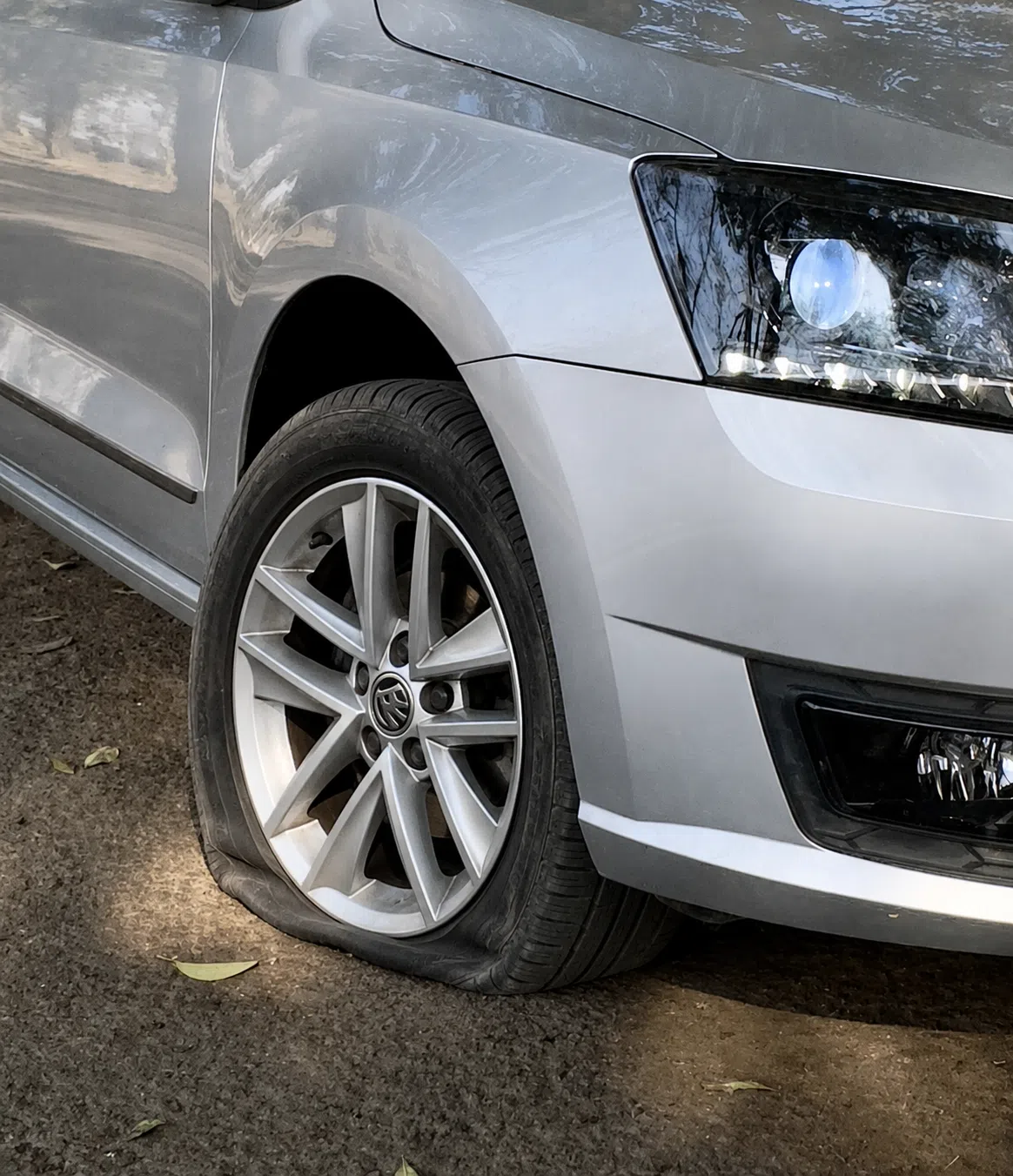
Don’t drive home on a fully flat tyre. (one with no air at all, where the rubber spreads outward when it meets the road). A tyre with some air left is a different situation, re-inflate it or change the wheel. But once the tyre has no air, the metal rim presses through onto the road. Within a few minutes you’ve destroyed the tyre, damaged the rim, and possibly stressed your suspension.
Don’t try to change a wheel on a motorway hard shoulder. People get killed doing this every year. Wait for recovery, they have the right equipment and protection.
Don’t sit in the car next to traffic. Even on a hard shoulder or verge, if a passing vehicle hits your car, you don’t want to be in it. Get out on the non-traffic side and stand well back.
Don’t accept help from random strangers who pull over. Most are well-meaning. Some aren’t. Tell them recovery is on the way.
Don’t ignore the speed limit on a space-saver spare. If you’ve fitted the small temporary spare, there’s a maximum speed printed on it, usually 80 km/h or 50 mph. Going faster than that on a space-saver is genuinely unsafe.
How To Tell What Kind of Flat You Actually Have
Walk around the car and look at all four tyres. Here’s what you’re checking for:
Fully flat: The tyre is visibly squashed where it meets the road. That corner of the car sits noticeably lower than the others. The rubber spreads outward. Sometimes the tyre is partly off the rim. Don’t drive on this beyond moving to immediate safety.
Slow puncture: The tyre still looks roughly the right shape but slightly low. You might see a nail or screw in the tread. The car was pulling slightly or you got a TPMS warning. If you suspect a slow puncture and want to verify, check the pressure with a gauge against the recommended PSI on your driver’s door sticker. You can drive carefully to the nearest tyre shop on this one.
Blowout: The tyre is in pieces. Sidewall split, tread peeled off, rubber strips hanging. You’ll know if this happened because of the loud bang while driving. The wheel may be damaged too. Call recovery, don’t try to fit a spare without checking the rim first.
How To Call Recovery
For most UK and US drivers, calling recovery is the realistic default, not because you couldn’t change the wheel yourself, but because the alternatives often aren’t available. Over 60% of new UK cars and 28% of new US cars come without a spare wheel, just a foam sealant kit. Even drivers with a spare often call recovery on motorways for safety reasons, or simply because their membership covers it.
UK: AA, RAC, Green Flag, or your insurance roadside number (usually on your policy or insurance app). If you’re not a member, AA and RAC both offer one-off pay-as-you-go callouts, typically £75-150.
US: AAA if you’re a member, or your insurance roadside number. Without coverage, expect $75-200 for a one-off call.
India: Your insurance roadside assistance line, most comprehensive policies include this free. If you don’t have that, Google “tyre puncture near me” and call the closest tyre shop. Typical cost ₹500-2,000 for a callout.
When you call, give them:
- Your location (use your phone’s “share my location” feature if possible)
- Your car make, model, and registration
- A flat tyre and whether you need a wheel change or a tow to a garage
They’ll give you an arrival time. Wait somewhere safe, not in the car.
A note for India: many Indian drivers handle smaller punctures themselves with a portable inflator. If your tyre still has some air and you can re-inflate it, this is often the quickest solution, drive straight to a tyre shop for proper repair. Don’t treat re-inflation as a permanent fix.
How To Change The Wheel Yourself (if you’re doing it)
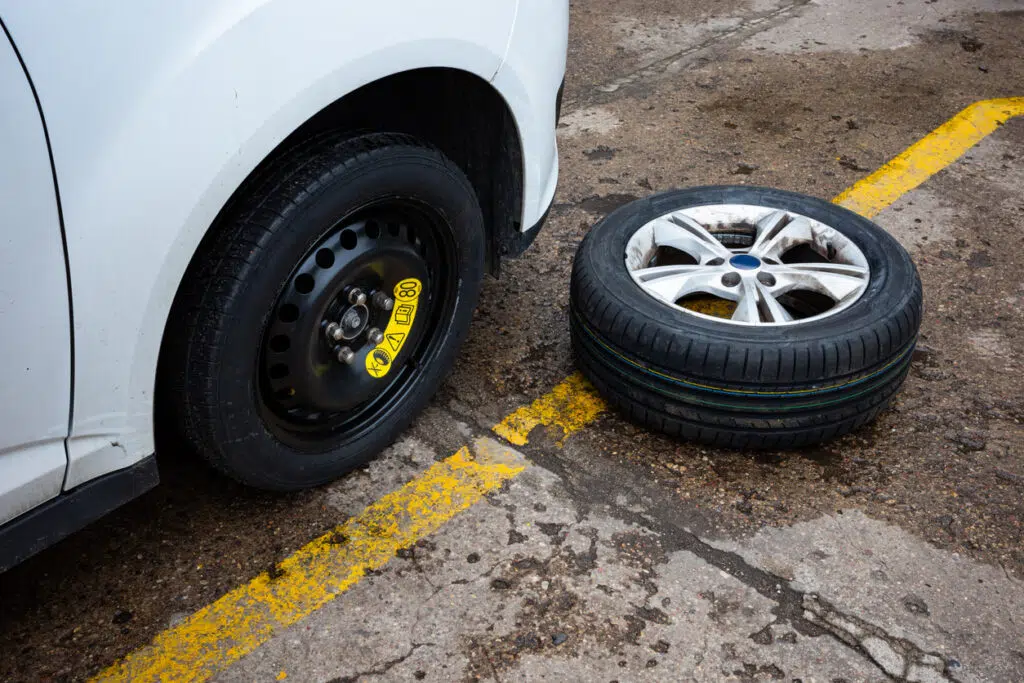
If you’re not confident doing this, call recovery instead, there’s no shame in it. Only attempt this if you have a spare, you’re somewhere safe, and you’ve done it before or you’re sure of the steps.
- Put the car in gear (manual) or Park (auto). Handbrake on. Chock the wheels if you have anything to use.
- Get the spare, jack, and wheel brace out of the boot.
- Loosen the wheel nuts before jacking the car up, it’s much harder once the wheel is off the ground.
- Jack the car at the proper jacking point. Check your owner’s manual, it’s not the suspension arm or anywhere on the underbody. There’s usually a reinforced point behind the wheel.
- Lift the car until the wheel is just clear of the ground, remove the nuts, swap the wheel.
- Fit the spare. Tighten the nuts hand-tight in a star pattern (top, bottom, side, side).
- Lower the car back down, then tighten the nuts properly in the same star pattern. Use a torque wrench if you have one.
- Stow the flat tyre, jack, and brace back in the boot.
If you’ve fitted a space-saver spare, check the speed limit printed on it. Drive carefully to a tyre shop, don’t take long journeys on it.
FAQs
Not long. At motorway speeds, a fully flat tyre is destroyed within a minute or two. At walking pace, you might preserve the tyre slightly longer, but the rim damage starts almost immediately once there’s no air supporting the wheel. Only drive far enough to reach somewhere safe to stop, usually a few yards at most.
Yes, but only to reach immediate safety. Twenty feet at walking pace is fine if you’re moving off a live road, into a layby, or onto a verge. The damage to the tyre and rim is minor at that distance. Don’t use the 20-foot threshold as permission to drive further, the damage scales quickly once you go beyond moving to safety.
Almost no distance. Once the tyre has no air, the rim is bearing the full weight of the car through whatever’s left of the tyre. Scuffing starts within yards. Visible deformation can happen within a few hundred metres. Alloy wheels are particularly vulnerable. If you want to avoid rim damage, don’t drive on the flat at all, call recovery or change the wheel.
Only if it’s a slow puncture and the tyre still has some air left. If the tyre is fully flat, driving to a petrol station to use the air pump will likely destroy the tyre and damage the rim before you arrive. Use a portable inflator if you have one, or call recovery. A petrol station air pump can re-inflate a slow puncture in an emergency, but the tyre will still need proper repair afterwards.
Don’t. There’s no safe speed on a fully flat tyre — even walking pace risks rim damage. If the tyre still has some air (slow puncture), keep speed under 30 mph and drive only to the nearest tyre shop. On a space-saver spare, follow the speed limit printed on the spare itself, usually 50 mph (80 km/h).

Founder of TheCarLane | Automotive Enthusiast
Ayush shares practical automotive knowledge based on real-world ownership and hands-on experience. His work focuses on diagnostics, engine systems, common car problems, and clear explanations that help everyday drivers understand their vehicles better.