
P0171 Fault Code means your engine is running lean: it’s getting more air than fuel. The engine’s computer noticed the imbalance, tried to correct it by adding fuel, and set this code when it ran out of room to correct. On VW, Audi, Skoda and SEAT petrol engines, the cause is usually a small air leak or a tired breather part and which part depends on the engine you have, not the badge on the car. You can normally keep driving for now, drive gently, and plan the fix soon.
This guide shows you what to do next: whether your car is safe to drive, which cause your engine points to, the ten-minute phone check that costs nothing, and what the repair really costs.
Can You Drive With the P0171 Code?
Yes, with a bit of care, and not forever.
Keep two limits in mind while the code is active. Go easy on hard acceleration, because a lean mixture burns hotter than the engine was set up for, and sustained hard driving is where that heat starts to matter and plan the fix in days or weeks, not months, a lean engine misfires more easily, and the longer it runs lean, the more the catalytic converter has to put up with.
Move faster if any of these show up: the engine stalls or idles roughly at junctions, you feel hesitation when you press the pedal, or new codes join P0171, especially misfire codes starting with P03. Those are signs the lean condition has grown past the “fix it soon” stage.
P0171 Symptoms on VW, Audi and Skoda
Plenty of cars show nothing except the check engine light. The computer hides small lean conditions well, which is why the code often surprises people at MOT time or after a routine scan.
When symptoms do appear, they look like this:
- A rough or uneven idle, often worst on a cold morning
- Hesitation or a flat feeling when you accelerate
- Slightly higher fuel use than usual
- A faint hissing from the engine bay at idle
- Occasional stalling when you come to a stop
One pattern worth noticing: if the roughness is clearly worse when the engine is cold and settles as it warms up, that leans toward a vacuum or breather leak. Cold rubber and plastic shrink, which opens small cracks; warm parts expand and partly seal them. Note when your car misbehaves, it’s a genuine clue, and your garage will thank you for it.
What the P0171 Fault Code Actually Means
Your engine watches its own fuel mixture every second through two numbers, short-term and long-term fuel trim. When something upsets the mixture, these numbers climb as the computer adds fuel to compensate. Once they climb past roughly +25% combined, the computer stops compensating quietly and reports the problem as P0171.
So the code isn’t sudden news, those two numbers have usually been recording the problem for weeks. Better still, they can point at the cause before you buy a single part. I explain how they work in my short term fuel trim guide, and the ten-minute check further down this page puts them to use on your car.
DTC P0171, P0171 00 and 16555 – Same Fault Code, Different Outfits
Scanners show this fault code in a few costumes, and it confuses people into thinking they have a different problem. Some apps label it plainly, others prefix it, so “DTC P0171” on a Volkswagen, Audi or SEAT screen is the same fault as “P0171” on any other scanner. DTC just means diagnostic trouble code.
- P0171 – the standard OBD2 format every basic scanner shows.
- P0171 00 – the same code with a two-digit suffix, shown by newer VAG software and some apps. The extra digits describe the fault type; “00” just means the plain, active version of the fault.
- 16555 – the old five-digit VAG number for the same fault. VCDS and older VAG tools display it as “16555 / P0171 – Fuel Trim, Bank 1: System Too Lean.”
All three mean the same thing. If your app shows “P017100” without a space, read it as P0171 with the 00 suffix, not as a mystery code.
And “Bank 1”? It’s the only bank you have. Every four-cylinder and three-cylinder VAG engine keeps its cylinders in one row, so Bank 1 covers the whole engine. Only the V6 and V8 Audis have a Bank 2, more on that in the combined-codes section below.
The P0171 Cause Map: Find Your Engine First
Different engines get P0171 for different reasons. Find your engine below and start with what usually causes it there, not with a twenty-item list. (Your engine size and type like “1.2” or “1.8T” is written on the engine cover and in your car’s logbook.)
1.2 and 1.4 MPI – the Non-Turbo Petrols (VW Polo, Skoda Fabia, SEAT Ibiza, older VW Golf)
On these engines, P0171 usually comes from old, cracked air hoses and dried-out seals. (MPI is the older non-turbo type – if your 1.2 or 1.4 is a TSI, it’s a small turbo engine and the FSI/TSI section below fits it better.) These cars are 10–25 years old, and hardened rubber lets in air the engine’s computer can’t see, which is exactly what this code means. The fix is usually a cheap hose or seal, not a sensor.
1.8T (older Audi A4, VW Passat, Skoda Octavia vRS, VW Golf GTI)
The 1.8T has two famous causes most VW specialists know: a small plastic breather valve that rots with age (part number 058 905 291 K, about £40, often changed in minutes) and a curved hose hidden under the intake that splits where nobody can see it. Ask a garage to check those two before anything else.
FSI and Early TSI (late-2000s VW Golf, Skoda Octavia, Audi A3, VW Passat)
The most common cause here is the breather valve on top of the engine, garages call it the PCV valve, which has a thin rubber skin inside that tears with age. Free test: with the engine idling, gently lift the oil filler cap. If the idle stumbles or the cap pulls back hard, that valve deserves the first look.
2.0 TSI / TFSI (later VW Golf GTI, Skoda Octavia vRS, Audi A4)
Same breather valve weakness, plus leaks in the turbo’s pressure pipes. If P0171 appears together with P0507 (high idle) or P0299 (low boost), that pairing points straight at the breather valve and the turbo’s pressure-control valve.
1.0 and 1.5 TSI – the Newest Engines
P0171 is rare on the newest generation. When it happens, it follows the same logic, an air leak or a breather fault.
The map at a glance:
| Your engine | Usual cause | Easiest first step |
|---|---|---|
| 1.2 / 1.4 MPI (non-turbo) | Old air hoses and seals | Feel the hoses (engine off and cold), or ask the garage to |
| 1.8T turbo | Breather valve (058 905 291 K) + hidden hose | Name both parts at the garage |
| FSI / early TSI | Breather (PCV) valve | The oil-cap test at idle |
| 2.0 TSI / TFSI | PCV valve + turbo pipe leaks | Mention any extra codes |
You don’t have to check any of this yourself. The map’s real job is one sentence at the garage, “it’s a 1.8T with P0171, please check the breather valve and the hoses under the intake first”, which points the diagnosis at the likely cause instead of paying for a hunt. If you’d like to do one thing yourself, the ten-minute phone check further down needs no tools and nothing under the bonnet.
P0171 Causes on VW, Audi and Skoda
Here’s the full list in the order it actually shows up on these cars, most likely first:
- Crankcase breather / PCV faults: Torn diaphragms, failed check valves, cracked hoses. The number one VAG lean-code cause across generations.
- Vacuum leaks: Brittle vacuum lines, the brake booster hose, leaking intake manifold seals.
- An under-reading MAF sensor: It tells the computer less air is coming in than really is. Cleaning sometimes helps; more on that in the FAQ.
- A stuck-open purge (EVAP) valve: Lets fuel-tank air into the intake at the wrong time. On VAG cars this more often causes rough idle after refuelling; I have covered the system properly in the P0441 guide.
- Weak fuel delivery: An ageing in-tank pump or a clogged filter starves the engine slightly; the mixture reads lean even though the air side is honest.
- A boost-side leak (turbo engines), split charge pipes or intercooler joints, showing up mainly under load.
- An exhaust leak before the O2 sensor: Extra oxygen at the sensor reads as lean. Rarer, but real on the FSI/TSI stud issue above.
Notice what’s near the bottom of every honest version of this list: the oxygen sensor itself. It gets replaced constantly for P0171 and it’s rarely the cause, it’s usually the messenger.
The 10-Minute Check Before You Spend Anything
Your scanner already holds the best clue, and reading it costs nothing. Any basic OBD2 adapter and a free app will do, I use a ₹2,000 Bluetooth adapter with the Car Scanner app for every reading on this site. New to this? My guide on how to scan your car with an OBD2 adapter walks you through connecting up in about five minutes; come back here once you can see live data. The two values you want on screen: short-term and long-term fuel trim.
Step 1 – Read the Trims at Warm Idle
Engine warmed up, car parked, read both trims and add them together. Write the number down.
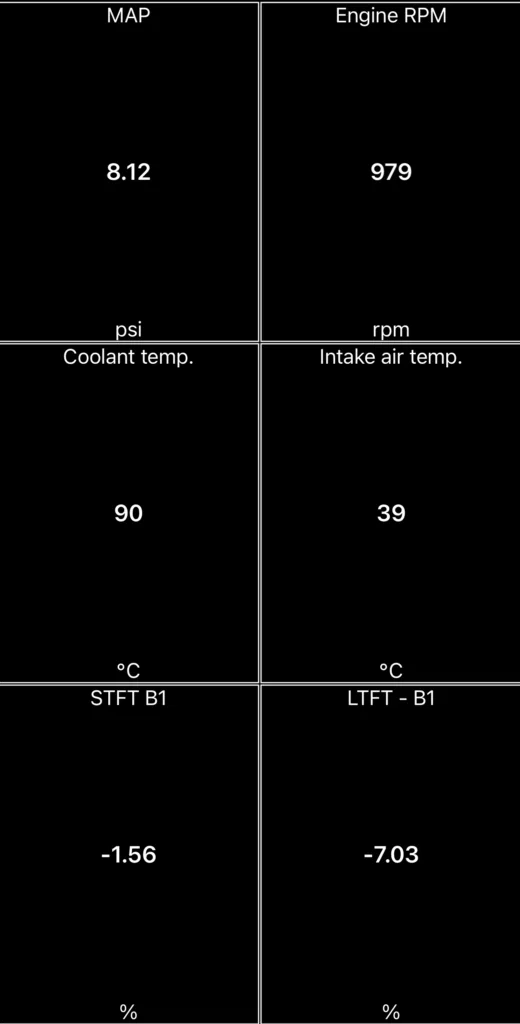
My warm idle: STFT −1.56 + LTFT −7.03 = −8.6% combined — inside the healthy ±10%. This is what a passing step one looks like.
Step 2 – Read Again at a Held 2,500 rpm
Still parked, hold the engine at a steady 2,500 rpm for thirty seconds and read the combined trims again.
What Your Two Numbers Are Telling You
Much worse at idle, improving with revs – unmetered air. Vacuum and breather leaks matter most at idle, when the engine pulls its deepest suction through the smallest airflow. As revs rise, the leak becomes a smaller share of total air and the trims relax. Go hunting on the air side: PCV, hoses, manifold seals.
Similar at idle and revs, or worse under load on a drive – look at fuel delivery or, on turbo cars, the boost plumbing. The air side is probably telling the truth.
VCDS users can see the same story in the adaptation values (measuring block 32 on older cars), idle adaptation sitting well above 5% points the same direction as a bad idle trim.
That single comparison is the difference between guessing and diagnosing, and it’s the exact method that found a split breather hose on cars all over the owner forums after their owners had already replaced sensors that were never broken.
How to Fix P0171 Fault Code
Most P0171 repairs on VW, Audi and Skoda models are small jobs, and a proper repair follows one rule whoever does the work: diagnose first, replace second. Knowing that order is what protects you from paying for the wrong parts.
Finding the Fault Comes First
A garage starts with inspection, cracked breather hoses, loose intake joints, oil traces around seals and if nothing shows, moves to a smoke test: the intake gets filled with visible vapour and the leak reveals itself. That one test decides the whole repair. A leak that has been seen gets fixed once; a leak that has been guessed at gets expensive.
The Repair Itself and How to Know It Worked
On most VAG engines the fix comes down to a cracked hose, a dried intake seal or a failed breather (PCV) valve, a cheap part and typically under an hour of labour. Your engine’s most likely part is in the cause map above, and naming it at the garage shortens both the diagnosis and the bill.
The expensive suspects, the MAF sensor, the oxygen sensor, the fuel pump, belong at the end of the list, because they’re the least common causes. A repair quote that opens with sensor replacement before any testing deserves one polite question: what did the test show?
You’ll know the fix worked when two things happen together: the code stays away, and the fuel trims settle back toward zero over a few days of normal driving. The light staying off proves nothing by itself, it stays off for a while after any clearing.
When to Visit a Mechanic?
Skip the DIY steps and go straight to a garage if the engine stalls, misfire codes (P0300-series) have joined P0171, the car hesitates when you accelerate or you’d simply rather not touch anything. None of that means disaster; it means the fault has outgrown a hose-squeeze.
Book a visit soon if the code keeps returning after clearing, or your own checks found nothing and the trims still sit high. That’s exactly what a garage’s smoke test is for.
Two things make the visit cheaper: bring your findings, engine type, trim numbers, any extra codes and ask for the smoke test before agreeing to any parts. A garage that starts with a sensor swap before testing the intake is guessing at your expense.
What Does Fixing P0171 Cost?
Typical price ranges at independent garages as of mid-2026, based on commonly quoted parts and labour. Your actual quote depends on your car, your region, and what the diagnosis finds, treat these as a final check, not an estimate for your repair.
| Fix | UK | US | EU |
|---|---|---|---|
| Vacuum / breather hose | £5–25 + fitting | $10–40 | €10–30 |
| PCV check valve (1.8T) | £35–45 part | $45–60 | €40–55 |
| PCV valve / diaphragm | £25–90 part; some TSI covers £120–250 | $40–300 | €30–250 |
| Smoke test (diagnosis) | £40–80 | $60–120 | €50–90 |
| Intake manifold seals | £60–150 fitted | $100–250 | €80–180 |
| MAF sensor (quality part) | £80–200 | $100–300 | €90–220 |
| Fuel pump | £150–400 fitted | $250–600 | €180–450 |
Most VAG P0171 repairs land in the top three rows. Use the table to judge whether a quote is in the right neighbourhood and if one opens with a fuel pump or an O2 sensor before anyone has smoke-tested the intake, ask for the diagnosis first.
P0171 With Other Codes
Codes rarely travel alone, and the company P0171 keeps changes the story:
P0171 + P0174 – P0174 is “too lean, Bank 2,” and only the V6 and V8 Audis have a Bank 2. If you drive one and both codes appear together, the cause is almost certainly shared, think fuel pressure, a large vacuum leak, or the MAF, because two separate bank-specific faults appearing at once would be quite a coincidence. On any four- or three-cylinder VAG engine, you’ll simply never see P0174.
P0171 + P0299 or P0507 – the 2.0T’s calling card. Underboost plus lean plus a high idle points hard at the PCV and diverter valve pair.
P0171 + misfires (P0300–P0304) – a lean mixture misfires more easily, so the misfires are often passengers, not drivers. Fix the lean condition first and the misfires usually leave with it.
P0171 then P0172 later – lean, then rich? That pattern often means a sensor is lying in both directions, usually the MAF or the computer over-corrected after a repair. Give the trims a few days to settle before reacting.
P0171 on Remapped Cars
A remap raises boost, and more boost puts more strain on every joint in the charge system. If P0171 arrived after a Stage 1 or after hard driving on one, check the boost plumbing and the diverter valve before anything else, because a pressurised leak leans the mixture exactly under the load a mapped car sees more of. My own Stage 1 runs healthy trims under boost, and I’ve logged what that looks like; a mapped car with slowly climbing positive trims under load has a leak or a fuelling limit worth finding early. The engine-family causes above still apply unchanged, a map doesn’t invent new failure parts, it just finds the weak ones sooner.
FAQs
Not today. Left for months, a lean engine runs hotter and misfires more, and the catalytic converter pays first. Weeks of gentle driving: fine. A year of ignoring it: expensive.
No. P0171 belongs to petrol engines chasing a fixed air-fuel target. Diesels meter fuel differently and never set it, if your TDI runs lean-ish, it tells you through different codes entirely.
You can, and it will come back, the code is a measurement, not a glitch. Clearing it without fixing anything only deletes your evidence.
Intermittent usually means temperature-dependent, a crack that opens cold and seals warm, or a fault right at the computer’s correction limit. The cold-morning pattern in the symptoms section is your clue.
Last Updated: August 2026

Founder of TheCarLane | Automotive Enthusiast
Ayush shares practical automotive knowledge based on real-world ownership and hands-on experience. His work focuses on diagnostics, engine systems, common car problems, and clear explanations that help everyday drivers understand their vehicles better.