
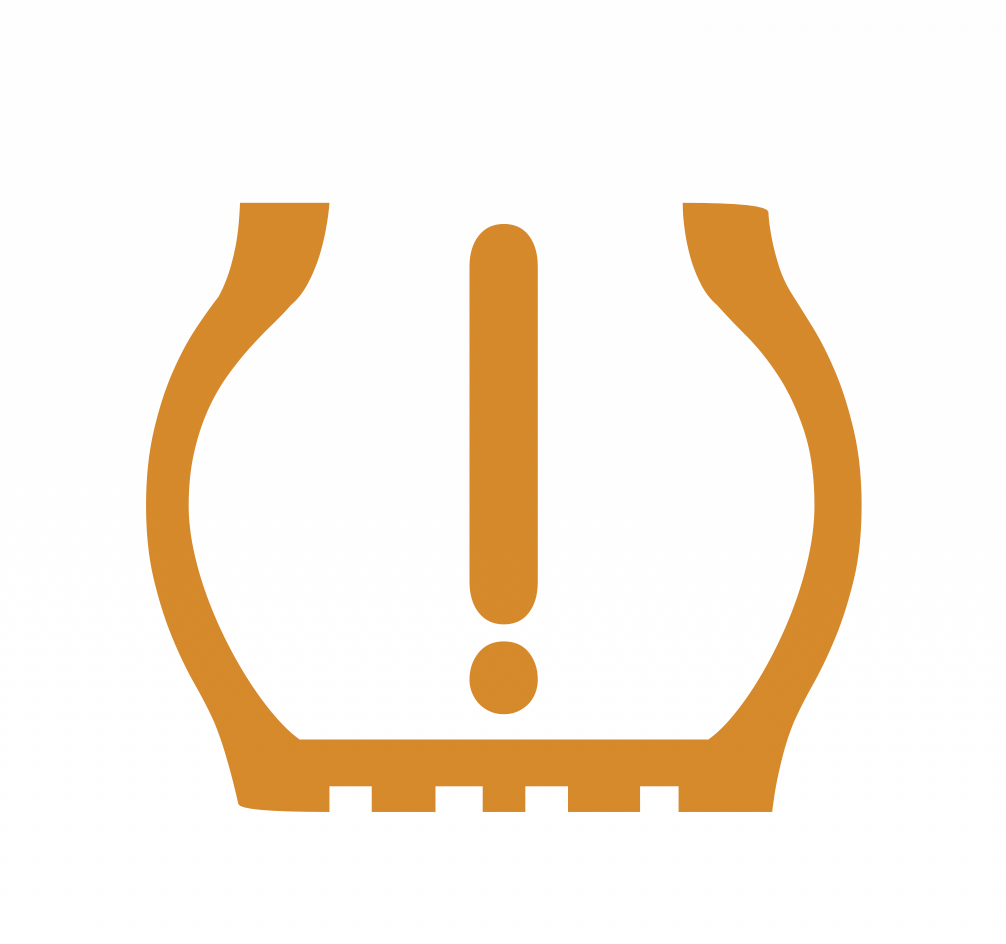
A VW tyre pressure warning light, the amber tyre with an exclamation mark, means one of two things, and Audi, Skoda and SEAT use the same light and reset. Steady: a tyre has lost about a fifth of its pressure (a quarter on US-spec cars), or you inflated the tyres and never told the car. Flashing for a minute and then steady: the system itself has a fault, usually a wheel speed sensor. Steady and the car feels normal: gauge all four, inflate to the sticker, then store the pressures in the menu or with the SET button. Flashing: the garage, not the tyres.
Can I Drive With the Tyre Pressure Light On?
Yes, as far as a gauge and an air line, if the light is steady and the car drives as it did yesterday. Pull over if it came on with a thump, the steering pulls, the car wallows, or you hear a rhythmic noise: that is a tyre going down now.
Flashing then steady is a system fault. The car is not watching your tyres until it is fixed, so drive normally, check the pressures yourself weekly, and book the garage. At the MOT only that fault fails; a steady light for low pressure does not, and the FAQ has the manual’s wording.
Does Your Car Have Tyre Pressure Sensors? The Ten-Second Test
If the car shows four pressures on a screen, it has sensors in the wheels. If the tyre menu only offers Set or Store, it has the indirect system, and that is most VW, Skoda, SEAT and Audi cars in Europe, the UK, Australia and India. The market and the year decide it, never the badge.
The indirect system, VW’s tyre pressure loss indicator, has no sensors at all. It uses the ABS wheel speed sensors to spot a tyre turning faster than the others, because a soft tyre is a smaller tyre. It knows nothing about actual pressures, which is why it needs you to store a baseline after every inflation, and why it cannot show you a number.
The direct system puts a sensor in each wheel, shows a pressure per wheel, and has a battery in every sensor that dies after five to ten years. Ross-Tech’s wiki lists the US cars that have it: the 2005-on Golf, GTI and Jetta, the 2006-on Passat, the 2007-on Eos, the 2009-on Tiguan and CC, with “some of the 2011+” Golf-platform cars switching to the indirect system and a reset button; the trade press adds the 2012 to 2016 US Passat and Beetle. Audi fits sensors wherever it sells the per-wheel display, which is most US Audis. In Europe it is the Touareg, some Passats, Arteons and Transporters, and Audis with the display option.
How to Reset the Tyre Pressure Warning Light, by Model
Inflate all four to the sticker inside the fuel filler flap or on the driver’s door frame, cold, in psi or bar as the sticker gives them, before you store. Storing the wrong pressures teaches the system to accept them. Cars with sensors in the wheels need no store: inflate to the sticker, drive for a few minutes, and the light goes out on its own once every sensor has reported; a store option in the menu on those cars only resets the warning thresholds.
Volkswagen With a Touchscreen (Golf Mk7 and Mk8, Polo From 2014, T-Roc, T-Cross, Tiguan Mk2, Passat B8, Touran Mk2, Arteon, T6.1)
Ignition on. Press CAR, then Setup (the cog; Settings on later units), then Tyres, then SET. The screen asks you to confirm that all four pressures have been checked and set, and says they have been stored. On the Golf Mk8, ID models and 2021-on Polo and T-Roc the tyre menu sits under Vehicle.
[IMAGE: the Tyres settings screen with the SET button on a VW group infotainment unit]
Volkswagen With a SET Button (Golf Mk6, Polo 6R, Jetta Mk6, Scirocco, Tiguan Mk1, Touran Mk1, Sharan, Caddy, Transporter T5.1 and T6, Up)
Ignition on, engine off. Press and hold the SET button, the one with the tyre symbol on it, for at least two seconds until the chime. It is near the gear lever or in the glovebox, depending on the model. US and Canadian cars: the 2011-on Jetta and 2015-on Golf have the button or the menu; the 2005 to 2010 Golf, Jetta, Passat and Eos, the 2009 to 2015 Tiguan and CC, and the 2012 to 2016 Passat and Beetle have sensors in the wheels and no button.
Skoda (Octavia, Fabia, Superb, Yeti, Rapid, Karoq, Kodiaq, Kamiq, Scala, Citigo)
Touchscreen cars from about 2013: CAR, then Tyres, then press and hold SET until the pressures are stored. Octavia Mk4, Enyaq and 2021-on Fabia: the tyre menu sits under Vehicle. Cars with the basic radio, and the Octavia Mk2, Yeti, Fabia Mk2, Roomster, Rapid and Citigo: the SET button with the tyre symbol, near the gear lever or low on the dash, held for about two seconds until the light flashes and the chime sounds.
SEAT (Ibiza, Leon, Arona, Ateca, Tarraco)
The SET button in the glovebox, ignition on, engine off, held until the beep: Leon Mk3 to 2017, Ibiza 6J and Leon Mk2. On the Easy Connect screen, Settings, then Tyres, then Set: Leon Mk3 from 2017, Ibiza 6F, Arona and Ateca. The tyre menu sits under Vehicle on the Leon Mk4 and Formentor.
Audi (A1, A3, A4, A6, Q2, Q3, Q5)
MMI cars: CAR, then Car systems, then Servicing and checks, then Tyre pressure monitoring, then Store tyre pressures, and confirm. A3 8P and A4 B8 without MMI: the trip-computer menu on the wiper stalk, Tyre pressure, then Store. Audis with the per-wheel display, which is most of them in the US and Canada, follow the same path; the screen shows the new values once each wheel has been read, and the light clears after a few minutes of driving even if you store nothing.
If there is no tyre entry in any menu, the car may not have the system at all, whatever the light says. A 2010 A3 on Audi Owners Club spent eight months like that: light on, no menu, no button, no fault codes at two garages. The only thing that cleared it was a scan tool that reaches the ABS module.
Why Is My Tyre Pressure Light On When My Tyres Are Fine?
Because the indirect system does not measure pressure. It measures difference, against a baseline you stored months ago. In order of how often each turns out to be the reason:
Two About Temperature
- The first cold morning of autumn. Pressure falls about 1 psi for every 5 to 6 degrees the air cools, so tyres filled in August look fine and sit 4 psi under the baseline. Inflate cold, store, done.
- You set them hot. The sticker pressures are for cold tyres. After a motorway run a tyre reads 3 to 4 psi high, so you let air out, and by morning it is under the baseline. Check before the drive, not after.
Three About Something That Changed
- You inflated and did not store. The light stays on until you press SET, however perfect the pressures are. New tyres, a puncture repair, a rotation, the space-saver: all of them need the store.
- A load the baseline did not know about. A caravan, a full boot, a roof box or one hard drive on a twisty road changes how the wheels turn against each other. Store with the car loaded as you drive it.
- The spare, snow chains or mixed tyres. Different sizes or tread depths on one axle read as a soft tyre until the proper wheel is back on.
The Two You Fix Somewhere Else
- A slow puncture. A nail, a leaking valve or a corroded alloy bead seat loses 2 to 3 psi a week, and the light comes back a fortnight after every reset. A weekly gauge check finds the one that is dropping.
- A wheel speed sensor. The one that flashes first, or arrives with an ABS or ESC message. The tyres are innocent; the fault section below covers it.
When the Light Keeps Coming On, Flashes, or Says the System Is Not Available
Three messages, three different problems.
The Light Comes Back Days or Weeks After a Reset
A tyre is losing air. Gauge all four weekly, find the one dropping 2 psi or more, and have it checked for a nail, a valve or a bead leak. Storing the pressures again only hides it for another fortnight.
Flashing for a Minute, or “System Fault” on an Audi
The system cannot work. On the indirect system that is almost always a wheel speed sensor, its wiring, or dirt and corrosion between the sensor and its toothed ring, and it usually arrives with ABS and ESC warnings. A 2016 T6 owner on t6forum had “tyre pressure monitoring unavailable” with an ABS controller error; a rear wheel speed sensor fixed it, and other members paid about £17 for the sensor and about £50 a corner to have it fitted. An Audi A3 at Links Automotive showed the same pair of warnings from a rear right sensor killed by a corroded wheel bearing. On a direct system the same message means a sensor battery is dead or a wheel without sensors has been fitted.
“Tyre Pressure Loss Indicator Currently Not Available”
Same cause as the flash: the ABS module has stopped trusting a wheel speed signal, or ESC is in a fault state. It can also show briefly after a battery disconnect until the car has been driven. If it stays, the ABS module holds the code.
The code lives in the ABS module rather than the engine module, so a generic reader shows nothing, which is why so many of these end up at a dealer. OBDeleven’s free plan reaches the brakes module on my Rapid and names the corner; VCDS does the same. Replace the sensor the code names, clear it, store the pressures, and the light stays off.
When a Tyre Pressure Warning Is Serious
A light that comes on suddenly at speed, with any change in how the car drives, is a tyre deflating: stop where it is safe and look. A direct system reading 1.5 bar or less on one wheel is the same instruction with a number on it. Everything else on this page is a job for this week. The one thing not to do is reset the light repeatedly without a gauge in your hand; a tyre run soft for a month overheats its sidewall, and that is how a slow puncture becomes a blowout.
How to Stop the Tyre Pressure Light Coming Back
A gauge in the door pocket, £10, and one cold check a month. Store the pressures every time air goes in or a wheel comes off, with the car loaded the way you drive it. And never store a baseline on a tyre you have not checked that morning; the system will believe whatever you tell it.
Tyre Pressure Sensor and Wheel Speed Sensor Repair Costs
Resetting the light is free and takes a minute. The repairs behind a light that will not stay off, at independent garages:
| Job | UK | US |
|---|---|---|
| Tyre pressure gauge | £5 to £15 | $8 to $20 |
| Puncture repair | £20 to £35 | $25 to $45 |
| Scan of the ABS module | £40 to £90 | $80 to $150 |
| ABS wheel speed sensor, fitted | £65 to £180 | $160 to $400 |
| Same, with diagnosis or a seized sensor | £130 to £350 | $250 to $520 |
| TPMS wheel sensor, fitted and coded | £60 to £150 each | $150 to $370 each |
The sensor itself is the cheap part: £12 to £40 aftermarket, over £150 genuine, and the T6 owners above paid £17. Diagnosis and a sensor rusted into the hub are what move a bill from the first row to the second.
The ABS Fault Codes Behind a Tyre Pressure Light
A wheel speed sensor fault stores in the ABS module as 00283, 00285, 00287 or 00290 in VCDS numbering, one per corner (G47 front left, G45 front right, G44 rear right, G46 rear left), with “implausible signal”, “electrical fault in circuit” or “mechanical malfunction” text, and Ross-Tech’s notes for them list an open circuit, a faulty sensor, too wide an air gap, or a damaged or rusted pick-up ring; OBDeleven shows the same corner. On a direct system the TPMS module stores a sensor-missing or sensor-battery code against the wheel. The ABS and ESC lights that arrive with the flashing tyre light are the clue, the Skoda warning lights page covers what each of those lamps means on its own.
FAQs
A flash of about a minute that settles to a steady light is the system reporting a fault in itself, not a soft tyre. On most VWs that is a wheel speed sensor; on cars with sensors in the wheels, a dead sensor battery or a wheel fitted without one. Check the pressures anyway, then have the ABS module scanned.
A tyre is losing air slowly, usually a nail or a valve. Gauge all four weekly; the one that drops 2 psi or more between checks is the leak. Resetting without finding it buys a fortnight.
The indirect system has switched itself off because a wheel speed signal or the ESC system is in a fault state. It is not a tyre problem. The code is in the ABS module and names the corner.
In the UK, yes, on cars first used from 1 January 2012: a tyre pressure warning lit during the test is a major defect. In the US it fails only in states that test the system. Inflate and store the pressures before any inspection, and fix a system fault rather than hoping it stays off.
In Europe, the UK, Australia and India, probably not: most VWs, Skodas, SEATs and Audis there use the ABS wheel speed sensors instead, so the car cannot show a pressure per wheel. In the US and Canada, most Audis and the 2005 to 2010 VWs do. Four numbers on the screen means sensors.
Last Updated: October 2026

Founder of TheCarLane | Automotive Enthusiast
Ayush shares practical automotive knowledge based on real-world ownership and hands-on experience. His work focuses on diagnostics, engine systems, common car problems, and clear explanations that help everyday drivers understand their vehicles better.