

VW coolant is now G12evo, which Volkswagen says replaces G13 and every older type in any model year. It also mixes with whatever VW coolant is in the tank, so one bottle covers a top-up or a refill. Audi says the same, except for the 2015 A3 2.0 TDI diesel.
So unless you own that 2015 diesel, G12evo is the bottle to buy. If the car’s still under warranty, get the genuine one, because VW won’t pay to drain anything else out.
The coolant to buy
Genuine VW and Audi G12evo, one gallon, premixed 50/50. Part number G12E0501GRTU. The Amazon listing is titled Audi, but the label carries both the VW and Audi badges. It pours straight in, so it suits a top-up.
Valvoline Zerex G40, one gallon, premixed 50/50. Valvoline rates it to VW’s G12++ standard, TL 774-G. It’s an option for cars out of warranty that started on G13 or an older type.
As an Amazon Associate, TheCarLane earns from qualifying purchases.
I’m an owner, not a mechanic. My own car is a Skoda Rapid 1.0 TSI, and Skoda shares these coolants with VW.
This guide leans on what VW and Audi tell their dealers, plus the coolant makers’ own data sheets. The two dealer bulletins date from February 2025 and March 2023, and both were written for the US. UK sellers describe the genuine bottle the same way, and I haven’t tested any coolant myself.
Which Coolant Does Your VW or Audi Take?
Your VW or Audi takes G12evo coolant today, whatever it left the factory with. That can feel wrong if your manual says G13, but the manual only shows the factory fill. VW has cleared the latest G12evo for every engine, for top-ups and full refills alike.
A Jetta, Tiguan, Atlas, Passat or Golf takes the same bottle as an Audi A4 or Q5. You don’t need a chart by model.
The one engine I can’t give a clean answer for is the 2015 2.0 TDI. VW dropped its G13 rule for that engine by 2025, but Audi’s 2023 bulletin lists G13 for the 2015 A3. If it’s yours, ask a dealer before you switch.
The Routan minivan is the odd one out, because VW’s bulletin skips it. For everything else, this table shows what each coolant looks like and when it came in.
| Coolant | VW standard | Factory colour | Used from |
|---|---|---|---|
| G11 | TL 774-C | Green-blue | 1994 |
| G12 | TL 774-D | Red | 1996 |
| G12+ | TL 774-F | Purple | 2000 |
| G12++ | TL 774-G | Purple | 2005 |
| G13 | TL 774-J | Purple | 2012 |
| G12evo | TL 774-L | Purple | 2018 |
Colours and years are from Audi’s chart, and the years aren’t hard lines. Audi’s own text dates G13 to model year 2008, not 2012. So a 2008 to 2011 car could have G12++ or G13.
How Do You Know Which VW Coolant Is in Your Car?
You can’t tell which VW coolant is in your car by colour, so start with the owner’s manual. It names what the car was filled with when new. A SEAT Ibiza manual, for example, names G13.
Why not colour? Because G12+, G12++, G13 and G12evo are all the same purple. Only the two oldest types look different.
My own Skoda Rapid shows the problem. Its coolant looks pink through the tank, so it could be any of the four newer types.
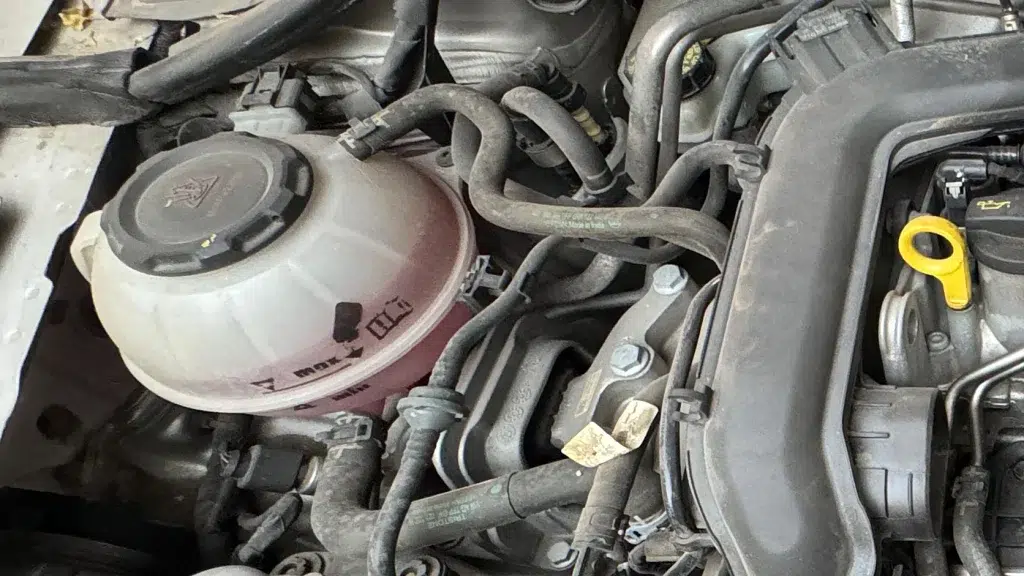
Brown coolant is the exception: VW, Audi and SEAT all put it down to mixed types. VW calls that normal after a G12evo top-up, while a SEAT manual says to change it soon. So if yours has gone brown and you don’t know why, have a garage look.
Can You Mix G12, G13 and G12evo Coolant?
You can mix G12, G13 and G12evo coolant in most combinations, but what goes on top of what matters. Audi publishes a chart for this, and it boils down to six rules:
- G12evo can go on top of any older VW coolant, in any amount.
- G13 and G12++ mix freely with each other.
- G13 can also go on top of G12 or G12+.
- Older coolant on top of G12evo works, but it weakens the corrosion protection.
- Red G12 on top of G13 does the same.
- G11 and red G12 must never be mixed.
What then? Audi’s advice is to change the coolant after a mix, unless it’s G12++ with G13. VW is more relaxed when G12evo goes on top of older coolant, and asks for no drain.
Can You Use G12evo Instead of G13?
You can use G12evo instead of G13 in any VW, and in any Audi except the 2015 A3 2.0 TDI. VW tells its own dealers the same thing.
It doesn’t work as well the other way round. Put older G12 in a car built with G13 and you lose some corrosion protection.
Which is better, G12 or G13? Neither maker ranks them. Each type replaced the one before, and the newest is the one to use.
What Coolant Is Equivalent to G13 and G12evo?
A coolant is equivalent to G13 or G12evo only if its maker names the matching VW standard. Ignore the colour and the word “European” on the front. Look for the code instead: TL 774-J for G13, TL 774-L for G12evo and TL 774-G for G12++.
Here’s how five bottles stack up:
- BASF lists Glysantin G65 as approved to TL 774-L, the G12evo standard.
- Valvoline rates Zerex G40 to TL 774-G, which makes it a G12++ coolant. Audi treats G12++ and G13 as fully compatible.
- Pentosin Pentofrost E lists TL 774-J, the G13 standard.
- Peak and Prestone sell violet “European” coolants for VW and Audi, but neither names a VW standard.
None of these is VW’s own coolant, which matters while your car is under warranty.
Can You Use Prestone or Universal Coolant in a VW?
Volkswagen’s answer on Prestone or universal coolant in a VW is no. If a dealer suspects non-VW coolant in the system, VW’s fix is a drain and refill. And you pay for it, because warranty doesn’t cover that work.
To be fair to Prestone, it sells a violet coolant for 2009 and newer VWs. It says that bottle can top up any violet coolant. But its product page names no VW standard, so that’s Prestone’s word, not VW’s approval.
The one mix that’s banned outright is an old one: green-blue G11 with red G12. Together they form acids and can clog the cooling channels, according to coolant maker febi.
Where Can You Buy VW Coolant?
You can buy genuine VW coolant at any VW or Audi parts counter, from online parts sellers or on Amazon. Take the part number with you, so you get the premix and not the concentrate:
- In the US, ask for part G12E0501GRTU: the one-gallon bottle, premixed 50/50. Older listings call it G12E0501GDSP.
- G12E1001GCON is the one-gallon concentrate, which you dilute before use.
- Two US parts sellers listed the premixed gallon at $25 to $39 on 19 November 2026.
- AutoZone’s VW coolant page lists violet Peak and Prestone bottles instead, at about $21 to $26.
- Walmart lists both brands too, plus Valvoline Zerex G40.
- In the UK, part G12E050A2 is one litre, ready mixed, for about £8 to £9.
If you’re buying oil too, my VW oil type guide lists the right one by model and year.
Concentrate or 50/50 Premix?
Buy the 50/50 premix coolant for a top-up, because it pours straight in with no measuring. Concentrate needs mixing with distilled water first, so one gallon makes two. Use distilled water only, and keep the coolant share between 40% and 60%.
If you keep having to top up, look for a leak before you buy more coolant. A leaking thermostat housing is one of the common 1.5 TSI problems, for example. And if a red coolant light comes on, my Skoda warning lights guide explains what to do.
FAQs
Both, depending on who printed the label. VW and Audi call G12+, G12++, G13 and G12evo purple, while Valvoline calls its G12++ coolant pink or violet. Only the original G12 is red, and G11 is green-blue.
G12evo is Volkswagen’s current coolant, built to its TL 774-L standard. New cars have left the factory with it since model year 2019. It’s now the service replacement for every earlier type as well.
As a genuine VW part in the US, yes: G12evo has replaced it. Other makers still sell coolant built to the G13 standard, such as Pentosin Pentofrost E.
Only with distilled water, and only to get you home. The mix has to stay at 40% coolant or more, and every splash of water thins it. So afterwards, ask a garage to test the strength.
Stop when it’s safe, then switch the engine off. Let it cool fully before you open the tank cap. Then check the level against the marks, top up with the right VW coolant and look for a leak.
Sources
- Volkswagen bulletin 19-17-01 on engine coolants, February 2025 and February 2022, published by NHTSA, the US vehicle safety regulator
- Audi bulletin 2025303 on factory fill coolants, March 2023
- SEAT owner’s manuals: Leon, Mii and Ibiza
- febi G12evo product sheet and MAHLE Technical Messenger 11/2024
- Makers’ data: BASF Glysantin G65, Valvoline Zerex G40, Pentosin Pentofrost E, Peak and Prestone
- Part numbers and prices, 19 November 2026: ShopDAP, STM Tuned, AutoZone, AKS Tuning and Brickwerks
- Skoda’s parts catalogue: G12evo ready mix
Last Updated: November 2026

Founder of TheCarLane | Automotive Enthusiast
Ayush shares practical automotive knowledge based on real-world ownership and hands-on experience. His work focuses on diagnostics, engine systems, common car problems, and clear explanations that help everyday drivers understand their vehicles better.