
This article contains affiliate links. As an Amazon Associate we earn from qualifying purchases, at no extra cost to you.
The Skoda check engine light indicates a fault in the engine, emissions system, or one of the sensors monitoring how your car runs. Your immediate action depends on whether it’s solid or flashing.
If the light is flashing, pull over to a safe area and call recovery. A flashing engine light in any VAG vehicle means you have a severe misfire and you will damage your catalytic converter within 10-15 minutes of driving on. A £40-80 ignition coil issue becomes a £400-900 repair if you carry on.
A solid yellow or amber light means you may drive carefully over short distances, but get the fault diagnosed within one week. The vast majority of solid-light causes are slight: a sensor fault, a loose fuel cap or a small emissions issue.
Now let’s run through exactly what to do next.
What Does The Engine Light Mean On A Skoda?
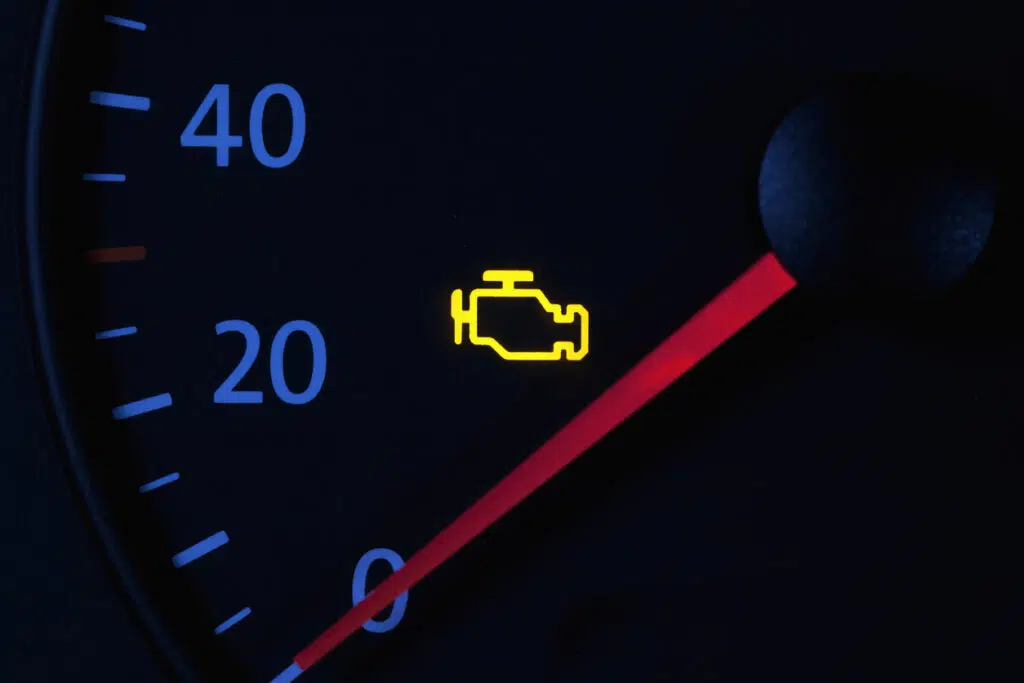
The engine light on a Skoda means the ECU has detected a fault somewhere in the engine, emissions system, or one of the sensors monitoring how the car runs. The light itself doesn’t tell you what’s wrong, it tells you the ECU has stored a fault code pointing to the specific cause. That code could mean anything from a £15 fuel cap to a £400 sensor replacement, which is why scanning the car with an OBD2 reader matters more than guessing at causes.
Most Skoda owners see this light at some point because the engine management system monitors dozens of variables continuously. A sensor drifts out of spec, an emissions component wears slightly, or a connector starts to corrode, any of these triggers the warning long before they affect how the car drives. Catching the issue early through the warning light is genuinely cheaper than waiting for symptoms to appear.
What To Do Right Now (Step-By-Step)
Step 1: Check whether the light is flashing or solid. Look at the dashboard for a few seconds. A flashing light pulses on and off rapidly. A solid light stays constantly illuminated. This single observation determines everything that follows.
Step 2: If solid, turn the engine off and wait 30 seconds. Don’t immediately restart. Give the ECU a moment to clear its current state. After 30 seconds, restart the engine.
Step 3: Watch what happens when the light comes back on. If the light is gone after restart, you’re dealing with an intermittent fault. The code is still stored in the ECU, but the immediate trigger has cleared. Drive carefully and book a diagnostic scan within the week.
If the light returns immediately, the fault is active. You can usually still drive — but only short distances, only without hard acceleration, and only to get the car somewhere safe.
Step 4: Check the obvious before anything else. Did you just refuel? Open your fuel filler cap, listen for a hiss of pressure releasing, then re-tighten it firmly until it clicks 2-3 times. A loose fuel cap is genuinely the single most common Skoda CEL cause across all models, and the fix is free.
I experienced this exact issue on my own Skoda Rapid after a 175km continuous motorway drive, the EPC light came on, but on other VAG vehicles the engine warning light triggers instead, depending on which sensor catches the EVAP pressure irregularity first. Opening the fuel cap, waiting 15 minutes for pressure to equalise, then restarting cleared it completely.
Step 5: If you have an OBD2 scanner, plug it in. The diagnostic port on every Skoda sits under the dashboard on the driver’s side, usually within reach when seated. A basic Bluetooth OBD2 reader with a smartphone app will pull the fault code in under two minutes. Note the code before clearing anything, that code is the most valuable diagnostic information you’ll have.
Can I Drive If The Check Engine Light Is On?
You can usually drive with the check engine light on if it’s solid amber and your Skoda feels completely normal, full power, smooth idle, no unusual smells or sounds. Stop driving immediately if the light is flashing, if you’ve lost significant power, or if you’re in limp mode.
For most solid-light situations, driving carefully to a garage or home is fine, but you should book a diagnostic check within the week. The fault may be minor right now, but it develops into something worse if you ignore it for too long. Drive with more caution if you notice a slightly rough idle, reduced fuel economy, or the light flickering on and off, aim to get it scanned within 24-48 hours rather than waiting a full week.
How long can you drive with the light on? A solid amber check engine light is fine for a single drive of up to a few hours, including motorway journeys, as long as the car feels normal. Driving for 4 hours to get home or to a garage is acceptable. What’s not acceptable is treating ongoing daily driving with the light on as normal, every drive risks aggravating the underlying fault, and small issues become expensive ones when ignored for weeks.
Most Common Causes Of A Skoda Check Engine Light
The check engine light covers a wide range of possible faults, but in practice, a small number of causes account for most cases on Skoda vehicles. Here are the most common ones, ordered by how often they actually occur.
Loose or failing fuel cap. This is genuinely the single most common cause across every Skoda model. The fuel cap seals the EVAP system, which controls fuel vapour. When it’s loose or worn, vapour escapes, and the system flags an emissions fault. Open the cap, re-tighten until you hear 2-3 clicks, then drive for a day or two, the light often clears itself once the system confirms the seal. Fault codes: P0455, P0456, P0457.
Oxygen sensor failure. Every Skoda has at least two oxygen sensors (also called lambda sensors) monitoring exhaust gases. They wear out gradually and typically fail between 60,000 and 100,000 miles. A failed oxygen sensor doesn’t usually affect how the car drives, but the ECU flags it because it can’t properly adjust the fuel mixture. Fault codes: P0130-P0140 range.
Ignition coil failure. Particularly common on the 1.0 TSI and 1.4 TSI petrol engines after 50,000-80,000 km. Coils age unevenly, so one usually fails first, triggering a misfire on that specific cylinder. The check engine light comes on, and you may feel a slight roughness at idle. Fault codes: P0301, P0302, P0303, P0304 (the last digit indicates which cylinder).
Throttle body carbon buildup. Petrol engines accumulate carbon on the throttle body over time, which affects how accurately it responds to inputs. The ECU notices the mismatch and triggers the light. A cleaning followed by a throttle adaptation usually fixes it without needing replacement. Most common on 1.0 TSI and 1.4 TSI engines after 60,000-80,000 km. Fault codes: P0507, P2015, P2101.
EGR valve issues. Common on Skoda diesel engines, particularly the 1.6 TDI and 2.0 TDI. The EGR valve clogs with carbon deposits over time, restricting exhaust gas recirculation. Cleaning often resolves it; replacement is needed in worse cases. Fault codes: P0401, P0402.
DPF (diesel particulate filter) problems. Almost exclusively a diesel Skoda issue. The DPF needs regular regenerations to burn off accumulated soot. Short-trip driving prevents complete regenerations, and the filter eventually clogs. Fault codes: P244A, P244B, P2002. For further information, TheCarLane has covered a detailed guide on DPF which you can read.
MAF (mass airflow) sensor contamination. The MAF sensor measures incoming air to the engine. It gets contaminated by oil mist, dust, or water spray (especially after driving through deep puddles). Once contaminated, it sends incorrect readings, and the ECU flags it. Fault codes: P0101, P0102, P0103.
Coolant temperature sensor failure. Affects how the ECU manages fuel mixture during warm-up. Common in UK winters when temperature swings stress older sensors. Fault codes: P0117, P0118.
Glow plug failure (diesel only). Glow plugs heat the cylinders for cold starts on diesel engines. They wear out gradually, and a single failed plug can trigger the light. Common on Skoda diesels after 70,000-100,000 km. Fault codes: P0670, P0671-P0674.
Catalytic converter wear. Older Skodas (100,000+ km) sometimes show catalyst efficiency codes as the cat ages and loses effectiveness. This is often misdiagnosed, a P0420 code usually means the upstream sensor or an exhaust leak, not actually a failing catalytic converter. Fault codes: P0420, P0430.
Timing chain stretch (chain-driven petrols). The 1.2 TSI and 1.4 TSI built up to about 2014 (Fabia Mk2 and vRS, Octavia Mk2, Yeti, Rapid before the 2015 facelift) drive the camshaft by a chain whose tensioner wears. The light comes with a rattle for a few seconds on a cold start, and it is the one petrol cause on this list that gets expensive if ignored: a chain kit is £600–1,200, a jumped chain is a cylinder head. Fault code: P0016.
AdBlue/SCR system faults (modern diesel only). Skoda diesels from 2015 onward use AdBlue (a urea solution) to reduce emissions. Sensors, pumps, and the AdBlue tank itself can develop faults that trigger the engine light. Fault codes: P20E8, P20BA, P204F.
Vacuum leaks. Small cracks in vacuum hoses or split intake boots affect how much air enters the engine. The ECU notices the mixture is off and flags it. Common on higher-mileage cars where rubber hoses have aged.
EVAP system faults beyond the fuel cap. Even with a tight fuel cap, the EVAP system has valves and hoses that can develop leaks over time. Less common than the fuel cap itself, but worth checking if the fuel cap fix hasn’t worked.
The fastest way to identify which one applies to your car is to read the fault code with an OBD2 scanner, which the next section walks through.
By Skoda Model – What’s Most Likely
Different Skoda models have different common CEL patterns based on their engines and known weaknesses. Here’s what UK owners report most often by model.
Skoda Octavia (Mk3 2013-2020, Mk4 2020-present)
1.0 TSI petrol (95/110 PS): Most common CEL causes are ignition coil failure (especially cylinder 1), carbon buildup on the throttle body after 60-80k km, and intake manifold faults on early builds. Specific codes: P0300, P0301-P0304 (misfires), P2015 (intake manifold runner position). The engine’s full fault list, turbo actuator, coolant housing, intake-valve carbon, coils and oil use, with the mileage each one turns up at, is in the 1.0 TSI problems guide.
1.5 TSI petrol (130/150 PS): This engine has a known issue with hesitation, kangarooing, and engine stuttering at low loads. The CEL often appears alongside these driveability complaints. The cause is usually software-related, and updated maps from Skoda have been rolled out. If you have an Mk4 Octavia 1.5 TSI with these symptoms, check whether your dealer has applied the latest software update.
1.6 TDI diesel: EGR valve carbon buildup is the leading cause. The DPF (diesel particulate filter) issues come second, usually due to incomplete regenerations from short-trip driving. Specific codes: P0401 (EGR insufficient flow), P244A/P244B (DPF differential pressure), P20E8 (reductant pressure too low).
2.0 TDI diesel: Similar to 1.6 TDI but with additional injector issues at higher mileages. AdBlue (SCR) faults are also common, specific codes start with P20xx.
Skoda Fabia (Mk3 2014-2021, Mk4 2021-present)
1.0 MPI petrol (60/75 PS): Older naturally aspirated engine. CEL most commonly relates to oxygen sensor failure, MAF sensor contamination, or coil-on-plug issues. Specific codes: P0130-P0140 series (O2 sensor), P0101 (MAF).
1.0 TSI petrol (95/110 PS, Mk3 late and Mk4): Same engine family as Octavia 1.0 TSI. Similar failure patterns, ignition coils, throttle body, occasional turbo wastegate issues at higher mileages.
1.4 TDI diesel (Mk3 only): Glow plug failures and EGR issues are common. This engine isn’t sold in Mk4.
Skoda Karoq (2018-present)
Karoq uses the same engines as Octavia, so CEL patterns are similar. The two most common causes UK Karoq owners report are throttle body carbon buildup on the 1.5 TSI and DPF regeneration faults on the 2.0 TDI.
Skoda Kodiaq (2017-present)
2.0 TSI petrol: Less common in UK market. CEL usually relates to ignition coils or throttle body.
2.0 TDI diesel (most common UK variant): DPF and AdBlue issues dominate. Glow plug controller failures appear at 70-100k km. Specific codes: P064D (glow plug controller), P20BA (reductant heater performance).
Skoda Superb (Mk3 2015-present)
1.5 TSI / 2.0 TSI petrol: Similar pattern to Octavia equivalents.
2.0 TDI diesel: Most common Superb engine in UK. Common CEL causes are DPF, EGR, and at higher mileages, the high-pressure fuel pump.
Skoda Yeti (2009-2017)
Now older vehicles, so wear-related causes dominate. Throttle body, MAF sensor, lambda sensors, and EGR valve issues account for most CEL triggers.
Skoda Rapid (2012-2019)
1.0 TSI / 1.2 TSI petrol: Same engine family patterns as Fabia and Octavia equivalents — ignition coils, throttle body, EVAP system. I scan my own Rapid preventively every few months with a Vgate iCar Pro, which catches stored codes before they trigger the CEL.
1.6 TDI diesel: EGR and DPF issues at higher mileages.
Skoda Scala (2019-present)
Uses 1.0 TSI and 1.5 TSI engines. CEL patterns mirror Fabia and Octavia equivalents.
How To Read Your Skoda’s Fault Codes Yourself
The single most useful diagnostic step you can take before any garage visit costs £25-35 once and saves you money every time you avoid a diagnostic fee.
What you need:
- A Bluetooth OBD2 adapter – I use the Vgate iCar Pro BLE 4.0, it is the best price-to-functionality for VAG vehicles. Here’s my honest review if you want the detail.
- A smartphone app – Car Scanner Pro is the most capable for VAG-specific codes
The process on any Skoda:
- Locate the OBD2 port. On Skoda models, it sits under the dashboard on the driver’s side, usually just above the pedal area. Some models have a small cover that flips down.
- Plug in the adapter with the ignition off.
- Turn the ignition on without starting the engine (key position II, or push the start button without pressing the brake on push-button models).
- Open Car Scanner on your phone and connect to the adapter via Bluetooth.
- Select your vehicle (Car Scanner has Skoda-specific profiles that unlock VAG manufacturer codes).
- Read fault codes. Note every code, including pending and history codes.
- Don’t clear them yet — let your mechanic see them if you’re going to a garage.
A scan typically takes 5-10 minutes for the full check. On my own Rapid, a full 195-code scan across all modules (engine, transmission, ABS, airbag, instrument cluster, etc.) takes 10-12 minutes.
How Do I Reset The Engine Light On My Skoda?
To reset the engine light on your Skoda, connect an OBD2 scanner to the diagnostic port, read and note the fault codes first, select clear codes in your scanner app. The light goes off immediately, but this only works in the long term if you have actually fixed the underlying fault.
If you reset without fixing the cause, the light returns within one or two drive cycles. Battery disconnection turns the light off temporarily but doesn’t fix anything, and on some models it can reset the throttle body adaptation. The proper sequence: read the code, fix the fault, clear the code, then drive a 30-50 mile mix of city and motorway driving so the ECU’s readiness monitors complete.
How Do I Fix The Skoda Check Engine Light?
The fix depends entirely on the fault code, which is why scanning the car first matters. Simple fixes are genuinely DIY, fuel caps, ignition coils, throttle body cleaning. Complex fixes, DPF servicing, EGR replacement, oxygen sensors, AdBlue system faults, ECU issues, need a specialist with VAG-specific diagnostic equipment.
For specific costs and which fix applies to your fault code, see the most common causes section above. For deciding between DIY, an independent specialist, and main dealer service, see the section below.
How Much Does It Cost To Fix A Skoda Check Engine Light?
UK repair costs vary by garage type, region, and whether you use OEM or aftermarket parts. These ranges reflect common UK owner reports, always get a quote before authorising work.
| Fault / Repair | UK Cost Range |
|---|---|
| Loose fuel cap (re-tighten) | Free |
| Fuel cap replacement | £15–25 |
| OBD2 diagnostic (independent) | £30–60 |
| OBD2 diagnostic (main dealer) | £80–150 |
| Ignition coil replacement (per coil) | £40–80 |
| Throttle body cleaning | £50–120 |
| Throttle body replacement | £200–500 |
| MAF sensor replacement | £80–200 |
| Oxygen sensor replacement (per sensor) | £80–200 |
| EGR valve cleaning | £100–200 |
| EGR valve replacement | £300–600 |
| DPF cleaning / forced regeneration | £150–400 |
| DPF replacement | £600–1,500 |
| Catalytic converter replacement | £400–900 |
| AdBlue / SCR system repairs | £200–1,200 |
Will An Engine Warning Light Fail My Skoda’s MOT?
Yes. An active engine warning light at the time of MOT testing typically fails under section 8.2 (emissions) for petrol engines, and under both section 4.10 (electrical) and section 8.2 for diesels, particularly if it relates to the DPF.
If your MOT is due soon, get the fault diagnosed and resolved before the test rather than hoping it’ll pass. A cleared light passes normally, but the ECU’s readiness monitors need to have completed since the last code clear — drive at least 30-50 miles after fixing the fault before booking the MOT.
When To Use A Skoda Dealer Or Independent Specialist
Skoda main dealer: Highest pricing, mandatory if your car is under warranty. Useful for warranty work, software updates, and recall campaigns.
Independent VAG specialist: Best value for out-of-warranty work. Look for VAG-specific specialists rather than general independents, they have ODIS or comparable diagnostic equipment and know the platform deeply. Typically 40-50% cheaper than main dealers.
General independent garage: Usually the cheapest option but with risk. Many don’t have VAG-specific diagnostic equipment and end up sending your car elsewhere for diagnostics. Best for simple mechanical work, not CEL diagnosis.
DIY: Sensible for fault code reading, ignition coil replacement, fuel cap replacement, and throttle body cleaning. A £25-35 OBD2 scanner pays for itself the first time you avoid a £60 diagnostic fee.
FAQs
The Skoda engine light indicates a fault in the engine, emissions system, or one of the sensors monitoring how the car runs. A solid amber light means a non-critical fault needing diagnosis within a week. A flashing light means a serious problem, usually a misfire, requiring immediate attention.
You can usually drive short distances if the light is solid amber and your Skoda feels normal. Stop driving immediately if it’s flashing or you’ve lost power. Solid-light situations need a diagnostic check within the week, not the same day.
You can drive 4 hours with a solid amber light if your Skoda feels completely normal throughout, but don’t make it ongoing daily driving with the light on. Stop and arrange recovery if the light is flashing or the car loses power, regardless of how far you still need to go.
The underlying fault hasn’t been properly fixed, clearing the code only resets the warning, not the issue. Common reasons include an unfixed sensor, an intermittently failing component, or a fault that needs VAG-specific diagnostic equipment to identify. If the same code returns after each reset, address that specific component.
If the light never illuminates during the ignition self-check, the bulb or warning system itself has failed and needs inspection. If the light is stuck on and won’t clear, the underlying fault hasn’t been fixed or the ECU’s readiness monitors haven’t completed since the reset.
Last Updated: May 2026

Founder of TheCarLane | Automotive Enthusiast
Ayush shares practical automotive knowledge based on real-world ownership and hands-on experience. His work focuses on diagnostics, engine systems, common car problems, and clear explanations that help everyday drivers understand their vehicles better.