

The battery warning light on your dashboard means your alternator has stopped charging the battery, not that the battery is dead. Your car is running on stored charge and will keep going for roughly 20 to 60 minutes. A steady light means the charging has failed: turn off what you don’t need, drive somewhere safe, and don’t switch the engine off until you’re parked, because it may not restart. A flashing light means the same fault is starting: you have more time, but book it in this week, while it’s still the cheap repair. And in either case, if the steering suddenly goes heavy or the temperature starts climbing, the belt has likely snapped: that’s the one situation where you pull over right now.
What the Battery Warning Light Actually Means

The battery light is really a charging system light. Here’s the simple version of how that works.
Your battery only starts the car. Once the engine is running, the alternator takes over: it powers everything and recharges the battery at the same time. The light comes on when the alternator stops doing that job properly. So from the moment you see it, the car is living off the battery’s stored charge, and nothing is refilling it.
That’s why the car drives normally at first. There’s still charge in the battery, and the car will happily use it. The light means a countdown has started, not that it’s finished.
The battery symbol on your dashboard is a red rectangle with a plus and minus sign, styled after an old-fashioned battery. People describe it as the battery icon, the battery sign, or just the red battery light on the dash: it’s all the same lamp.
One note for hybrid drivers: the hybrid battery warning light is a separate warning for the high-voltage pack. This guide covers the red 12-volt charging light that every car, hybrid or not, has.
Flashing vs Steady Battery Warning Light: What Each One Means
A steady light means the alternator has stopped charging. A flashing light means the fault is coming and going. Steady is more urgent. Flashing is cheaper, if you act on it.
Steady light while driving. The car relies solely on the battery for power. There is around 20 to 60 minutes left in which you can turn off any unnecessary accessories, drive to somewhere safe, and get the problem checked out immediately.
Flashing/blinking light. The charging process starts and stops repeatedly. Most likely caused by loose connections, worn belt, or alternator going bad. You have some time left, but the problem is only getting worse. Fixing it now might be cheap, compared to later. With a start-stop vehicle, see the smart alternator section below first.
On at idle, off when you rev. The battery indicator light coming on at idle and off when you rev means thealternator still works, but barely. Cold weather will finish it. Book it in now, while it’s a planned repair instead of a roadside one.
Can You Keep Driving With the Battery Light On?
Yes, for a while. A healthy battery gives you roughly 20 to 60 minutes of driving once the alternator stops charging. What decides where you land in that range is electrical load: lights, wipers, heater and heated screens all shorten it, and an ageing battery shortens it further. Treat 20 minutes as your planning number and anything beyond it as a bonus.
Here’s what to do:
- Turn off everything you don’t need. Heated seats, heated rear window, air con, the stereo. All of it is draining the same charge that keeps the engine running. If it’s dark, keep your lights on. Being seen matters more than saving battery.
- Drive somewhere sensible, not somewhere perfect. Home if it’s close. A garage if one is on the way. A safe car park if not. Don’t try to finish a long trip with this light on.
- Do not switch the engine off until you’re parked where you want to be. This is the bit nobody tells you. Starting the engine takes more battery power than anything else the car does. A car running fine on its last bit of charge can easily refuse to start again after a two-minute fuel stop.
When the charge gets properly low, the car warns you itself. The dash dims, the stereo cuts out, random warning lights appear. That’s your final warning. Park.
When to Stop Immediately
There’s one version of this that changes everything, and you can spot it in seconds.
The alternator is driven by a belt, and on many cars that same belt also drives the water pump, and on older cars the power steering pump too. If that belt snaps, you lose all of them at once. So the thing to watch for is the combination: battery light, plus steering that suddenly feels heavy, plus the temperature gauge climbing. If your car has electric power steering, the heavy steering clue won’t show, so watch for the battery light and rising temperature together. A burning rubber smell often comes with it.
If you get that combination, pull over and switch off. Don’t push on. An engine without its water pump overheats in minutes, and the belt that caused it costs almost nothing compared to the engine it can wreck. Call recovery.
If it’s just the battery light and everything else feels normal, you’re in the calmer situation above. Switch things off and drive to safety.
Safe Checks You Can Do Yourself First
Before you book anything, three quick observations will tell you and your garage a lot. None of them need tools.
First, check what else lit up. The battery light on its own points at the charging system. The battery light plus the check engine light, or several random warnings flickering together, usually means the whole car is running on low voltage. Still a charging problem, but it tells the garage it’s been developing for a while. Second, think about what happened recently. A jump start last week, a new battery fitted recently, or slow cranking on cold mornings all point the diagnosis in different directions. There’s a full section below for the new-battery situation, because it has its own explanation. Third, with the engine off and cold, open the bonnet and look at the battery terminals. White or greenish crust on the clamps is corrosion, and corrosion on its own can cause this light. While you’re in there, look at the belt. Cracks, fraying, or anything loose is worth mentioning.
That’s where DIY inspection ends. Actual electrical testing needs a multimeter or a scanner, and that’s the next part, because it’s the bit most guides skip completely.
What Causes the Battery Warning Light
Six causes cover almost every case, listed with the one almost nobody mentions first:
An unregistered new battery. Start-stop cars only. If the trouble started right after a battery change, this is the first suspect, and almost nobody mentions it. Full explanation in the registration section below.
A failing alternator. The most frequent cause by far. It usually struggles at idle first, so the light appears at junctions and clears on the move, and the headlights dim while you wait. Some fail with a whine or grinding from the front of the engine, others go quietly.
A worn or snapped belt. A worn one squeals on cold starts or at full steering lock, long before it lets go. A snapped one is the pull-over emergency covered earlier: heavy steering and a climbing temperature gauge.
Corroded or loose battery terminals. White or green crust on the clamps interrupts charging on its own, and a light that flickers over bumps often traces back here. The cheapest fix on this list.
The battery itself. Less common than people assume, but one failing internally can drag the system voltage down despite a healthy alternator. Slow cranking over recent weeks is the giveaway, and it’s why garages test rather than guess.
A faulty voltage regulator. The reverse problem: too much charge instead of too little. Unusually bright dash lights, bulbs blowing early, and a reading above 15 volts point here. On most cars the fix comes bundled with the alternator.
The Voltage Numbers That Tell You What’s Wrong
This light is triggered by voltage, so the quickest way to know what’s really happening is to look at the voltage yourself. Two ways to do it: a £10 multimeter on the battery terminals, or even easier, a cheap OBD2 adapter that shows battery voltage live on your phone. If your car doesn’t list a battery voltage sensor in the app, look for “Adapter voltage” in Car Scanner instead. The adapter measures it at the OBD port itself, which is wired straight to the battery. If you’ve never used one, my guide to scanning your car with an OBD2 adapter shows the whole process with screenshots.
Here’s what the numbers mean:
| Reading | When | What it means |
|---|---|---|
| 12.4–12.8 V | Engine off | Healthy, charged battery |
| Below 12.2 V | Engine off | Battery discharged or getting old |
| 13.8–14.4 V | Engine running | Alternator charging normally |
| Below ~13 V | Engine running | Alternator not charging properly. This is battery-light territory |
| Above ~15 V | Engine running | Overcharging, usually a faulty voltage regulator. Also triggers the light |
On my own Skoda Rapid, the system voltage at idle reads just over 14 volts, which is exactly where a healthy charging system should sit, and your car should be close to it too, give or take a few tenths.
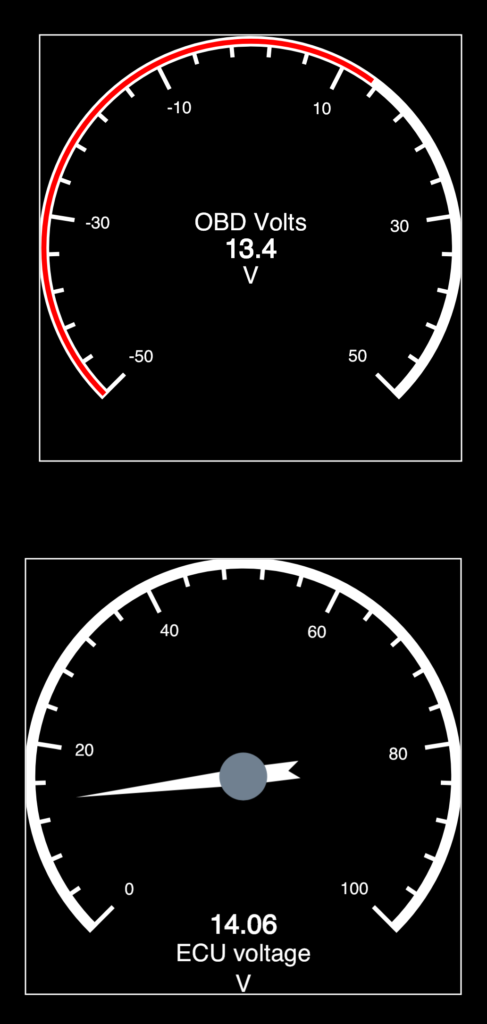
My Rapid at idle: the ECU reports 14.06 V, the adapter reads 13.4 V at the port. Both say the same thing: charging normally
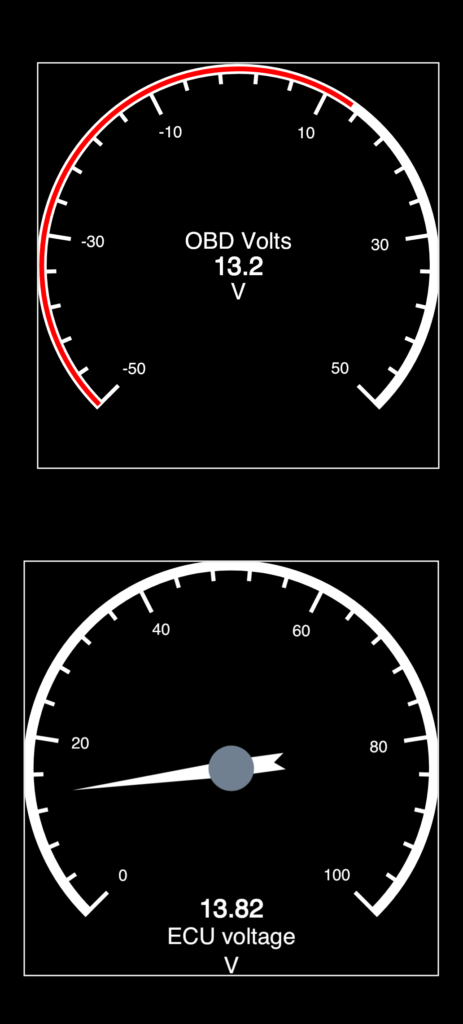
Headlights, blower and demister on: still 13.8 V. A healthy alternator holds the band under load; a failing one is dragged into the 12s
Start-Stop Cars and Battery Registration
If your car is from the last ten years or so and has start-stop, two things work differently.
First, modern alternators don’t hold a steady voltage on purpose. To save fuel, they charge hard when you slow down and back off when you accelerate. So on a recent VW, Skoda, BMW or most other modern cars, it’s normal to see the voltage move around between roughly 12.5 and 15 volts as you drive. One low reading on its own doesn’t condemn the alternator the way it would on an older car. The light is still the thing that matters: the car’s battery management system knows its own charging plan, and if it puts the warning on, it has seen something genuinely wrong.
Second, and this is the one that catches people out: on most start-stop cars, a new battery has to be registered to the car. The car tracks how old and how worn its battery is, and charges it accordingly. Fit a new battery without telling the car, and it carries on charging as if the tired old one were still in there. The results will sound familiar if you’ve ever searched this in frustration: start-stop stops working, odd electrical faults appear, the new battery wears out early, and sometimes warning lights show up on a car you just spent money on.
On Volkswagen Group cars this is a battery adaptation done with a proper diagnostic tool. On BMWs it’s called battery registration, and it matters even more because of the battery sensor on the negative terminal. The job itself takes five minutes with the right tool, and it’s exactly the kind of thing a basic code reader can’t do.
One more trap in the same area: start-stop cars need the right battery type, not just the right size. They use AGM or EFB batteries, and yes, they cost more. Fitting a cheaper standard battery to a start-stop car saves money once and costs money every year after.
Battery Light Still On After Replacing the Battery or Alternator?
The new part isn’t talking to the car, or the car isn’t talking to it. On a start-stop car, an unregistered battery is suspect number one, exactly as covered above. On the alternator side, modern alternators are connected to the engine computer through a small sense wire. If that wire is damaged, corroded, or simply wasn’t clicked back in during the swap, you get a brand new alternator and a battery light at the same time.
A reconditioned alternator that was faulty out of the box. This happens more than you’d think. A lot of replacement alternators are remanufactured units, and some of them are dead on arrival. If your light appeared right after an alternator change, get the output tested before blaming anything else.
Grounds and connections. A corroded earth strap, or a battery clamp that’s hand-tight instead of properly tight, creates resistance that the charging system reads as a fault. Free to check, free to fix.
A blown fuse in the charging circuit. An alternator that failed badly can blow a fuse on its way out. The new alternator then works perfectly into a circuit that’s dead.
If you’ve already paid for parts and the light is still on, don’t agree to more parts. Ask the garage to test the charging voltage at the battery, check the sense wire, and confirm the battery is registered if your car needs it. That conversation costs nothing and it has saved people from paying for a third alternator that was never the problem.
How to Fix the Battery Warning Light (and Why You Can’t Just Reset It)
There’s no reset for this light. It isn’t triggered by a stored code a scanner can clear; it watches your charging voltage live, so it switches off on its own the moment the system charges properly again, and not before. Clear a stored P0562 without fixing anything and the light comes straight back.
The fix is whichever cause the voltage test above pointed to: terminals, belt, alternator, or the right battery registered properly. Repair it, start the engine, and if you’re seeing 13.8 to 14.4 volts, the light is already out.
OBD2 Fault Codes Linked to the Battery Light
You don’t need a scanner to understand this light, but the car often stores voltage codes alongside it, and they’re useful backup.
| Code | Meaning | What it usually points to |
|---|---|---|
| P0562 | System voltage low | Alternator not charging, weak battery, poor connections |
| P0563 | System voltage high | Overcharging, faulty voltage regulator |
| P0620 | Generator control circuit | Wiring or control fault between ECU and alternator |
| P0621 | Generator lamp L control circuit | The warning light circuit itself |
| P0622 | Generator field F control circuit | Alternator internal control fault |
One honest note about all of these: they confirm the car saw a voltage problem. They don’t name the broken part. P0562 with a solid battery light and 12.3 volts at idle usually ends up being the alternator, but the voltage test is the proof, not the code.
Battery Warning Light Repair Costs: UK, US and India
Prices below are typical fitted ranges gathered from retailers like Halfords, AutoZone and Amaron dealers in mid-2026. Treat them as planning figures, not quotes: your exact price depends on your car’s battery size, your location, and the day’s offers, so always check the current figure before committing.
| Fix | UK (typical, fitted) | US (typical, fitted) | India (typical, fitted) |
|---|---|---|---|
| Terminals cleaned, connections sorted | £0–40 | $0–50 | ₹0–500 |
| Serpentine belt replacement | £60–150 | $100–250 | ₹1,500–4,000 |
| Standard battery | £70–150 | $100–180 | ₹3,500–8,000 |
| AGM/EFB battery for start-stop, incl. registration | £160–230 | $150–280 | ₹10,000–20,000 |
| Alternator replacement | £250–500 | $350–800 | ₹8,000–20,000 |
Two things to ask before you say yes to a quote. If it’s an alternator, ask whether it’s new or reconditioned, and what warranty it carries. And if your car has start-stop, make sure the battery quote is for the correct AGM or EFB type and includes the registration step. The £90 bargain battery that’s the wrong type ends up being the most expensive battery you ever buy.
Is the Battery Warning Light an MOT Failure?
No, not by itself. The battery light isn’t one of the warning lamps an MOT tester checks, so the symbol being on won’t directly fail the test the way an engine management or ABS light does. It can still cost you a pass through the side doors, though: the battery itself must be secure and not leaking, and if the charging fault behind the light has dropped the system voltage far enough, other checked systems can misbehave during the test.
The sensible order is the same as with any warning light: fix the cause before the test rather than gambling on the tester’s checklist. If a garage is doing the MOT anyway, just ask them to look at the charging system first. That conversation is free. A recorded fail sits on your car’s history for good.
FAQs
Usually 20 minutes to an hour on a healthy battery. Less with lights, wipers and heating running, and less again if the battery is old. Drive somewhere safe and sensible, and don’t switch the engine off until you’re parked where you want to be.
Sometimes, yes. A battery failing internally can drag the voltage down even with a good alternator, and a battery drained flat by short trips can do the same until it recovers. It’s less common than an alternator or belt fault. Testing both takes minutes, guessing costs money.
Give it one proper drive first. After a jump, the alternator works hard to refill a flat battery and the voltage can look odd for a while. If the light is still on after that first decent drive, get the charging system tested, because flat batteries and failing alternators often go together.
Cold weather cuts a battery’s capacity and makes the engine harder to turn over, so winter exposes weak batteries and tired alternators that summer was covering for. It’s the same reason cars struggle to start on cold mornings. If the light comes with slow cranking, sort it before the first cold snap, not after the morning the car won’t start at all.
No. Audis, VWs and plenty of others show a separate message when the battery inside your key fob runs low. That’s a £2 coin cell and a two-minute fix. Nothing to do with the red charging light this guide is about.
Disconnecting the battery wipes the ECU’s learned values and readiness monitors, so some cars show a check engine light or run rough for a few drives afterwards while everything relearns. Give it two or three normal journeys. If the light is still on after that, scan it, because a real code may be hiding behind the coincidence.
Last Updated: August 2026

Founder of TheCarLane | Automotive Enthusiast
Ayush shares practical automotive knowledge based on real-world ownership and hands-on experience. His work focuses on diagnostics, engine systems, common car problems, and clear explanations that help everyday drivers understand their vehicles better.