

DPF regeneration is the process where your diesel heats its exhaust filter and burns off the trapped soot, turning it into a small amount of ash. It happens automatically every few hundred miles, usually while you drive, and most owners never notice.
You only notice it when something feels off. A light keeps coming back, the car sounds different when you park, or a garage says it’s fine and you’re not convinced.
This guide covers how often is normal, how to tell what your car is doing, and what it costs when it won’t finish. It applies to any diesel, and the readings you’ll see come from my own, a BMW X5 at 84,561 km.
Quick Answers
How often is normal?
Every 250 to 600 miles on most diesels. Town cars sit at the busy end.
How do I know it’s happening?
Faster idle, stop-start stops working, hot smell, fans running after you park. No car has a light for it.
What should I do?
Keep driving 10 to 15 minutes at a steady speed. Don’t switch off if you can help it.
How long does it take?
10 to 25 minutes on the move. 30 to 60 minutes if a garage forces one.
Every drive is a regen. Normal?
No. That’s a fault worth chasing, and driving more won’t fix it.
What does it cost?
Nothing when the car does it. ₹3,000 to ₹8,000, £80 to £150 or $200 to $600 if a garage forces one.
Can I sort it myself?
If the light is off, yes, one long drive. If the light is on, you need a tool or a garage.
Is it Normal For My DPF to Regenerate This Often?
Most diesels run a regeneration somewhere between every 250 and 600 miles. If you mostly do town driving, expect the busy end of that. If you commute on motorways, you might go a thousand miles and never notice one.
Manufacturers set their own triggers, and few publish them. BMW is one that does, and its service documentation matches that range: a regeneration at the latest every 600 miles, and after only 250 to 500 miles on cars that mostly do short trips. Treat it as a good guide for any diesel, because the physics behind it is the same on all of them.
So a regen every week or two on a town-driven car is normal. Annoying, but normal.
Here’s what isn’t normal. A regeneration on almost every drive. A warning light that returns within days of being cleared. Regens that start and never seem to finish. Any of those means something is wrong, and driving more won’t fix it.
That distinction matters because plenty of owners get told “it’s normal” and are left with no way to check. So check it yourself. The soot reading further down takes fifteen minutes and costs about ₹2,000 in kit.
How Long Does a DPF Regeneration Take?
Ten to twenty-five minutes of driving for a normal one. It varies with how much soot is sitting there, your speed, and the weather, so don’t worry if yours runs a bit shorter or longer.
A forced regeneration at a garage takes longer, usually 30 to 60 minutes, because it’s burning a bigger backlog while the car sits still.
The mistake people make is stopping at fifteen minutes and assuming it finished. If the idle is still high and stop-start still isn’t working, it didn’t.
How Do I know if My DPF is Regenerating?
No manufacturer fits a light that says “regenerating now.” Some cars show a message, most tell you nothing. So you go by feel.
Signs your car is doing one:
- The engine idles faster than usual when you’re stopped
- Stop-start refuses to switch the engine off at lights
- A hot, sharp smell, strongest when you get out
- The cooling fans keep running after you park
- Fuel consumption climbs for that trip
- The engine note changes slightly
None of these mean something is broken. They’re the car working.
There is one way to know for certain. Many diesels report regeneration status as live data, and a cheap OBD2 adapter can read it. Names differ between cars and apps, so look for anything with “regen” or “particulate filter” in it. On mine it reads 0 for nothing happening, 1 for passive, 2 for active. Other cars show a simple yes or no.
If your car doesn’t offer it, you’re back to the signs above, and they’re reliable enough once you know them.
Why Does My DPF Regenerate So Often?
Four reasons, in the order they’re worth checking.
Short trips. The most common cause by far. Your exhaust never gets hot enough to clean itself on the move, so the car has to force the job. Check your own average speed, which most cars show in the trip computer. Mine reads 23.1 km/h over 8,124 km, which is pure city driving, and a car used like that regenerates far more often than a motorway car.
A clogged EGR valve. A fouled EGR valve pushes more soot into the filter, so it fills faster, and on a VW-group diesel it usually announces itself as P0401. Cleaning it fixes the cause instead of the symptom. On a 2.0 TDI, stuck swirl flaps do the same damage; the code is P2015, the fix is a bracket, and the filter keeps refilling until the flaps move again.
A faulty pressure sensor. The car measures filter blockage with a differential pressure sensor. When that sensor or its pipes go bad, the car sees a full filter that isn’t. You get regens you don’t need. This is a common and often cheap fix, and it’s why a scan beats guessing.
Failed regens stacking up. Every regeneration that gets cut short leaves its soot behind. Do enough short trips and the car is always behind, always trying again.
If your car regenerates on nearly every drive, it’s one of the last three. Get it scanned before you spend money on anything.
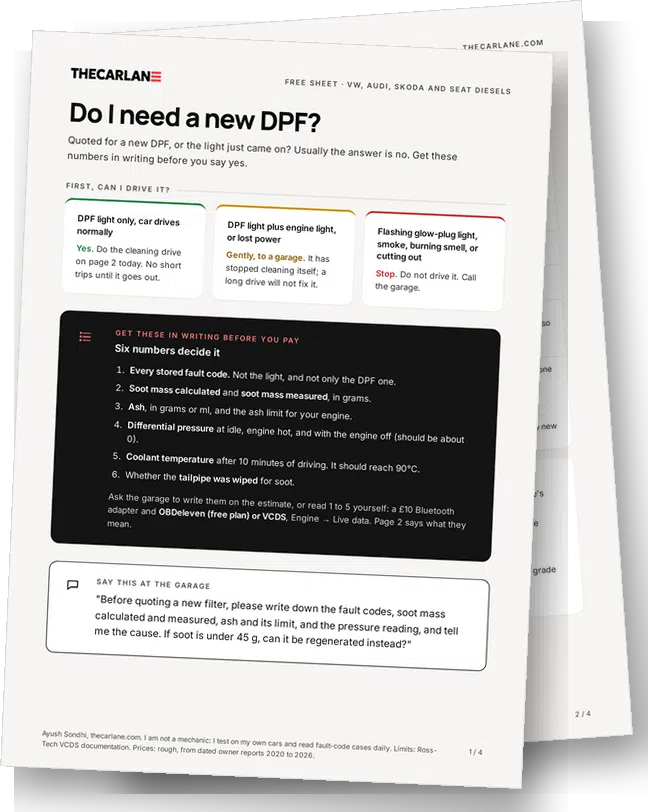
Free sheet · 4 pages · VW, Audi, Skoda, SEAT diesels
Light keeps coming back? Six numbers decide if it’s a £150 regen or a £2,000 filter
Most lights mean “regen needed”, not “filter finished”. The sheet gives you the six numbers to ask for, what they mean, and what each fix should cost.
No spam. One email with the sheet, then nothing unless you reply.
What Happens if a Regeneration Keeps Getting Interrupted
One interrupted regen is nothing. The car parks the job and picks it up on your next drive.
The damage is in the pattern. Soot from every failed attempt carries over, the filter fills, and eventually you get a warning light instead of a quiet background process.
There’s a second cost people miss. Active regeneration works by injecting extra fuel, and some of that fuel can end up in your engine oil. On cars that fail regens constantly, the oil level slowly rises.
If your dipstick reads higher than it did at the last service, treat it as a warning, not a bonus. Some cars mark a maximum level on the dipstick for exactly this reason.
There’s one more thing worth knowing, and it’s the bit that frightens people. A properly blocked filter chokes the exhaust, and the car will eventually cut its own power to protect itself. That’s limp mode: no revs, no speed, usually a light on the dash.
It isn’t a breakdown and nothing has snapped. The car is telling you the filter has gone past the point where driving fixes it, and it needs a garage now rather than next month.
The fault codes this pattern leaves behind
Scan the car at this stage and the codes tell you exactly where you are on that slope. P2458 comes first. It means regenerations are running too long or aborting too often, and it is the early warning. Ignore it and soot keeps climbing until you hit P2463, which means the load has passed the ECU’s limit. That is the code that decides whether a drive can still fix this, and your soot percentage decides which way it goes. If the filter itself has degraded and no longer traps soot efficiently, you get P2002 instead, which is rarely the dead filter it sounds like. Read the code, then read your soot level. Those two numbers tell you more than the warning light ever will.
Can I Fix a Blocked DPF Myself?
You can’t push a button. In a car, the engine computer decides. What you can do is give it the conditions it needs, and they’re the same on every diesel.
Take a 20 to 30 minute drive on a main road or motorway. Anything above 40 mph works, 60 to 70 mph is ideal. Keep the engine working rather than coasting.
In a manual, stay a gear lower than usual to keep the revs and exhaust temperature up. Automatics do the same job in sport or manual mode, holding a lower gear. With neither, a steady 60 mph in top gear still works.
Two things stop a regeneration before it starts: a cold engine and low fuel. Many cars refuse to begin one below about a quarter tank. Warm the car up first, then drive.
Revving in the driveway does nothing. A parked engine has no load, so the exhaust never reaches the temperature the burn needs. The car has to be moving.
If you’ve got the adapter from the soot check further down plugged in, you can watch it work. The status flips from 0, the exhaust temperature climbs toward 600°C, and the soot number starts falling. The first time you see that happen on your own screen, the DPF stops being a mystery.
If you notice the signs mid-drive, just carry on for another 10 to 15 minutes. Main roads beat traffic. Steady throttle beats crawling.
You’ll know it worked when the idle drops back, stop-start returns, and the smell clears.
What if I Can’t Do Long Drives?
Plenty of people can’t. School runs, city commutes, a car that only moves at weekends.
The answer is one deliberate drive a week. Twenty minutes on a fast road, engine warm, above 40 mph. Not a lifestyle change, just a habit.
Diesel is genuinely the wrong car for someone who only drives two miles at a time. If that’s you and you’re facing repeat DPF bills, the honest advice is to consider petrol next time.
How to Trigger a DPF Regeneration Yourself
Partly. It depends on how blocked it is.
If it’s early, yes. A 20 to 30 minute drive above 40 mph clears a partly loaded filter, and an additive before the drive improves the odds on a borderline filter.
If a forced regeneration fails, the filter comes out, for cleaning or replacement.
What doesn’t work: revving on the driveway, and cleaning sprays.
What is DPF Regeneration, and How Does it Work?
The diesel particulate filter traps soot, the black particles a diesel makes, before it leaves your tailpipe. Nearly every European diesel since 2009 has one, and every BS6 diesel in India since 2020.
A filter that only collected soot would block within weeks. So the car burns it off, turning soot into a much smaller amount of ash. That burn is regeneration.
Passive regeneration happens by itself on longer drives. A coating inside the filter lets soot burn at normal motorway exhaust temperatures, roughly 250 to 450°C depending on the car. BMW, for example, documents 280 to 350°C for its own diesels. You never notice it.
Active regeneration is the car stepping in. It injects extra fuel to push exhaust temperature toward 600°C and burns the backlog off deliberately. This is the one you can feel, and the one that gets interrupted.
An active regeneration takes about 10 to 25 minutes of driving to finish. It varies with soot load, speed and temperature, so don’t worry if yours runs a little shorter or longer.
One thing regeneration can’t do: burn ash. Ash is what’s left after the soot burns, it never goes away, and it slowly fills the filter over its life. That’s why a filter eventually needs cleaning or replacing no matter how well you drive. Look after it and a filter usually lasts somewhere north of 100,000 miles. Feed it nothing but short trips and it can be finished a long way before that.
How to Check Your DPF Soot Level Yourself
This is how you get a second opinion when a garage tells you it’s fine and you’re not sure.
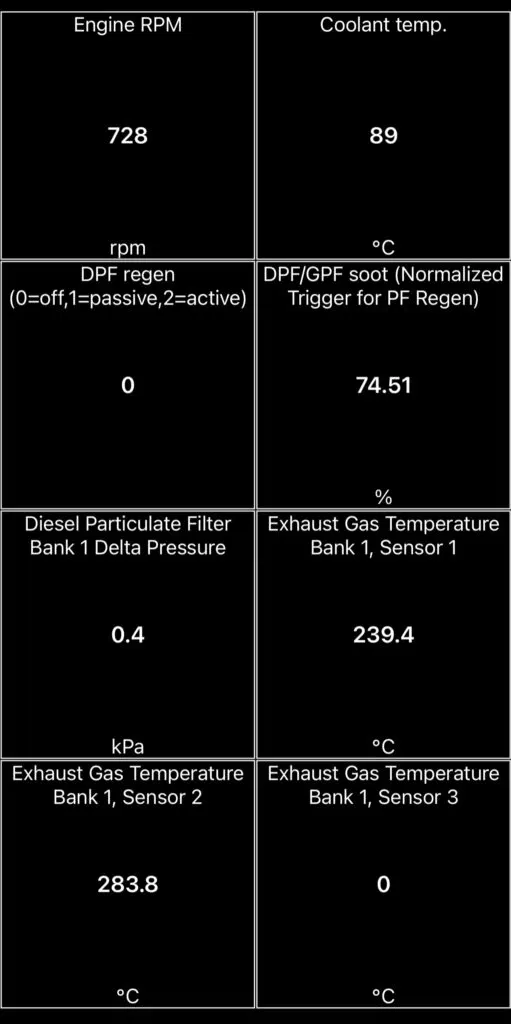
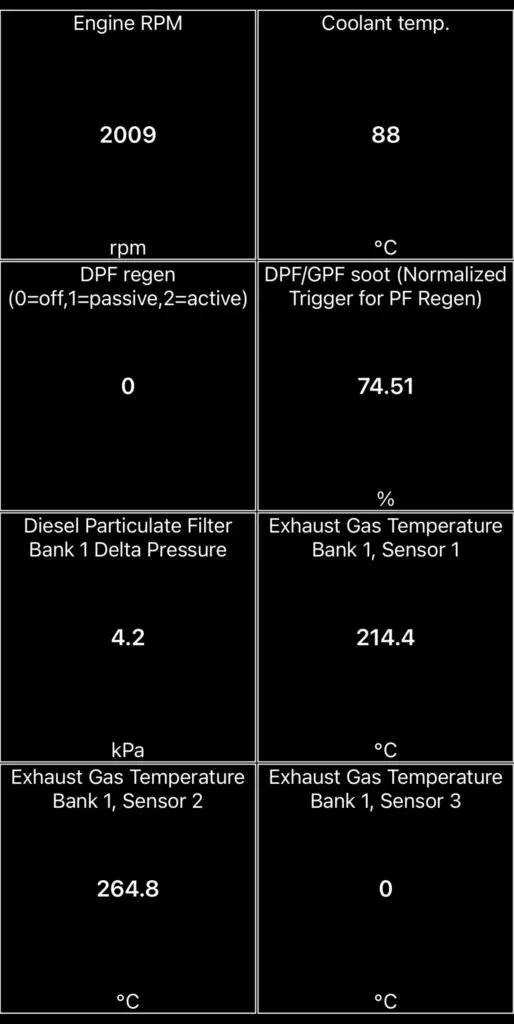
You don’t need special kit. Any cheap Bluetooth OBD2 adapter and any scanner app that shows live data will do. I used a Vgate iCar Pro adapter with the Car Scanner app, about ₹2,000 all in.
Plug the adapter into the OBD socket under your dashboard, connect the app, and search the live data list for “DPF”, “soot”, and “regen”. Add whatever your car offers to one screen.
Some cars share plenty, some share almost nothing. If nothing useful appears, your car keeps that data in the manufacturer’s own system, and you’ll need a brand-specific app or a garage scan instead. That’s normal and it isn’t a fault.
Warm the engine fully first, because a cold reading is a useless reading. Fully warm means coolant sitting steady around 85 to 90°C, or roughly fifteen minutes of driving. Then note the values twice: once at idle, once holding a steady 2,000 rpm in park.
Here’s what my car showed, fully warm:
| Reading | Idle (728 rpm) | 2,000 rpm |
|---|---|---|
| Regeneration status | 0 (none) | 0 (none) |
| Soot level | 74.51% | 74.51% |
| Filter pressure difference | 0.4 kPa | 4.2 kPa |
| Exhaust temp, sensor 1 | 239°C | 214°C |
| Exhaust temp, sensor 2 | 284°C | 265°C |
| Coolant | 89°C | 88°C |
Reading your own numbers:
The pressure pair is the real health check, and it works on any car because you’re watching a pattern, not matching my figures. It measures how hard exhaust gas has to push through the filter.
Mine read 0.4 at idle and 4.2 when I raised the revs. Low at idle, rising sharply with revs, is what a clear filter does. A filter that reads high at idle and barely changes when you rev is blocked.
Your app may show this in kPa, mbar, bar or psi. The units don’t matter. The shape of the change does.
The soot number confuses everyone
Let me be clear about it. That 74.51% is progress toward the next regeneration. It is not how full your filter is.
Mine is about three quarters of the way to its next burn. After a successful regeneration it drops back and starts climbing again.
How full the filter actually is, in grams or as a life percentage, is a separate value that most cars keep to themselves. Your warning light is the car’s own alarm for that, which is why the light matters more than any number you can read.
What a cheap adapter can’t see
My car reports soot as a percentage, not in grams, which is normal for most brands. One of my three exhaust temperature sensors read a flat 0°C.
That 0 isn’t a fault, and if you see one, don’t panic. It means your car doesn’t share that particular value over the standard connection. Ignore any reading that shows 0 or an impossible number, like an exhaust temperature in the thousands.
If you drive a VW, Audi, Skoda or SEAT, OBDeleven publishes gram bands for its readings: under 10 g is good, 10 to 15 acceptable, 15 to 20 high, and 20 g or more means it needs a regeneration or a clean. Those bands are for their VAG readings only. Don’t grade a percentage from any other brand against them.
Why DPF Problems Get Worse in Winter
Cold weather makes every part of this harder. Your engine takes longer to warm up, the exhaust runs cooler, and a short trip that just about worked in July doesn’t reach temperature in January.
That’s why DPF lights cluster in the cold months. Nothing broke. The same driving stopped being enough.
If your car is borderline, add one longer drive a week through winter and you’ll probably never see the light.
What is a Forced DPF Regeneration, and When Do You Need One?
Sometimes driving isn’t enough. Soot has built too far, or too many attempts got cut short, and the car won’t clear itself no matter how far you go.
A forced regeneration is a diagnostic tool telling the engine computer to run a controlled burn while the car sits still. You’ll also see it called manual, static, or parked regeneration.
You need one when the long drive has failed twice, or a scan shows soot beyond what the car is allowed to burn off by itself.
At a garage it costs ₹3,000 to ₹8,000 in India, £80 to £150 in the UK, or $100 to $200 in the US, and takes 30 to 60 minutes. Any workshop with a proper diagnostic tool can do it, whatever you drive.
Doing it yourself needs a tool with manufacturer-level access, not a basic code reader. VW group owners have VCDS and OBDeleven. Ford owners have FORScan. For most other brands there’s no cheap DIY route, so a multi-brand handheld or a garage is the realistic answer. The table further down shows what does what.
Worth knowing before you pay for an app plan: OBDeleven’s own documentation says you can check soot level free, but the forced regeneration sits behind their paid plan.
That refusal protects you. A filter past the safe window needs cleaning, not lighting.
When even a forced regen fails, you’re past regeneration. It burns soot, but it can’t remove ash and it can’t fix a cracked filter. From here it’s cleaning or replacement, and the cost page covers both by car.
How Much Does DPF Regeneration Cost?
| What | Cost |
|---|---|
| The car doing it on a motorway run | Free |
| The car forcing one itself | About a litre of extra diesel |
| An additive dose | ₹1,500 to ₹2,500 / £15 to £25 / $20 to $30 |
| Garage forced regeneration | ₹3,000 to ₹8,000 / £80 to £150 / $100 to $200 |
| DIY forced regeneration | Price of a capable tool or app plan |
These are approximate 2026 prices, not quotes. What you’ll actually pay depends on your car, where you live, and how blocked the filter is.
If a forced regen can’t fix it, you’re into cleaning or replacement territory.
Which is the real argument for the weekly drive. It’s the cheapest maintenance you’ll ever do.
Do DPF Additives Actually Work?
The one people ask about by name is JLM DPF Regen Plus. It’s a fuel additive you pour into the tank, and JLM says it lowers the temperature soot burns at, so a regeneration can finish at temperatures your driving actually reaches.
My honest read, based on how the chemistry is described rather than a test I’ve run: it helps borderline cases. A dose before a proper motorway drive improves the odds of that regen completing, especially on a short-trip car.
It won’t rescue a heavily blocked filter, and it does nothing about ash. If the light is already on and driving has failed, no bottle fixes that.
Which Tools Can Force a DPF Regeneration?
Reading DPF data and commanding a regeneration are two different abilities, and tool marketing blurs them. Reading is cheap and nearly universal. Commanding needs manufacturer-level access, and that’s where tools start charging.
Rows marked tested are from my own hands. The rest come from each maker’s own material, so check your exact model before paying.
| Tool | Brands | Reads DPF data | Forces a regen |
|---|---|---|---|
| Cheap adapter + Car Scanner | Most cars | Yes (tested on my X5) | No |
| Torque Pro | Most cars | Basic | No |
| OBDeleven | VW group, BMW varies by country | Yes | Yes on VAG, paid plan |
| VCDS | VW group | Yes | Yes |
| BimmerLink | BMW, Mini | Yes | Listed for many models |
| FORScan | Ford | Yes | Listed for many models |
| Carly | Several brands | Yes | Advertised for some brands, untested by me |
| Autel, Foxwell handhelds | Multi-brand | Yes | Varies by model |
If your brand isn’t listed, a multi-brand handheld or a garage visit is your route. There’s no universal app that forces a regeneration on every car.
One India note from my own testing: OBDeleven’s advanced BMW features aren’t licensed here, so a BMW owner in India gets basic access only. Check the tool maker’s country and model list before you buy anywhere.
Can I Just Remove the DPF?
No. It’s illegal in the UK, an MOT fail since 2014, and it can void your insurance; the warning light page has the rules and fines by country. It’s also the wrong fix: a filter that keeps blocking is telling you something else is wrong.
FAQs
Once is fine. The car picks it up next time you drive. It’s doing it over and over that causes the damage.
The idle drops back, stop-start starts working again, and the smell clears. On an app, the status goes back to 0 and the soot number falls.
A hot, sharp smell is normal and so is a brief puff on older cars. Thick black smoke that keeps coming is not, and that wants a scan, not another drive.
Yes, roughly a litre. That’s the mpg dip you notice for one trip and then forget about.
No, and it’s worth pushing back on. A forced regen burns soot but it doesn’t tell you why the soot got there. If nobody has scanned for an EGR fault, a bad pressure sensor or an injector problem, you’re paying to fix the same thing repeatedly.
Last Updated: August 2026

Founder of TheCarLane | Automotive Enthusiast
Ayush shares practical automotive knowledge based on real-world ownership and hands-on experience. His work focuses on diagnostics, engine systems, common car problems, and clear explanations that help everyday drivers understand their vehicles better.