

An O2 (oxygen) sensor measures the amount of oxygen in your car’s exhaust gases. It helps the engine control unit (ECU) adjust the air-fuel mixture so the engine runs efficiently and produces fewer emissions. Most modern cars have at least two O2 sensors, one before and one after the catalytic converter.
What is an O2 Sensor and How Does it Work
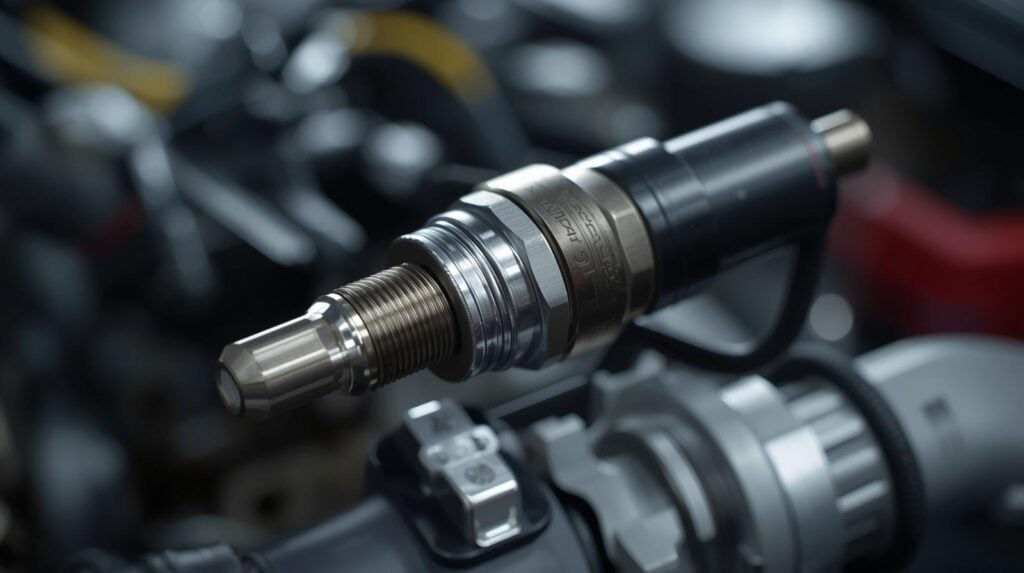
An oxygen sensor — also called an O2 sensor — sits inside your car’s exhaust system and measures how much oxygen is leaving the engine. It sends that data to the ECU multiple times per second so the engine can continuously adjust the air-fuel mixture, maintain efficient combustion, and keep emissions in check.
The sensor generates a small voltage based on the difference in oxygen concentration between the exhaust gases and outside air. Around 0.1 volts indicates a lean mixture — too much air, not enough fuel. Around 0.8–0.9 volts indicates a rich mixture — too much fuel. The ECU reads this voltage signal constantly and adjusts fuel injection to maintain the ideal air-fuel ratio of approximately 14.7:1 for petrol engines. This process is called closed-loop fuel control.
Without a working O2 sensor the ECU loses this feedback and the engine runs on fixed fuel maps — which wastes fuel, increases emissions, and can damage the catalytic converter over time.
Upstream vs Downstream — Two Sensors, Two Different Jobs
Most modern cars have at least two O2 sensors. Understanding which one is failing matters because the symptoms and fault codes are different.
The upstream sensor — O2S1, also called the pre-cat sensor — sits before the catalytic converter. Its job is active fuel control. It monitors the air-fuel ratio in real time and feeds that data to the ECU to adjust injection. This sensor directly affects engine performance, fuel economy, and idle quality.
The downstream sensor — O2S2, also called the post-cat sensor — sits after the catalytic converter. It doesn’t control fuel mixture. Instead it monitors how efficiently the catalytic converter is cleaning the exhaust gases by comparing its readings to the upstream sensor. If both sensors show similar switching patterns it indicates the catalytic converter isn’t filtering effectively — which typically triggers a P0420 fault code and check engine light.
A failing upstream sensor affects how the engine runs. A failing downstream sensor usually triggers emissions-related codes without immediately affecting drivability.
Live O2 Sensor Data From My Own Car
Rather than describing what healthy sensor behaviour looks like in theory, here is a live OBD2 recording from my Skoda Rapid 1.0 TSI showing both sensors in real driving conditions.
Both O2S1 and O2S2 are switching continuously between 0.1V and 0.9V as driving conditions change. This is exactly what healthy sensor behaviour looks like — the ECU is actively adjusting the fuel mixture and both sensors are responding rapidly to those changes.
A sensor that gets stuck at a fixed voltage — flat-lining at 0.1V or 0.9V rather than switching — is failing. A stuck upstream sensor means the ECU has lost its feedback loop. A stuck downstream sensor means the catalytic converter monitoring has failed. Either way the check engine light follows.
What Does a Downstream O2 Sensor Actually Do?
A downstream O2 sensor is located after the catalytic converter. Its main job is to monitor how efficiently the catalytic converter is cleaning the exhaust gases.
Unlike the upstream sensor, the downstream sensor does not directly control the air-fuel mixture. Instead, it compares its readings with the upstream sensor.
If the catalytic converter is working properly, the downstream sensor’s signal should be more stable and show fewer fluctuations. If both sensors show very similar readings, it may indicate that the catalytic converter is not filtering emissions effectively.
When this happens, the ECU may trigger a check engine light, often related to catalytic converter efficiency.
Why O2 Sensors Have a Built-In Heater
O2 sensors only work correctly at approximately 600°C. At lower temperatures the ceramic element doesn’t generate a reliable voltage signal and the ECU runs in open-loop mode — using fixed fuel maps rather than real-time sensor feedback.
The built-in heater warms the sensor to operating temperature quickly after a cold start, allowing the ECU to enter closed-loop mode faster. This matters most for fuel economy and emissions on short trips where the exhaust never gets fully hot on its own.
When the heater circuit fails the sensor takes much longer to reach operating temperature — or never does. The fault codes this produces are P0135 for the upstream heater circuit and P0141 for the downstream. These don’t always cause obvious drivability symptoms immediately but fuel economy drops and emissions increase.
What Causes O2 Sensors to Fail
Carbon buildup from rich running or oil burning coats the sensor tip and reduces its ability to read oxygen accurately. Coolant leaks that reach the exhaust contaminate the sensor. Age and mileage — most sensors last 80,000 to 150,000 km depending on fuel quality and driving patterns. Short trips where the sensor never fully heats accelerate wear because the heater element cycles more frequently.
On remapped or modified engines running richer than stock fuelling, upstream sensor lifespan shortens because the sensor spends more time reading at the rich end of its range. If your car has been remapped, factor this into your maintenance awareness.
If your car is showing any of these signs, see the symptoms of a faulty O2 sensor for a full diagnosis guide.
How to Prevent Early Failure
Use good quality fuel consistently — poor fuel quality accelerates carbon buildup on the sensor tip. Fix oil burning issues promptly — oil reaching the exhaust is one of the fastest ways to contaminate a sensor. Avoid prolonged idling and favour longer drives that allow the exhaust to reach full operating temperature. If the check engine light shows a misfire code, fix it before it damages the catalytic converter and downstream sensor.
What to Do If You Suspect a Failing Sensor
Run an OBD2 scan first. The fault code tells you which sensor is affected — bank number and sensor position — before you spend anything. Replacing the wrong sensor is a common and avoidable mistake. A P0135 points to the upstream heater circuit. A P0420 points to catalytic converter efficiency, usually caused by the downstream sensor or a failing cat. A P0130 or P0136 indicates the sensor itself rather than its heater.
For symptoms without a fault code — rough idle, poor fuel economy, hesitation — check live sensor voltage data with an OBD2 scanner. A sensor switching normally between 0.1V and 0.9V is healthy. A flat line at either end is failing.
If your sensor has already failed and you want to know what replacement will cost, see O2 sensor replacement cost.
Last Updated: April 2026
FAQs
The ECU loses accurate fuel mixture feedback and the engine runs rich or lean on fixed maps. Fuel economy drops, performance suffers, and a rich-running engine can damage the catalytic converter — which is significantly more expensive to replace than the sensor itself.
Not worth attempting. The failure is internal — the ceramic element wears out and loses sensitivity. Cleaning the tip removes surface deposits but doesn’t restore the sensor’s ability to generate accurate voltage readings. Replace it.
Yes — incorrect air-fuel ratio data from a failing upstream sensor causes the ECU to inject the wrong amount of fuel, which can produce misfires under load or at idle.
es. The engine runs in open-loop mode using fixed fuel maps. It starts and drives but with reduced efficiency and increased emissions.
An upstream sensor failure causes hesitation and sluggish acceleration because the ECU can’t correctly adjust fuel delivery under load. A downstream sensor failure usually doesn’t affect acceleration directly.
Most modern cars have two — one upstream before the catalytic converter and one downstream after it. Some larger engines with multiple exhaust banks have four.
Not directly. A failing upstream sensor causes the engine to run lean — too much air, not enough fuel — which raises combustion temperatures. Sustained lean running can contribute to engine heat buildup over time but an O2 sensor fault alone won’t trigger the temperature warning. If overheating and an O2 fault code appear together, the O2 sensor is likely a symptom of something else rather than the cause.
Bank 1 is the side of the engine containing cylinder 1. Sensor 1 is the upstream sensor before the catalytic converter on that bank. On a three-cylinder engine like the 1.0 TSI there is only one bank so Bank 1 Sensor 1 is the upstream sensor and Bank 1 Sensor 2 is the downstream.
The downstream sensor after the catalytic converter on Bank 1. Its job is monitoring catalytic converter efficiency rather than controlling fuel mixture.