
Long term fuel trim is the correction your engine computer has learned to apply to the fuel map to keep the mixture right. A healthy engine sits inside ±10%, and most sit inside ±5%. Positive means the computer is adding fuel because the engine runs lean. Negative means it is pulling fuel because the engine runs rich.
If you have a scanner in your hand and the number looks wrong, the sign tells you the direction and the pattern tells you the part. High at idle but fine at cruise is almost always unmetered air. High at every speed points at the airflow sensor or fuel delivery. Pegged at 25 means the computer has run out of correction. A negative number in the teens means something is adding fuel you didn’t ask for.
Every rule below is one that shows up in forum threads year after year, and where I could, I checked it on TheCarLane’s test car, my own Skoda Rapid 1.0 TSI on a Stage 1 map, logged with a Bluetooth adapter and the Car Scanner app.
What Is Long Term Fuel Trim, and How Is It Calculated?
Long term fuel trim is the engine computer’s memory. Short term fuel trim reacts to the oxygen sensor in real time and swings around zero all day. When the short term correction keeps leaning the same way for long enough, the computer decides the base fuel map is off and moves that correction into long term memory. A technician on Paul Danner’s forum puts it in one line: long term exists to keep short term near zero.
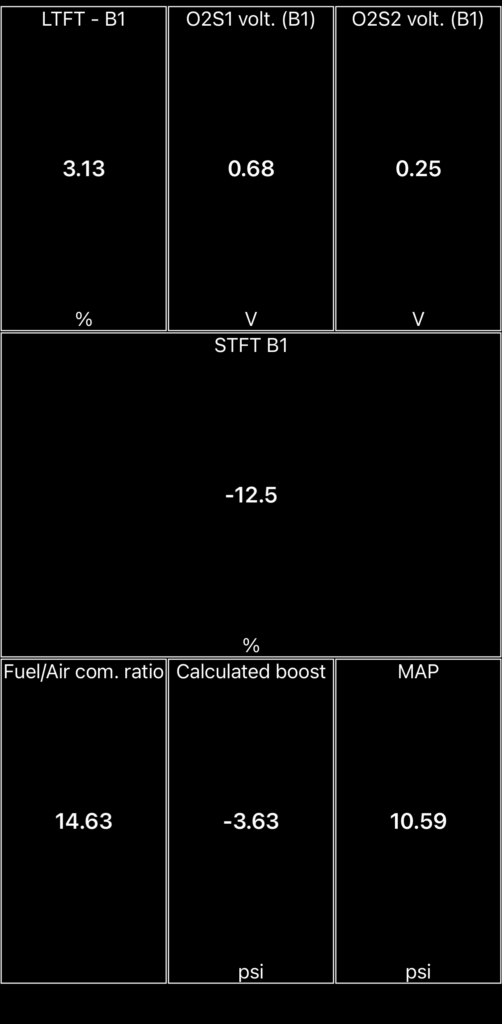
So LTFT is not calculated from one reading. It is built up over drive cycles, from the average of the short term corrections in each operating condition, and it survives switching the car off. That is why you see it sitting at +3% on a cold start before the oxygen sensor has even warmed up: it is what the computer learned last week, not what it sees now.
The difference between the two trims, and why you add them together to judge the engine, is on the short term fuel trim page. This page is about the learned number on its own.
What Should Long Term Fuel Trim Be? The Normal Range at Idle and Cruise
Inside ±10% is acceptable. Inside ±5% is where a healthy engine spends most of its life. Zero is the target, but no engine sits exactly on it. As a regular on the Bob Is The Oil Guy forum put it: every car is different.
Here is what normal looks like on my engine, warm, at idle, with no fault codes stored.
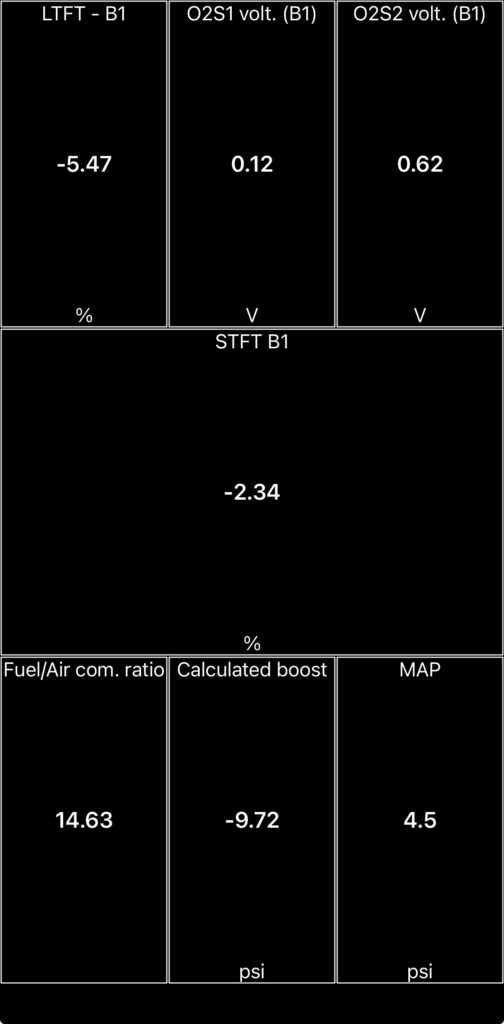
Reading: TheCarLane, Skoda Rapid 1.0 TSI, warm idle, LTFT B1 −5.47%, Car Scanner
Is a negative LTFT at idle normal?
On a direct-injection turbo engine, yes. Mine rests at −5.47% at idle and has for as long as I have logged it. The computer has learned that this engine runs a touch rich at idle and trims a little fuel out, which is the system doing its job. The number to worry about is not a steady −5. It is a number that used to be −5 and is now −15, or one that swings past −10 and stays there.
LTFT B1 normal range
B1 means Bank 1. On an engine with its cylinders in one line, the Rapid included, Bank 1 is the only bank, so LTFT B1 is the only long term figure you will see, and everything on this page applies to it. The idle number and the cruise number do not have to match, for a reason covered further down.
What shifts LTFT without anything being wrong
A few things move the number a couple of percent and mean nothing: a change of fuel blend, E10 against E5 or a tank of ethanol-heavy fuel; a change of altitude, thinner air at height; extreme cold or heat; a new air filter or intake; and a fresh remap, which throws the old learning away. If the number moved a little at the same time as one of those, wait a tank and log it again before chasing it.
The LTFT Diagnostic Chart: What Your Reading Means
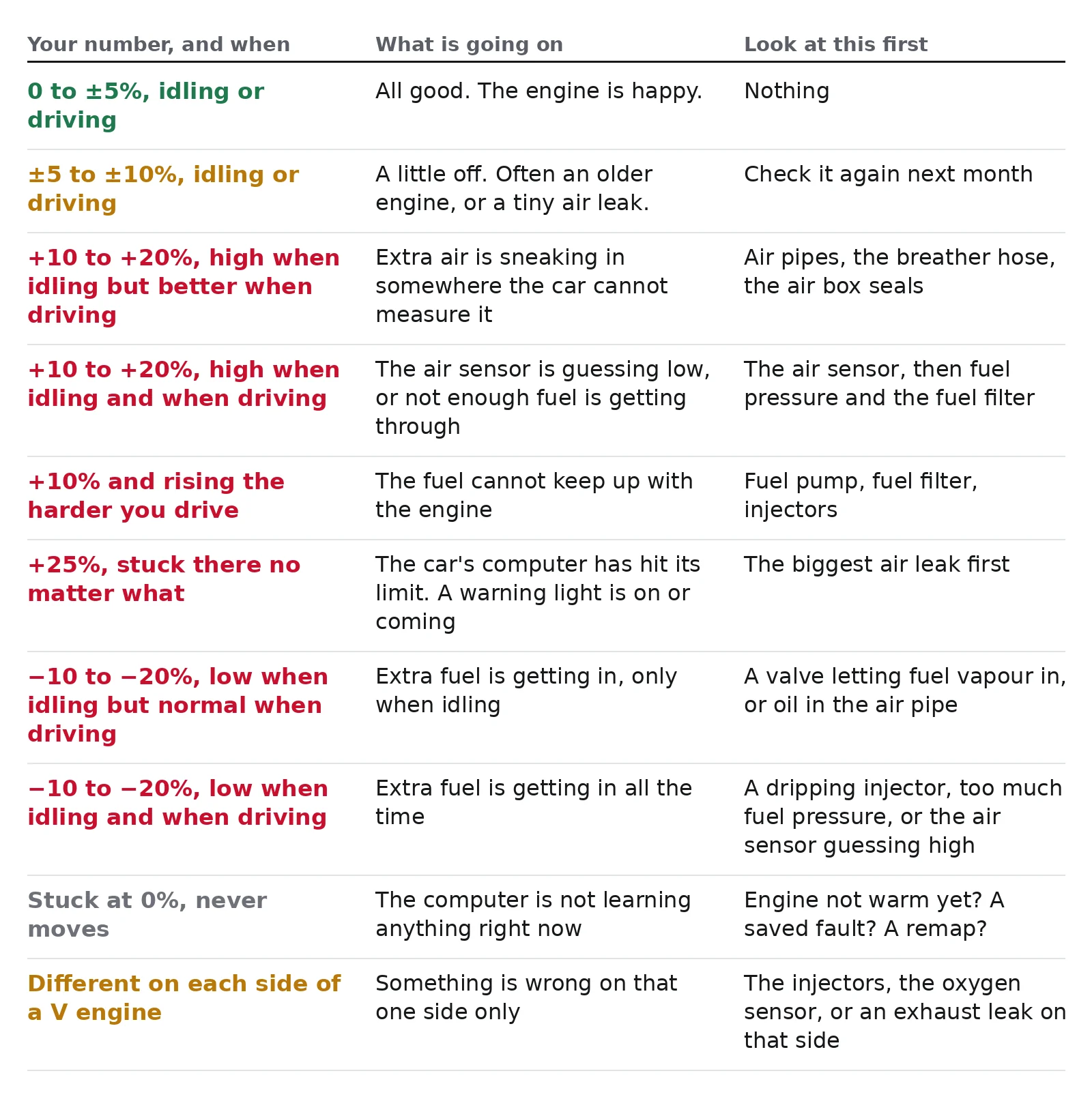
Find your number in the left column, then check when it happens: idling, driving, or both.
| Your number, and when | What is going on | Look at this first |
|---|---|---|
| 0 to ±5%, idling or driving | All good. The engine is happy. | Nothing |
| ±5 to ±10%, idling or driving | A little off. Often an older engine, or a tiny air leak. | Check it again next month |
| +10 to +20%, high when idling but better when driving | Extra air is sneaking in somewhere the car cannot measure it | Air pipes, the breather hose, the air box seals |
| +10 to +20%, high when idling and when driving | The air sensor is guessing low, or not enough fuel is getting through | The air sensor, then fuel pressure and the fuel filter |
| +10% and rising the harder you drive | The fuel cannot keep up with the engine | Fuel pump, fuel filter, injectors |
| +25%, stuck there no matter what | The car’s computer has hit its limit. A warning light is on or coming | The biggest air leak first |
| −10 to −20%, low when idling but normal when driving | Extra fuel is getting in, only when idling | A valve letting fuel vapour in, or oil in the air pipe |
| −10 to −20%, low when idling and when driving | Extra fuel is getting in all the time | A dripping injector, too much fuel pressure, or the air sensor guessing high |
| Stuck at 0%, never moves | The computer is not learning anything right now | Engine not warm yet? A saved fault? A remap? |
| Different on each side of a V engine | Something is wrong on that one side only | The injectors, the oxygen sensor, or an exhaust leak on that side |
What Causes High Long Term Fuel Trim?
Something is letting in air the computer did not measure, or not delivering the fuel it asked for. Which of the two it is depends on how the number behaves between idle and cruise.
Lean at idle, fine at cruise: the vacuum leak signature
This is the most common thread on every forum, and it has the cleanest test. Unmetered air is a big share of a small airflow at idle and a tiny share of the large airflow at 2,500 rpm, so a leak pushes the trims high at idle and lets them fall as revs rise.
MOTOR magazine’s diagnostic column gives the professional version of the test: hold the engine at 2,500 rpm and watch the correction. If it drops by 15% or more, you have a vacuum leak. Their example is a bank at +24% at idle falling to about +20% or lower at 2,500. The same column warns not to trust the airflow reading to judge a leak, because the MAF value reacts to the problem rather than causing it.
An owner on Toyota Nation logged exactly that: 15.4% at idle, down to 10.4% at 2,500 rpm. The leak was a split in the intake hose between the airflow sensor and the throttle, letting in air the sensor never saw. After the fix his long term trim dropped below 3%. The same thread has the old garage trick, spraying carb cleaner around the intake gasket and listening for the idle to change, and the honest caveat that it does not catch every gasket. A smoke test does.
Where to look, in order: the intake boot and its clamps, the PCV hose and valve, the intake manifold gasket, the brake booster hose, and on a turbo engine every clamp on the pipe between the turbo and the throttle body.
Long term fuel trim 25% at idle: pegged at the ceiling
Twenty-five is not a reading. It is the wall. On many engines the computer can only learn around 25%, and the exact limit is set per engine. A thread on a Nissan owners’ forum had both banks pegged at +25 with the idle still steady, and the replies drew the usual line: both banks high points at something shared, like the fuel pump; one bank high points at an injector on that bank.
Pegged trims mean start with the biggest possible leak, because a small one cannot push a trim that far.
LTFT that gets worse with rpm or under load
Now the pattern flips. If the number climbs as you rev the engine or load it, the leak explanation dies, because a leak matters less at high airflow, not more. Something cannot keep up with demand. A weak fuel pump, a blocked filter, tired injectors, or an airflow sensor reading low at high flow.
An owner on Focus Fanatics worked through it from the other side: his trims did not improve at high rpm, so he ruled out a leak and went after the MAF and fuel delivery. The reply he got is worth keeping: long term trims are built over many drive cycles and should not move much just from revving.
How to fix high LTFT
Find the air or find the fuel. Smoke test the intake before you buy anything. Then clean the airflow sensor and compare grams per second before and after, because a cleaned sensor that reads the same was never the problem. Then fuel pressure at idle and under load. Replace what the tests point at, clear the adaptations with a scanner, and watch the trims relearn. If a P0171 or P0174 is stored, the P0171 guide breaks the causes down engine by engine for VW Group cars.
What Does It Mean If Long Term Fuel Trim Is Negative?
The engine is running rich and the computer is pulling fuel to compensate. Something is adding fuel it did not command, or a sensor is telling it the engine is colder or breathing less than it is.
The problem readings are the ones people post: −18, −20, a number that arrived suddenly, or one that keeps drifting further negative month after month.
−18, −20: the numbers people post, and what usually sits behind them
- A leaking injector. Fuel dribbles in when it should not. Trims go negative at every speed, and often one cylinder shows a misfire count or a rough idle with it.
- High fuel pressure. A stuck regulator delivers more fuel per injector pulse than the computer expects, so it trims out fuel everywhere.
- An airflow sensor reading high. The computer fuels for more air than is really there. Negative at all loads, and the grams-per-second figure looks big for the engine size at idle.
- A purge valve stuck open. Fuel vapour from the tank flows into the intake at idle. Negative at idle, closer to normal at cruise, because the vapour is a smaller share of a bigger fuel flow. It often comes with a P0441 or P0455 code, on VW Group cars especially, and the pinch test for it is on the short term fuel trim page.
- A coolant sensor stuck cold. The computer thinks the engine is cold and enriches for it. Negative trims that appeared after cooling-system work are this until proven otherwise.
- Oil into the intake. A tired PCV system feeds oil mist into the manifold. The trim drifts negative slowly, over months, and there is residue in the intake pipe.
How to fix negative LTFT
Idle-only negative: pinch the purge hose for a moment and watch the trim move. Negative everywhere: fuel pressure first, then an injector leak-down or balance test, then the airflow sensor reading against the engine’s known idle value. Replace, reset the adaptations, relearn. A stored P0172 or P0175 confirms the direction and the bank; it does not name the part.
LTFT Bank 1 vs Bank 2: Why Is It High on One Bank?
Because the fault is on that bank. Anything shared by the whole engine, the airflow sensor, fuel pressure, a big vacuum leak at the manifold, pushes both banks the same way. A few percent between the banks is normal; more than five apart, and staying apart, is a bank fault. A fault that only shows on one bank has to be physical and local: an injector on that side, that bank’s front oxygen sensor, or an exhaust leak ahead of that sensor pulling in air the sensor reads as lean.
Two things trip people up here. First, an engine with its cylinders in one line has one bank, so a scanner that shows Bank 1 only is not hiding anything.
Second, “bank 1 sensor 2” is the oxygen sensor after the catalytic converter. It watches the converter; it does not set the trims. Every trim number on your screen comes from sensor 1, the one before the cat.
Why Is My LTFT Different at Idle and at Cruise?
Because the computer does not store one long term number. It stores a table of learned corrections by engine speed and load, and shows you the cell you are in. Idle is one cell. Cruise is another. Boost is another again. Service manuals describe it exactly that way: correction tables keyed to rpm and load, learned in closed loop, with a ceiling.
You can see it on one engine in one afternoon. My idle reading is −5.47%. Under boost, the same day, the long term correction reads +3.13%.
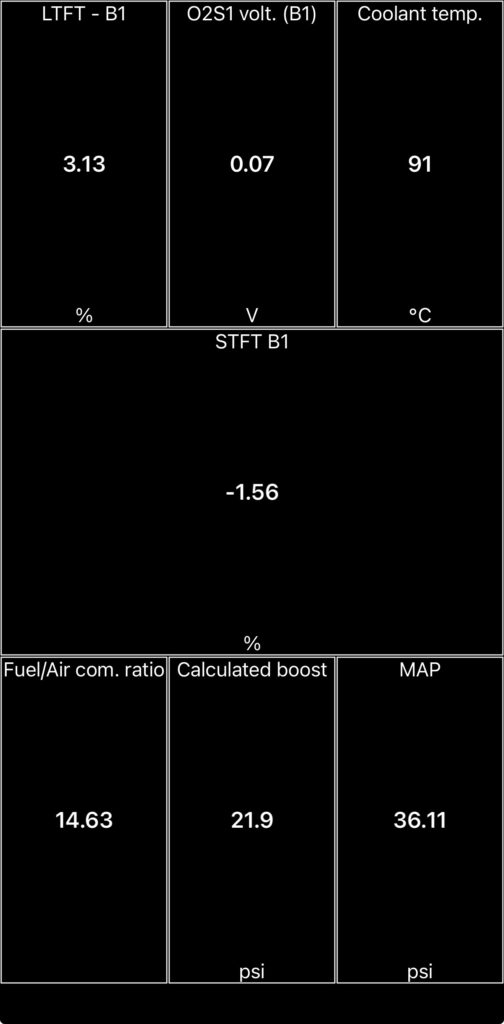
Manufacturer tools show the cells by name. On VW Group engines OBDeleven and VCDS list an idle adaptation and a partial-load adaptation as separate values; BMW tools show additive and multiplicative adaptations; Ford’s are keep-alive memory cells. The single LTFT percentage a cheap adapter shows is a translation of whichever cell applies.
Long Term Fuel Trim High but Short Term Normal? What That Means
It means the system has finished its job, not that the numbers disagree. Short term reacts. Long term learns. Once long term has learned a correction, short term no longer has to make it, so short term goes back to swinging around zero, and the long term number quietly carries the fault.
Richard McCuistian, an ASE master technician, describes the sequence after a reset: short term drifts first, long term follows it, and as long term reaches the same figure, short term returns to zero because the learning has been done. A calm short term next to a long term at +14% is not a healthy engine. It is a stable fault the computer has stopped fighting.
The opposite case, short term negative while long term is positive, is on the short term fuel trim page, along with the combined rule for reading both numbers together.
How Do You Reset Long Term Fuel Trim?
With the scanner, from the engine module, after the fault is fixed. On a VW, Audi, Skoda or SEAT the function is called resetting the adaptation values, and OBDeleven, VCDS and most VAG-capable apps have it under the engine control unit.
Other makes call it something else, and the scanner menu is where you find it: Ford and Mazda reset the keep-alive memory, GM tools reset the learned fuel values, BMW tools delete adaptations, Toyota and Honda use an ECU reset followed by an idle relearn. Cheap apps often hide it under special functions or a reset ECU button. If your app has no reset at all, clearing the stored codes usually clears the learned trims with them; see below.
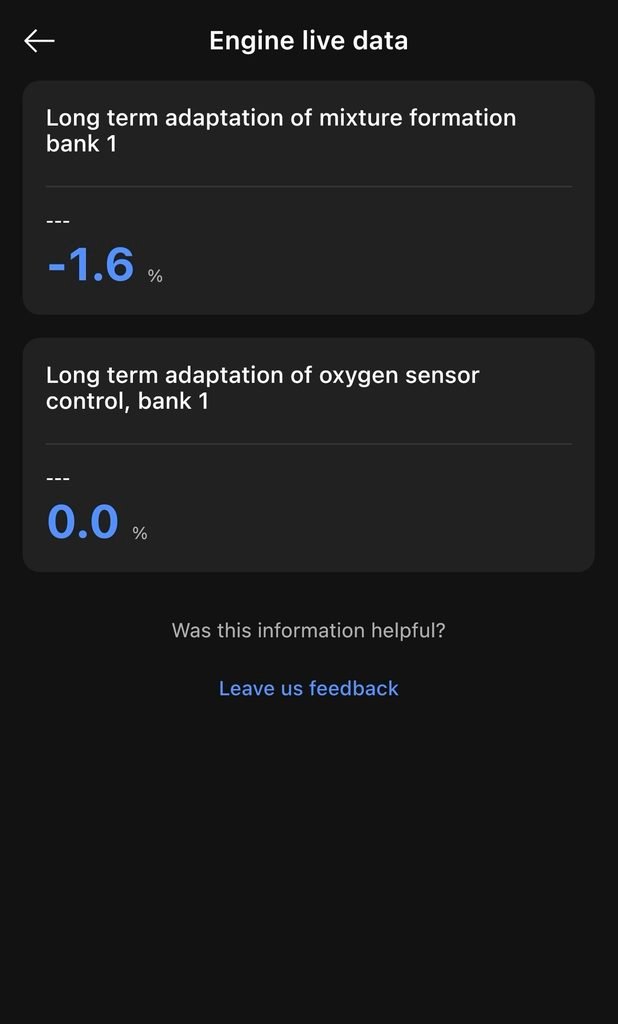
Do not reset it by pulling the battery. It is the standard forum advice, and on most modern cars it also wipes things you did not mean to touch: throttle and idle adaptations on VW Group, Honda, BMW and others, sometimes the gearbox’s learned shift points too, and it can leave you with a rough idle or a throttle fault the car did not have before. The scanner does the same reset without the side effects. If you have already pulled the battery on a VW Group car, the P2101 page covers the throttle relearn.
After a reset, long term returns to 0% and short term does the work for a while. Expect a slightly rougher idle for a few minutes, then a normal drive of ten to twenty minutes before the long term number starts to settle. Right after a reset, watch short term rather than long term; that is where the truth shows first.
Why is my LTFT stuck at 0, or not changing?
Because the computer is not learning, and there are four common reasons. The engine is not in closed loop yet: cold engine, cold oxygen sensor, or a sensor that has failed, so there is nothing to learn from. A stored lean or rich code has frozen learning until it is cleared. An aftermarket tune has turned long term learning off, which some tuners do on purpose. Or your tool is showing the raw scale some manufacturers use, a number centred on 128 where anything above is lean and below is rich, and ten steps either way is the same as 10%. Warm the engine, confirm closed loop, clear any stored codes, and watch again over a full drive before deciding the number is stuck.
If instead the number jumps around, it is usually the app switching between cells as you move from idle to cruise, or a front oxygen sensor on its way out; long term should move slowly, and a long term that behaves like short term is telling you the sensor, not the fuelling.
Does clearing fault codes reset LTFT?
On most cars, yes. Clearing codes with a scanner usually clears the learned adaptations with them, which is why the trims look perfect for a day after a garage visit and then drift back. Read the trims before you clear anything; once the code is gone, so is the evidence.
Is LTFT the Same on Every Car and Engine?
The scale is the same; the behaviour behind it is not. Every petrol car since OBD2 arrived reports long term fuel trim as a percentage the same way, so the ±10% rule travels between a Rapid, a Ford and a Subaru. But three things are set per engine:
- The limits. Every manufacturer clips how far the trims can learn, commonly around ±25%, and sets the point at which a code is stored. The exact numbers are calibrated per engine.
- The learning. On a programmable ECU the knobs are visible: Haltech’s documentation describes a rich bias, which makes the long term value learn a few percent rich of target as a safety margin, and a gain map that sets how fast short term corrections become learned values. Factory ECUs have the same settings; you cannot see them.
- The resting number. A direct-injection turbo like mine rests slightly negative at idle. An older port-injected engine often drifts a little positive as leaks and deposits build. Both are normal for their own engine.
Even the same model varies. A JustAnswer thread had an owner with three similar Subarus asking why the numbers were so different; the answer was that one was out of range, one was healthy and one was heading lean, and each was reading its own condition correctly.
So compare your engine to itself over time, and read the pattern, direction, idle versus cruise, one bank versus both, before you read the absolute number.
One more thing: this page is about petrol engines. A diesel runs lean by design and does not fuel by lambda feedback the same way, so most diesels show no long term fuel trim, or a value that never moves. Diesel fuelling health lives in other numbers, injector correction values on VW Group engines for one, and a page for those is on its way.
Check Your Own Long Term Fuel Trim
Everything above starts with the number on your screen. All you need is a Bluetooth adapter and a free app; the Vgate iCar Pro with Car Scanner is the combination behind every log on this page. On a VW, Audi or Skoda, the OBDeleven 3 free plan adds the adaptation screen you need for the reset. New to scanning? Start here. Warm the engine fully, log idle, then log a steady cruise, and you have the two numbers this whole page is built on.
FAQs
Ten to twenty minutes of normal driving to start settling, a few drive cycles to finish. Watch short term meanwhile: if it pulls hard one way straight after the reset, the fault is still there.
It is the edge, not a fault. Inside ±10% is acceptable, inside ±5% is healthy. A +10 that used to be +3 needs a smoke test; a +10 that has read +10 for years is probably just an old engine.
Yes. A few percent negative is normal. Past −10, something is adding fuel: a dripping injector, high fuel pressure, a stuck purge valve, or an airflow sensor reading high. Past −20, a rich code is coming.
Usually around 20 to 25% either way, held long enough, though the exact limit is set per engine. P0171 and P0174 mean lean, P0172 and P0175 mean rich; the code names the direction and the bank, not the part.
Yes, and it also wipes the throttle and idle adaptations, sometimes the gearbox’s learned shifts too. You can trade a trim reset for a rough idle or a throttle fault. Use the scanner’s reset; it clears only the trims.
Warm the engine, open live data, find LTFT B1, Long Term Fuel Trim Bank 1, or LONGFT1 depending on the app. Note it at idle and again at a steady 40 to 60 mph. Those two numbers are what this page reads.
Last Updated: September 2026

Founder of TheCarLane | Automotive Enthusiast
Ayush shares practical automotive knowledge based on real-world ownership and hands-on experience. His work focuses on diagnostics, engine systems, common car problems, and clear explanations that help everyday drivers understand their vehicles better.