
DSG gearbox problems on VW, Skoda, SEAT and Audi cars follow the gearbox, not the badge. The 7-speed dry-clutch DSG (DQ200) is the one with the reputation: it judders when the clutch pack wears, loses drive when the mechatronic cannot hold pressure and, on older 0AM boxes, loses reverse when a selector fork bearing fails. The 6-speed wet-clutch boxes are tougher but need their oil changed on time. If yours judders or hesitates, keep driving and book a scan. If PRNDS flashes or drive drops out, stop. Most fixes cost £250 to £2,000, not a new gearbox. Buying used: avoid a 2008 to 2013 dry-clutch 7-speed without repair history.
Can You Drive With a DSG Fault?
Yes, if it’s mild, no if it’s losing drive.
A slight judder pulling away, or shifts that feel harsher or slower than they used to, are early warnings. This is the cheap stage to fix, so book a scan this week and keep driving until then.
If it keeps juddering in traffic, the revs flare between gears or it thumps into gear, drive gently to a garage and nowhere else. The same goes if it went into limp mode once and a restart cleared it. The restart didn’t fix anything.
Don’t drive it if PRNDS stays flashing, the car loses drive (the revs rise and nothing pulls), you smell burning or reverse has gone. A 7-speed that has lost drive once can do it again on a roundabout, so get it recovered.
A rattle at idle, or a shudder at start-up and shut-down, often points to the flywheel, not the gearbox. And a car that “only does it sometimes” still has a fault. Limp mode itself is covered in my VW limp mode guide.
Which DSG Gearbox Is in Your Car?
Dry and wet DSGs fail for different reasons and cost different money. Identify yours first, then read its section below. On a wet box, check when the oil was last changed before anything else.
Three Ways to Tell Without a Garage
Scan the gearbox module. A scanner that reads VW-group modules (OBDeleven, VCDS, Carista) shows the control unit’s part number under Identification. Its first three characters name the gearbox; the codes are in brackets below.
Read the data sticker. The boot-floor sticker and the service book list a three-letter gearbox code next to the engine code; a dealer or the parts catalogue maps it to the family.
Use the torque rule. Engines up to 250 Nm (1.0, 1.2, 1.4 and most 1.5 TSI, the 1.6 TDI) got the dry DQ200. Stronger engines got a wet box: DQ250 until the DQ381 arrived in 2017, DQ500 in Transporters and 4Motion diesels.
The Families in One Minute
- DQ200 (0AM, 0CW): 7-speed, dry clutches, 250 Nm, 2008 on. Polo, Fabia, Ibiza, Golf, Octavia, Leon, A1, A3, Q2, Karoq, Arona with small engines.
- DQ250 (02E, 0D9): 6-speed, wet clutches, 350 Nm, 2003 to about 2020. Golf GTI, GTD and R to 2017, Octavia vRS, Passat and Superb 2.0 TDI, Yeti 4×4, Leon FR, A3, TT.
- DQ381 (0GC): 7-speed, wet, 420 Nm, 2017 on. Golf 7.5 and 8 GTI, GTD and R, Octavia vRS, Tiguan and Kodiaq 2.0 TDI, T-Roc, Q3, Arteon.
- DQ500 (0BH, 0BT): 7-speed, wet, 600 Nm, 2010 on. Transporter T5 to T6.1, Tiguan Mk1 4Motion diesels, Passat and Superb BiTDI, Arteon R, RS3, TT RS.
- DQ400e (0DD): 6-speed wet hybrid, 2014 on. Golf and Passat GTE, A3 e-tron, Octavia and Superb iV.
- Audi longitudinal S tronic (DL382 0CK, DL501 0B5): A4, A5, A6, A7, Q5. A different gearbox, not covered here.
Why Do DSG Gearboxes Fail?
DSG gearboxes fail from three causes: lost hydraulic pressure, worn clutches and, on the wet boxes, oil that was never changed. DSG gearboxes mainly fail from three causes: lost hydraulic pressure, worn clutches and, on the wet boxes, oil that was never changed. A DSG is two clutches run by a mechatronic unit, a control computer bolted to a hydraulic valve body inside the gearbox. When that valve body cannot hold pressure the car loses drive, which is the DQ200’s best-known fault. Dry clutches wear faster in stop-start traffic because no oil carries the heat away. On the wet boxes the oil degrades, so a missed service risks a mechatronic or clutch bill later.
7-Speed DQ200 Problems: Mechatronic, Clutch and Selector Fork
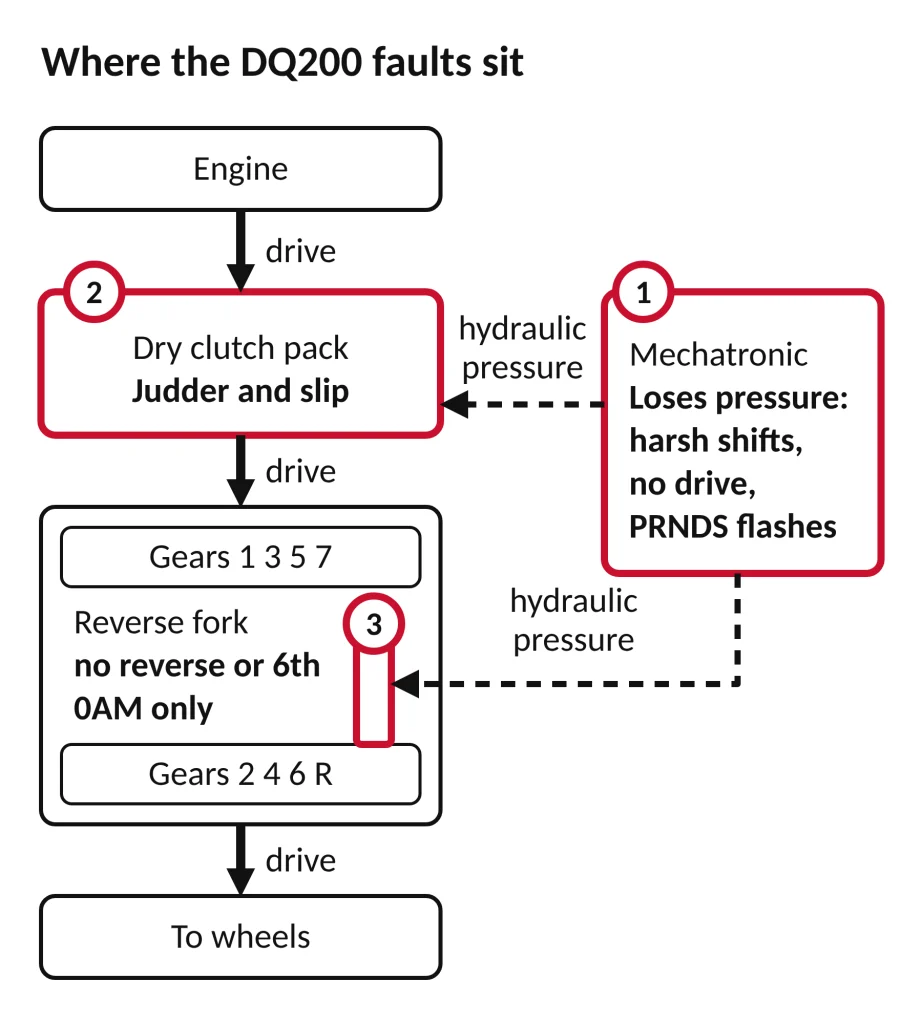
Three faults are well documented on the DQ200, and they announce themselves differently. The reverse selector fork is the one less experienced garages misread.
The Mechatronic Hydraulic Unit
Eco Torque, a Bedfordshire gearbox workshop, describes one way the unit loses pressure: the wall of the pressure canister (the accumulator) in the valve body is too thin and can split. The pump then overworks and can burn out. Its repair includes the newer valve body design VW and Audi brought in, so ask any rebuilder whether theirs does.
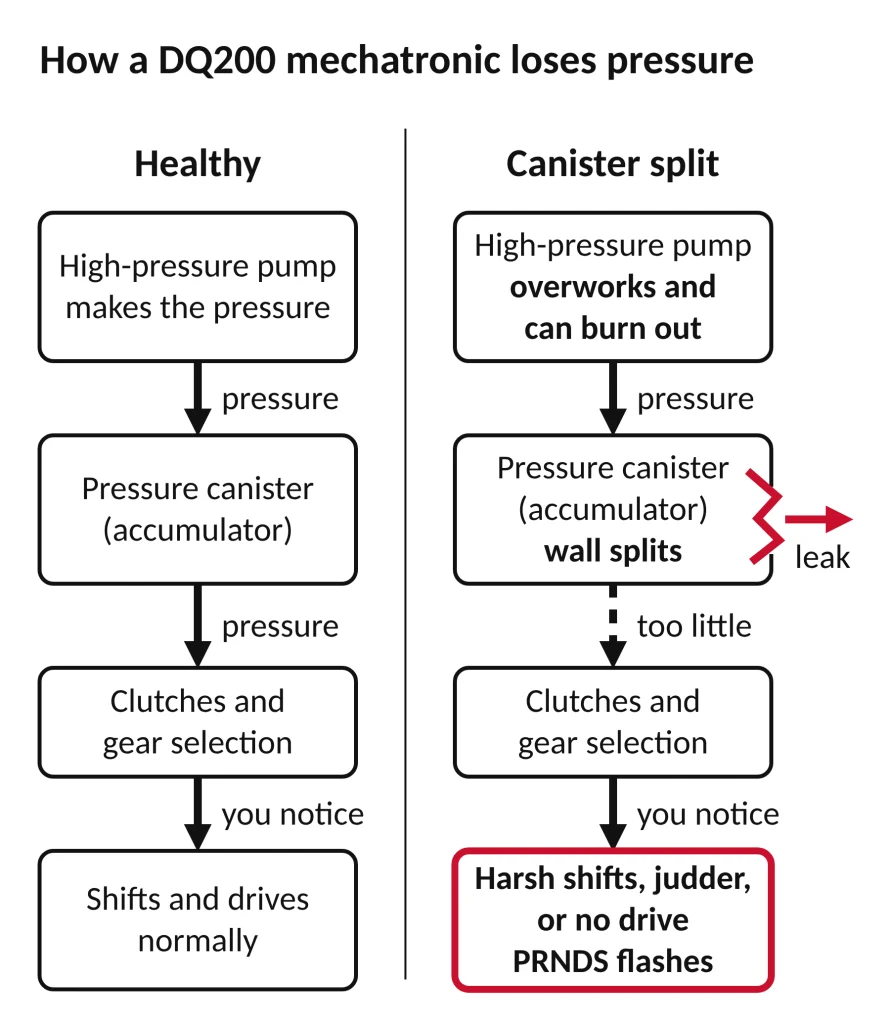
What you notice: harsh or incorrect shifts, juddering in 1st gear, the current gear flashing, a flashing engine light or PRNDS, or even complete loss of drive. Owners on Eco Torque’s page say a restart clears it on cold mornings. My reading, not Eco Torque’s: the pump gets another go at building pressure. Don’t keep restarting to get home.
Codes: P17BF (hydraulic pump protection), P189C and P1895 (function restriction from insufficient pressure or a pressure drop), P0841 (fluid pressure sensor 1).
Clutch Pack Wear
The DQ200 uses two dry friction discs in one housing, made like a manual clutch. Worn clutches judder when you pull away or change gear, let the revs run up as the clutches slip, and can bang into engagement hard enough to stall the engine. Heat is the enemy: Stedman’s Garage says it builds in slow, stop-start driving, in queues and when creeping forward on the clutch, and that a dry clutch has no oil to cool it.
Eco Torque says numerous customers arrive blaming the mechatronic when the clutch was fitted incorrectly, and that a new pack must be shimmed correctly with the specialist tools.
The Reverse Selector Fork
On DQ200 boxes built before 2018, a bearing on the reverse and 6th selector fork fails and the fork moves sideways in its guide. Eco Torque calls it “when, not if” on anything older than that. The car grinds going into reverse, then loses reverse and 6th, and the dashboard flashes PRNDS or the engine light.
The codes it throws are pressure and selection faults, so a less experienced garage quotes a mechatronic. The fix is a strip-down and an upgraded fork, far cheaper than a mechatronic, and worth doing whenever the mechatronic is out anyway. ECU Testing lists P072C, stuck in gear 6, as the giveaway.
Which Years Carry the Most Risk
Kfz-Dietrich, a German repairer, says the revised 0CW (from 2013) has an updated mechatronic that makes emergency mode clearly rarer, and revised clutch parts and hydraulics that reduce judder, though it gives no figures. My reading: that puts cars built from 2008 to about 2013, before the revision, at the most risk. A 0CW is still a dry-clutch box, so clutch wear still applies.
The 2013 Oil Recalls
Automotive World and Gasgoo reported that Volkswagen’s Chinese unit recalled 640,309 cars from 25 November 2013 so the synthetic gearbox oil could be replaced with mineral oil. Hong Kong’s Transport Department listed a DQ200 gear-oil replacement from the same date, warning of electrical faults in the gearbox power supply with synthetic oil, in particular in a hot, humid climate with a lot of stop-and-go driving. Earlier, in June 2013, VW UK told Autocar it saw no reason to recall its roughly 48,000 DQ200 cars, because the humidity, temperature, dust and congestion involved are not seen in the UK.
6-Speed DQ250 Problems: Oil Service and Mechatronic
The DQ250 has a very different reputation from the DQ200: a strong gearbox that suffers when it is neglected. Its clutches run in oil, so the oil and filter are service items, and skipping them shortens its life.
Control Units, a UK mechatronic repairer, lists these codes: P0716 and P0722 for the input and output speed sensors (G182, G195), P0746 and P0776 for the pressure control valves, and P0751 to P0771 for the shift solenoids. Its pages list the symptoms separately: limp mode, harsh or delayed shifts, a flashing gear indicator and a “gearbox malfunction” warning. Its repair service costs less than its exchange unit (£749 against £1,249, plus VAT), so ask about a repair before a replacement.
DQ381, DQ500 and the Hybrid Gearbox
DQ381 (2017 on): the wet 7-speed that replaced the DQ250. ABS Stuurapparaten, a Dutch repairer, lists some jerking in low gears, especially in city traffic, and says a software adjustment can significantly improve the box. It says failures are often down to a defective control unit.
DQ500: the 600 Nm box in Transporters and 4Motion diesels. Strong, but Eco Torque reports a loss-of-drive fault from mechatronic failure on T5 and T6 vans.
DQ400e: the wet 6-speed with the electric motor built in (Golf GTE, Passat GTE, A3 e-tron). Anything past a scan involves the high-voltage system, so use a hybrid-qualified workshop.
DSG Oil Leaks: Where They Come From
VWG Specialists, a Birmingham workshop, names the mechatronic cover seal and the driveshaft seals as leak points on wet-clutch boxes, and says the lost oil ruins them quickly. The repair is to fix the leak and refill with the specified oil.
The DQ200 has two oils: one for the gears and a separate hydraulic oil inside the mechatronic (Kfz-Dietrich). Eco Torque rates internal high-pressure leaks as very common and external low-pressure leaks as uncommon, so a dry underside does not clear a DQ200 of pressure faults; the codes and the pressure reading do. Look under the gearbox at every service all the same: a leak caught early is a seal, not a mechatronic.
Is It the Gearbox, the Flywheel or the Engine?
Three things outside the gearbox get blamed on it every week.
1.5 TSI EVO hesitation. The 1.5 TSI hesitates and lurches at low speed when cold, which can feel like clutch judder. It is an engine-side fault: HonestJohn reported in March 2020 that VW Group had a software fix, in place since February, for all affected models. If the car has that engine and the judder is cold-only, the engine update comes before any clutch work.
Misfires. A misfire under load shakes the car as you pull away. A misfire code (P0300 to P0304) in the engine module settles it.
Dual mass flywheel. A rattle at idle that changes when drive is taken up, or a shudder or quiver at start-up and shut-down, points to the flywheel, not the gearbox (VWG Specialists and Stedman’s Garage describe both). It sits between the engine and the clutches and wears like a manual car’s. Fit it at the same time as a clutch pack, because the labour overlaps.
The quick test: a gearbox fault logs codes in the gearbox module and changes with gearbox temperature; an engine fault logs codes in the engine module and changes with engine temperature and load. The small petrols’ own faults are on the 1.0 TSI engine problems and 1.4 TSI engine problems pages.
How to Check a DSG With a Scanner
Scan before you buy a part or approve a quote. A basic OBD2 code reader usually reads only the engine module, so you need a scanner that speaks to VW-group modules: OBDeleven, VCDS or Carista. I use OBDeleven and a Vgate adapter but have not scanned a DSG, so the values below come from the Ross-Tech wiki and the repairers’ pages.
- Read the gearbox module (address 02, Transmission Electronics). Save every code with its freeze frame and check the part number under Identification. How to scan a car with OBD2 covers the basics.
- On a DQ200, watch live data: gearbox oil temperature (sensor G510), hydraulic pressure (Kfz-Dietrich gives the pump’s cut-off pressure as about 60 bar) and the clutch 1 and clutch 2 adaptation counters (Ross-Tech measuring blocks 180 and 200). A unit that cannot hold pressure, or clutch values at their adaptation limit, is a diagnosis.
- On a wet box, check oil temperature, oil level status, the sensor and solenoid codes, and the mileage at the last oil service.
- Clear nothing until it is written down. The codes logged at the moment of the fault are the best evidence the garage will get.
OBDeleven’s free plan reads the module and live data; clearing adaptations or running the clutch basic setting needs PRO (see OBDeleven plans). My OBDeleven 3 review covers what it reads on a VW-group car. A cheaper route is a Vgate adapter with Car Scanner’s VAG profile, which lists the gearbox module; I have not tried it on a DSG (Vgate iCar Pro review).
Next step: with the codes written down, go to the costs. If the car has shifted badly since a recent repair, read the reset section first.
Can You Reset a DSG?
Partly, and only the right way. The throttle-to-the-floor trick in the videos is not part of Ross-Tech’s documented 0AM procedure.
The real reset is the clutch basic setting, run from the gearbox module with VCDS or OBDeleven PRO. Ross-Tech’s procedure for the 0AM needs no stored faults apart from the basic-settings one, gearbox oil between 30 and 60 °C, the selector in P, ignition on with the engine off, the parking brake applied, the brake pedal held and the throttle untouched. The engine is started only when the live data shows the value Ross-Tech names, and the readout finishes three to six minutes in. A defined test drive follows, until each clutch has logged at least three adaptations.
The basic setting starts the clutch adaptation again, so the gearbox relearns its clutches. It cannot repair a worn clutch, so if the judder comes back soon after one, suspect the clutch.
Clearing the codes is not a reset. The restriction returns the next time the mechatronic cannot build pressure.
What It Costs to Fix or Replace a DSG
A refurbished DSG gearbox fitted costs £1,500 to £4,000 in the UK, but you rarely need one. The parts that fail are usually replaced on their own for less.
These are approximate ranges
| Job | UK | US | Europe |
|---|---|---|---|
| Diagnostic scan | from £45 | from $60 | from €55 |
| Software update or adaptation | £120 to £250 | $160 to $330 | €140 to €295 |
| Wet-clutch oil and filter service | £250 to £375 | $330 to $500 | €295 to €445 |
| Mechatronic repair or exchange | £900 to £2,050 | $1,190 to $2,710 | €1,060 to €2,420 |
| Dry clutch pack, DQ200 | £800 to £1,200 | $1,060 to $1,590 | €945 to €1,415 |
| Wet clutch pack | £1,000 to £1,900 | $1,320 to $2,510 | €1,180 to €2,240 |
| Dual mass flywheel | about £500 | about $660 | about €590 |
| Refurbished gearbox, fitted | £1,500 to £4,000 | $1,980 to $5,280 | €1,770 to €4,720 |
Sources: Bumper’s UK survey of 1 October 2026 for software, service, selector, clutch and gearbox ranges; Your Local Mechanic’s published diagnostic price; Control Units’ DQ250 mechatronic prices (£749 by post to £1,699 fitted, plus VAT); WhoCanFixMyCar’s average dual mass flywheel quote of £499; ABS Stuurapparaten’s €1,000 to €1,200 for a mechatronic repair fitted in the Netherlands.
What to Check Before You Pay for a Repair
The whole gearbox. Treat a new or refurbished unit as the last resort, not the first quote. The mechatronic, clutch pack, selector fork and flywheel are each replaceable on their own.
No reverse. On a 0AM DQ200, ask whether the selector fork was checked before you agree to a mechatronic.
Judder. Ask for the adaptation values, the oil condition on a wet box and an engine check before you agree to a clutch pack.
A weak battery. A battery that sags on cranking logs P0562 and random gearbox faults. Test it (see battery warning light), clear the codes and drive for a day before you approve a mechatronic.
The numbers. Ask for the codes, the system pressure reading and the clutch adaptation values. A garage that cannot show them is guessing with your money.
After the job. Don’t take the car back until the basic setting and the adaptation drive are done; Ross-Tech’s 0AM page says a large majority of its support requests relate to incorrectly installed mechatronic units. Ask for the adaptation counters on the invoice, three per clutch minimum. A car that shifts badly straight after a repair is often missing that, not a part.
Which DSG Gearbox Should You Avoid?
Not all of them. My reading of the sources, by gearbox and year:
- Avoid, or price in a mechatronic: DQ200 cars built 2008 to 2013 with no evidence of a mechatronic or clutch replacement.
- Budget for a selector fork repair: a 0AM DQ200 older than 2018 that has not had the fork done. Scan the part number to see which version you have.
- Buy, but check: a DQ200 built from 2018, and the DQ381. Have the gearbox module scanned and ask the dealer whether gearbox updates are outstanding for the VIN.
- Buy with a service history only: any wet box. The DQ250 and DQ500 want oil every 40,000 miles, the DQ381 every 80,000. No history, no sale, however nice the car.
Before you buy any DSG, ask for the gearbox service history separately from the engine’s, get the gearbox module scanned before you pay, and drive it from cold. Judder on the first pull-away or a pause into Reverse is a warning sign.
How to Make a DSG Gearbox Last
Two things are in your hands: the oil in a wet box and the heat in a dry clutch. Looking after both costs little next to the repairs they prevent.
If You Have a Wet Box (DQ250, DQ381, DQ500)
Change the oil on time: it is the one job that is fully in your hands. TPS, VW’s own trade arm, lists oil and filter every 40,000 miles for the DQ250, oil every 40,000 miles for the DQ500 and oil every 80,000 miles for the DQ381. Pay for a proper job: the right oil, a new filter where the box has one, the level set at the specified temperature, and a scan while it’s on the ramp. If a garage can’t tell you the oil spec, go elsewhere.
If You Have the 7-Speed Dry Clutch (DQ200)
TPS lists no service interval for it, so your job is keeping heat out of the clutch. This is how the box works, not VW advice. Hold the car on the brake, never on the throttle. Brake pressed, the clutches open; creeping, or holding a hill on the throttle, is a slipping clutch. Use hill hold or the handbrake. In a long queue, N or D with your foot on the brake are both fine, just don’t creep.
Don’t remap past 250 Nm. A Stage 1 on a 1.4 TSI already gets there (see is a Stage 1 remap safe). Change a tired battery before winter; low voltage throws random gearbox faults. And when the judder starts, change the clutch pack then, not after it starts banging into gear and taking the flywheel with it.
FAQs
The 7-speed dry DQ200 built from 2008 to 2013 with no record of mechatronic or clutch work, and any wet box without oil-service history.
It depends on the gearbox and its history. The wet boxes (DQ250, DQ381, DQ500) are the safer ones if their oil is changed on time; Stedman’s Garage rates them significantly more reliable than the dry DQ200. The DQ200 is the weak one: 2008 to 2013 cars carry the most risk, and a 0AM built before 2018 can need a selector fork.
£1,500 to £4,000 for a refurbished unit fitted in the UK, but it is the last resort. A mechatronic repair or exchange is £900 to £2,050 and a clutch pack £800 to £1,900.
Early signs are a slight judder pulling away and shifts that feel harsher or slower than before. Later come flaring revs, a thump into gear and a flashing PRNDS light. Scan it at the first sign; the codes show which part is failing.
The wet 6-speed DQ250 is the stronger gearbox if it has been serviced every 40,000 miles. The dry 7-speed DQ200 is lighter and more efficient but has the known faults listed above.
Last Updated: October 2026

Founder of TheCarLane | Automotive Enthusiast
Ayush shares practical automotive knowledge based on real-world ownership and hands-on experience. His work focuses on diagnostics, engine systems, common car problems, and clear explanations that help everyday drivers understand their vehicles better.