
P0087 (P008700 on a Volkswagen, Audi, Skoda or SEAT scanner, 16471 in VCDS) is the fault code for fuel rail pressure too low: the engine control unit asked for a fuel pressure it did not get. On a 2.0 TDI it sets when rail pressure falls 150 to 200 bar short of the request. The usual causes are a fuel filter, an in-tank lift pump or a pressure sensor, £35 to £450 fitted; a failed high-pressure pump is the exception. Drive briefly if the engine runs normally; stop if it cuts out, long-cranks or smells of fuel. First check: specified against actual rail pressure on live data.
Can You Drive With P0087?
Usually yes, briefly, and only if the car behaves. The code is a pressure reading the control unit did not like; what matters is what the engine does with it.
- Drive gently to get it scanned if the warning light is on but the car starts, idles and pulls normally. Keep the revs low.
- Do not drive if the engine cuts out under load, hesitates on hills or at motorway speed, cranks for several seconds before starting, or has gone into limp mode more than once. A cut-out in traffic is the real danger.
- Stop now if you can smell fuel or see a wet patch under the engine. Low rail pressure with a leak is a fire risk.
Two engine-specific reasons to hurry. A TSI or TFSI runs lean when rail pressure drops under load, and a long run of misfires, the kind that brings a check engine light flashing, can cook the catalyst. A common-rail TDI with a dying high-pressure pump pushes swarf through the rail and the injectors, so one pump becomes a whole fuel system. If the car has cut power to protect itself, VW limp mode explains what it is doing and how it resets.
What Does the P0087 Fault Code Mean?
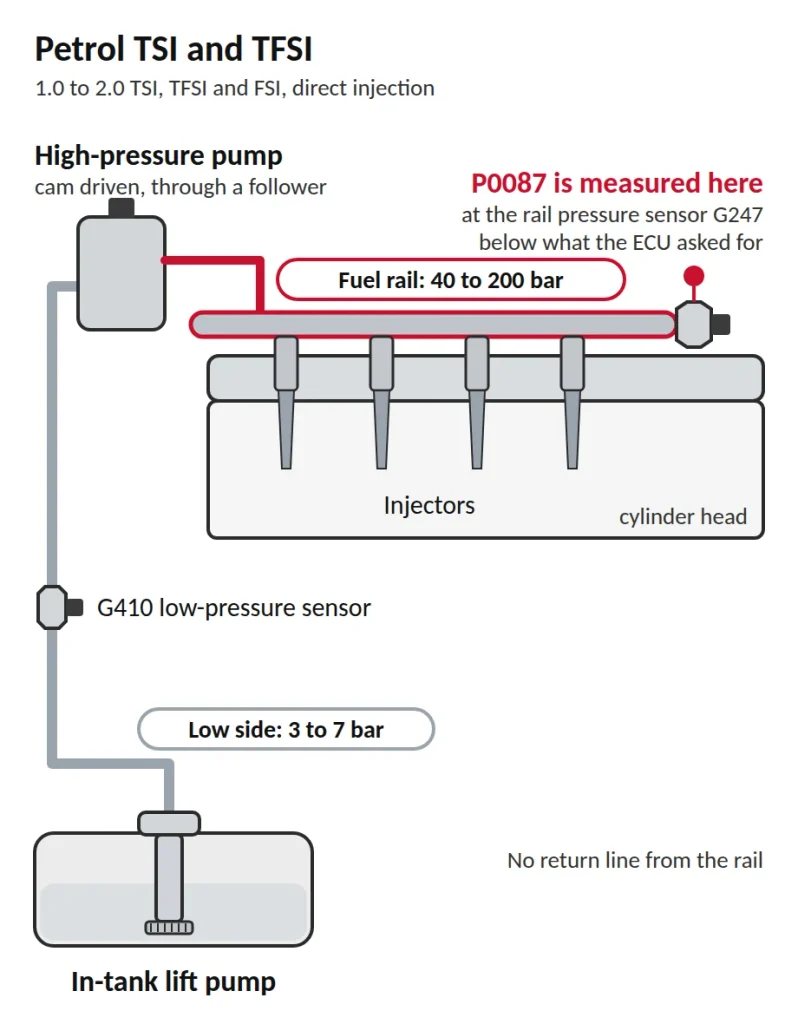
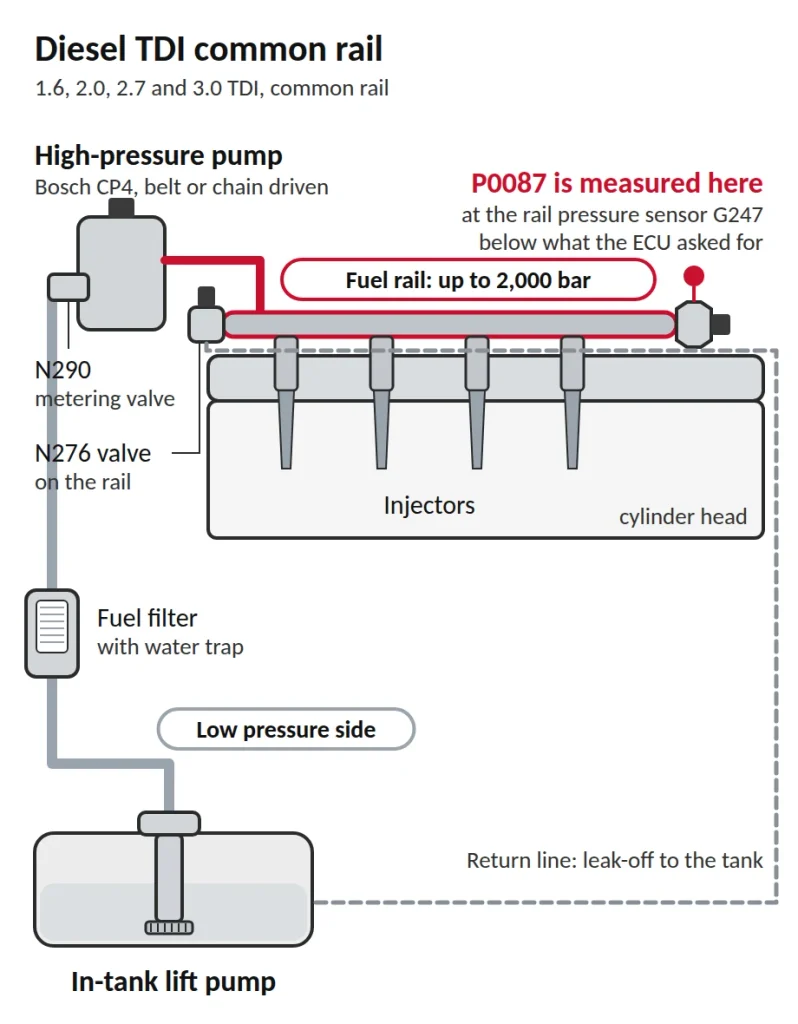
P0087 is the engine control unit reporting that the fuel pressure at the injectors fell below the pressure it asked for. Your engine has two fuel pumps. An electric pump in the tank pushes fuel forward at low pressure, about 3 to 7 bar on a petrol direct-injection engine. A mechanical pump on the engine then squeezes it much harder for the injectors: roughly 40 to 200 bar on a TSI or TFSI depending on the engine, and over 1,500 bar on a common-rail TDI. A sensor on the rail, the metal tube the injectors hang from, reports the real pressure back. The control unit compares it with the pressure it wanted and adjusts a valve on the pump to close the gap.
When the gap stays too big for too long, the code sets. VW’s own chart for the 2.0 TDI (CJAA) sets it when the pressure falls 150 to 200 bar short of the request, or below about 120 bar while the engine runs; P00C6 is the same complaint during cranking. Petrol engines work with smaller numbers, around 15 bar of shortfall on the 2.0 TFSI, according to the Ross-Tech wiki.
So the code tells you where the pressure was measured, not which part let it down. Anything between the tank and that sensor can be the cause, which is why the causes below are sorted by engine.
What Causes DTC P0087 on VW, Audi, Skoda and SEAT Engines?
Same code, two different fuel systems. Petrol direct injection and common-rail diesel fail in different places, so start with your engine. Causes are in the order worth checking, cheapest and most common first. On the small EA211 engines the pump is rarely the first suspect; the 1.0 TSI problems and 1.4 TSI engine problems pages list what fails first on each.
Petrol TSI and TFSI: the Supply Side
- Weak in-tank lift pump or its control module. The cause VW tells its dealers to rule out first on the 2.0 TSI. The high-pressure pump cannot make pressure from fuel it never receives. VW’s bulletin 2031426 for the 2008 to 2015 2.0 TSI tells technicians to test the low-pressure supply before touching the high-pressure pump. Shows up under load, when hot and with a low tank.
- Wrong or blocked fuel filter. Where the regulator lives in the filter, a replacement with the wrong rating (4 bar fitted where 6 bar belongs) sets P0087 and P310B together, says the Ross-Tech wiki. Often the whole story on a recently serviced car.
- Low fuel pressure sensor G410 or its wiring. A drifting G410 makes the control unit chase a pressure that is already fine. VW extended its warranty in the US, which says how often it failed.
Petrol TSI and TFSI: the High-Pressure Side
- Worn cam follower, 2.0 TFSI (EA113, 2004 to about 2012). The follower between the inlet camshaft and the pump wears through, the stroke shortens, pressure falls. VW and Audi bulletins cover the worn camshaft (TPI 2014143, TSB 2015153). Engine codes AXX, BGB, BPJ, BPY, BWA: Golf Mk5 GTI, A3 8P, A4 B7, Leon Cupra, Octavia vRS Mk2.
- High-pressure pump. Real, but rarer than owners think,and VW makes its dealers prove it before fitting one (the rule is under What Not to Replace). A published 2009 Tiguan repair found the pump’s seal failed and its follower loose inside: 6.5 bar against 40 requested.
- After a remap. A Stage 2 or 3 map asks for more fuel than the stock pumps deliver at high revs. Expect it only at full throttle near the top of the rev range; is a Stage 1 remap safe covers where stock fuelling runs out.
Diesel TDI: the Supply Side
- Fuel filter. First on every diesel: £35 to £60 fitted, and water and dirt restrict flow long before the filter is “due”. Shows up under load, on hills, when towing and during DPF regeneration.
- In-tank lift pump. T5, T6 and Crafter vans suffer most because they carry weight and tow. Same pattern as the filter: fine unladen, P0087 when the van works.
- Contaminated fuel. Petrol in a diesel tank, or a bad fill, wrecks the high-pressure pump’s lubrication. VW’s TPI 2023624 covers it. Look for metal in the filter before anything else.
Diesel TDI: Rail, Valves and Injectors
- Fuel pressure regulating valve N276 on the rail. It bleeds pressure back to the tank by design. When it leaks or sticks, pressure sags and P0087 arrives with P1065 or P0088. About £135 for the Bosch part on a 2.0 or 3.0 TDI, and on the V6 (Touareg, Q7, A6, Cayenne) VW notes it needs adapting after any fuel-system repair.
- Fuel metering valve N290 on the pump. It controls how much fuel enters the pump. A worn valve gives slow pressure build and long cranking.
- Injectors leaking back too much. Worn injectors return more fuel than they should, so the pump never catches up at idle and on cold starts. A return-flow test finds the odd one out.
- High-pressure pump failure. The Bosch CP4 pump can fail and send metal through the rail and injectors. This is the expensive one, and the one to rule in or out before driving on.
P0087 Symptoms and What They Tell You
The lights you see are a check engine light plus the EPC lamp on a petrol engine, or a flashing glow plug warning light on a TDI, with power loss or limp mode. What follows is diagnostic reasoning rather than a test result: the pattern around the code usually says more than the code.
- Only under load, hot, towing or on hills. Supply cannot keep up: filter first, then lift pump. The high-pressure pump is rarely the cause when idle is perfect.
- Only on cold start, or long cranking every morning. Pressure is leaking away overnight or building too slowly: injector back-leak, N290, or a tired high-pressure pump. VW’s 2.0 TSI bulletin describes exactly this: crank, no start after the car has sat. If the long crank only happens in the cold, read car hard start when cold first, because glow plugs and batteries fake this pattern.
- During or just after a DPF regeneration. Regeneration adds post-injection fuel, so demand jumps. A marginal lift pump or filter fails that test first. Clear the code, watch whether it returns only on regen days.
- With P0562 (low system voltage). The lift pump runs on battery voltage. A weak battery or alternator starves it. Fix the charging fault before buying fuel parts; a battery warning light that has flickered recently is the tell.
- Only at full throttle after a remap. Fuelling exceeds pump capacity. The cure is a milder map or an upgraded pump; a factory replacement pump changes nothing.
- Random, with no pattern and a perfectly running car. Suspect the sensor or its wiring before anything mechanical.
How to Diagnose P0087 Step by Step
Work from the cheapest test to the most expensive part. Live data first, because a cheap scanner shows the number that decides it.
1. Read and Save the Freeze Frame
Every scanner stores the conditions at the moment the code set: engine speed, load, coolant temperature, speed and fuel level (my guide to how to scan a car with OBD2 shows where the freeze frame hides in the app). Clear nothing yet. High load at speed points at supply, the filter or the lift pump. Cold start at low speed points at the high-pressure side or leaking injectors. A fuel level near empty points at the tank: fill it and see whether the code returns before you spend a penny.
2. Watch Specified Against Actual Rail Pressure
Any OBD app that reads the fuel rail pressure PID (Car Scanner on a Vgate iCar Pro, Torque, OBDeleven, VCDS) can show the actual value; VCDS and OBDeleven also show the specified value. Watch it at idle, at 3,000 rpm with no load, and on a steady pull in third gear. Actual should track specified within a few bar on a petrol engine and within a few tens of bar on a diesel. A gap that opens under load is a supply problem. A gap at idle is a high-pressure side problem.
3. Test the Low-Pressure Side
On a petrol engine with a G410 sensor, read the low fuel pressure and the lift-pump duty cycle. The Ross-Tech wiki gives 2.8 to 7.2 bar for the low side on the 2.0 TFSI and a lift-pump duty of 35 to 55 percent at idle; above 60 to 70 percent means the pump is working too hard, and a value swinging between 35 and 95 percent means it is failing. On a diesel without a low-side sensor, change the filter if it is more than a year old, then run the VCDS output test for the transfer pump or have a garage gauge the supply.
4. Diesel: Return-Flow Test on the Injectors
A garage fits graduated bottles to each injector’s return line and idles the engine for a few minutes. Any injector returning about 10 percent more or less than the others is the fault, according to Professional Motor Mechanic’s guide to the test. This is a one-hour job that saves buying a pump.
5. Petrol: Pull the High-Pressure Pump and Look
On a 2.0 TFSI the pump comes off with three bolts and the cam follower sits under it. Worn through means you have found the cause, and probably a damaged camshaft lobe. On the 2.0 TSI, VW’s dealer test is to run the N276 valve test plan and listen for a click from the pump: a click means the pump works.
6. Check for Metal Before Anything Goes Back Together
On a common-rail TDI, open the fuel filter housing and look for grey sludge or glitter. Metal means the pump has failed internally and every part downstream is suspect. Stop and get a quote for the full system before driving the car again.
How to Fix P0087 Fuel Rail System Pressure Too Low
The fix follows the test result. Find yours and do the matching job.
Supply Side
- Tank was near empty, code stays away on a full tank. Nothing to replace yet. Keep it above a quarter; if it returns with fuel in, test the lift pump. You.
- Diesel, pressure sags under load, filter over a year old. New filter at the correct rating, then prime by cycling the ignition three or four times. You.
- P0562 alongside, or a tired battery. Fix the battery or alternator and clean the earth straps before buying fuel parts. You.
- Low-side pressure or lift-pump duty out of range. New in-tank lift pump, genuine part, plus its control module if the voltage test fails. Garage, or you via the tank access panel.
High-Pressure Side
- 2.0 TFSI, follower worn. New cam follower and O-ring, and check the camshaft lobe under it; a scored lobe means the camshaft too. You, or garage for the camshaft.
- G410 or G247 reading wrong. Check the plug for corrosion, then replace the sensor. Garage.
- Return-flow test finds one injector out. Replace that injector only. Garage.
- TDI, slow pressure build, N276 or N290 suspected. Replace the valve, then have the learned values reset with VCDS or ODIS. Garage.
- Idle rail under 10 bar, N276 test silent, low side fine. High-pressure pump; on the 2.0 TSI the VW number is 06H127025Q. Garage.
- Metal in the filter housing. Whole fuel system: tank clean, lift pump, filter, pump, rail, valves, injectors, lines. Quote in writing, and ask to see the metal. Garage.
- P008700 with P12A300 on an S4, S5 or SQ5 3.0T. Software update under Audi TSB 2048604/3, no parts. Dealer.
Confirm the Fix
For any of these, clear the code and repeat the live-data test under the freeze-frame conditions, hill or trailer included; VW’s own check drive for the 2.0 TSI pump holds 3,000 to 5,500 rpm. Specified and actual together for two tanks of fuel means fixed.
DIY or Garage?
One rule: the low-pressure side is yours to try, anything that opens a high-pressure line goes to a garage. Those lines hold pressures that can injure you, and on a TDI the repair needs a reset in dealer software afterwards.
Whoever does the work, ask for the numbers: the low-side pressure, specified and actual rail pressure under the fault, the return-flow volumes on a diesel. A garage that quotes a high-pressure pump without them is guessing with your money. One owner on the VW T6 forum had spent £6,600 by July 2025 on injectors, sensors, two pumps and finally a whole fuel system, and still had the code, because nobody logged the pressure under the fault first.
Codes That Appear With P0087 and What Each One Changes
P0087 rarely comes alone, and the code next to it often names the side of the system to look at.
- P2293, P310B, P129F or P008A (TSI and TFSI). The low-pressure family. Test the G410 sensor, the lift pump and the filter rating before anyone mentions the high-pressure pump.
- P1065 (P106500) or P0088 (TDI). Pressure regulation out of range, or too high and too low at once. One pump cannot be weak and strong, so look at the N276 and N290 valves and at whether the learned values were reset after a repair.
- P00C6 (P00C600). Pressure too low while cranking. The system leaks down between drives: return-flow test the injectors, then the pump.
- P0562. Low system voltage. Fix the battery or alternator first; the lift pump cannot work on a weak supply.
- P12A300 on a 2017 to 2018 S4, S5 or SQ5 3.0T. Audi’s TSB 2048604/3 fixed P008700 with this code by updating the software. Ask the dealer before buying parts.
What It Costs to Fix P0087
Approximate prices, fitted unless stated, checked October 2026. The UK column comes from the price guides named below; the dollar and euro columns are the same jobs converted at £1 = $1.32 and €1.17 and rounded, a guide to the scale of each job rather than a quote. US garages charge more for labour and less for parts.
| Job | UK | US | Europe |
|---|---|---|---|
| Diesel fuel filter | £35 to £60 | $45 to $80 | €40 to €70 |
| Cam follower, 2.0 TFSI | £90 to £160 | $120 to $210 | €100 to €190 |
| Low fuel pressure sensor G410 | £80 to £160 | $100 to $210 | €90 to €190 |
| Rail pressure sensor G247 | £100 to £220 | $130 to $290 | €120 to €260 |
| Regulating valve N276 | £200 to £350 | $260 to $460 | €230 to €410 |
| In-tank lift pump | £230 to £450 | $300 to $600 | €270 to €530 |
| High-pressure pump, petrol | £350 to £900 | $460 to $1,200 | €410 to €1,050 |
| High-pressure pump, diesel | £550 to £1,200 | $730 to $1,600 | €640 to €1,400 |
| Injector return-flow test | £60 to £120 | $80 to $160 | €70 to €140 |
| Full fuel system after contamination | £4,000 to £7,000 | $5,300 to $9,300 | €4,700 to €8,200 |
Sources: ClickMechanic and Bumper price guides for the filter and pumps; Autodoc UK for the N276 valve (£133.99) plus an hour of labour; T6 owners’ reports for the full system.
What Not to Replace Without Testing
- The high-pressure pump. VW’s bulletin 2031426 tells its own dealers not to replace it if idle rail pressure is within 1 bar of 40 bar or the N276 test clicks. Hold your garage to the same standard.
- A set of injectors. Test the return flow. Replace the one that fails.
- The engine control unit. Audi’s P008700 bulletin says in plain words: do not replace the ECM, update the software.
- Anything on a diesel, before the fuel filter. It is the cheapest part in the system and the first thing to rule out.
How to Stop It Coming Back
Diesel owners should change the filter every year or 20,000 miles, sooner if the van tows or you fill up at unfamiliar stations. After any fuel-system repair on a TDI, have the learned values for N290 and N276 reset, because without that reset the code can return with a new part fitted. The 2.0 TFSI needs its cam follower looked at with every oil change once the car passes 60,000 miles.
Whatever the engine, a healthy battery matters, since the lift pump is the first thing to suffer from low voltage. Keep the tank above a quarter in winter or on a car with a known-weak pump. If you remap, ask the tuner where the stock pumps run out, and stay below it or budget for the pump upgrade.
FAQs
Rail pressure fell 150 to 200 bar short of what the control unit asked for, or below about 120 bar while running. Check the fuel filter, the lift pump and the N276 valve before the pump.
On the fuel rail, the metal tube the injectors hang from, under the engine cover. Most petrol direct-injection engines also have a low-pressure sensor (G410) on the supply line to the high-pressure pump.
Compare specified and actual rail pressure on live data. A gap under load means filter or lift pump; a gap at idle or cranking means valves, injectors or pump. Replace the part the test names, never the pump on the code alone.
Yes. A restricted or wrong-rated filter starves the high-pressure pump under load, so the code appears on hills, when towing or during DPF regeneration. On a diesel it is the first thing to rule out.
Gently and briefly, if the car runs normally. Stop if it cuts out, cranks for a long time, goes into limp mode repeatedly or smells of fuel.
Last Updated: October 2026

Founder of TheCarLane | Automotive Enthusiast
Ayush shares practical automotive knowledge based on real-world ownership and hands-on experience. His work focuses on diagnostics, engine systems, common car problems, and clear explanations that help everyday drivers understand their vehicles better.