
U112300 (“Databus error value received”) means one control module received a value that another module had marked as faulty. So the fault is usually in the sender, not in the module showing the code. You can usually keep driving, but take a red warning, limp mode or an ABS or ESC light seriously.
First, scan every module and find the one whose code names a part. However, if the entry is sporadic and nothing is lit on the dash, clear it and watch. VCDS shows the same code as U1123 00.
Can I drive? Usually yes. In limp mode or with the red battery light, only as far as home or a garage.
Senders traced: a wheel speed sensor, the steering wheel sensor, another unit’s software, or a false alarm.
Documented fixes: a new steering wheel, cleaned sensors or a dealer software update, by model.
Do not replace: the radar, camera or gateway that shows the code.
Cost: nothing to clear it. Garage diagnosis is £90 to £120 or $100 to $150.
This guide is built on 19 Volkswagen and Audi service bulletins, a real scan log and owners’ repair reports. The scanner notes come from my own Skoda Rapid, and prices were checked in November 2026.
What Does Code U112300 (Databus Error Value Received) Mean?
U112300 means a module received a message in which the sender flagged one of its own values as an error. The databus is the network the modules share.
An error value is a placeholder. A module sends it when it cannot supply a real reading, for example when its own sensor has failed. So the module that stores U112300 is reporting another module’s problem.
Your scan tool may word it differently. You may see “Databus error value received”, “Data bus, received error value” or, in VCDS, “U1123 00 – Received Error Message”. All three are the same code.
Here is how it looks in a real VCDS scan of a 2016 Golf:
Address 09: Cent. Elect. (J519)
535060 - Databus
U1123 00 [009] - Received Error Message
Confirmed - Tested Since Memory Clear
Fault Frequency: 25
Mileage: 158975 km
Date: 2019.12.05
The code sits in the central electrics module, and it has come back 25 times. However, the engine module logged P0562, system voltage too low, three seconds earlier. So on that car the first thing to check is voltage, not the central electrics module.
U112300 Is Not a Lost-Communication Code
U112300 is not a lost-communication code, because the message did arrive. Volkswagen uses separate codes for the other cases: U112100 for a missing message and U112200 for an implausible one.
For contrast, my own Skoda Rapid stored 01304, which means the gateway lost contact with the radio. The VAG fault code 01304 page covers that one.
Can You Drive With U112300?
Yes, you can usually drive with U112300, because the code records missing information and not a mechanical failure. What else is lit on the dash decides how far you should go.
- Only a driver-assist message: drive normally, without that aid.
- ABS or ESC light on: the car drives, but those systems may be switched off. So drive gently and scan it soon.
- EPC light or limp mode: follow the VW limp mode guide and the EPC light guide.
- Drive system: malfunction” on an Audi: follow the Audi drive system malfunction guide.
- No crank, or the red battery light: test the battery and charging first, with the battery warning light guide.
Once you know the car is safe to drive, check whether the fault is live.
The Warnings That Usually Come With It
U112300 comes with driver-assist messages, a row of warning lights, a no-start, or no warning at all. The code has no warning light of its own, so those warnings belong to the system that lost its input.
- On 2022 and 2023 Volkswagens: “Travel Assist currently not available”, “Emergency Assist limited availability” or “Park Assist and Rear Traffic Alert is currently not available”.
- On 2021 to 2024 Audis: “Audi Active Lane Assist: malfunction!” or “Traffic Jam Assist: malfunction!”.
- On 2016-era Golf and Jetta models: the ABS, ESC and tyre pressure lights together.
- On a 2021 to 2024 Audi A3: sometimes a no-start, with an engine start system fault.
- On some electric models: no warning at all, and every function still works.
U112300 Static or Sporadic: Check the Status First
First check whether U112300 is static or sporadic, because a sporadic entry with a clear dash may need no repair. Static, also shown as active, means the fault is present now. Sporadic, also shown as passive or intermittent, means the module logged it earlier and does not see it now.
Next, read the counter. VCDS calls it Fault Frequency, and it shows how many times the fault has come back. The mileage and date show when the module logged it.
Then apply one rule. If it is sporadic, the count is under 5 and nothing is lit, clear it and rescan in a week. If it is static, or the count keeps climbing, find the sender.
Audi draws a similar line in its own repair instruction for this code. There, a sporadic entry counts as a real fault once its counter reaches 5.
What Causes U112300: Known Senders and False Alarms
U112300 is caused by whichever module sent the error value. These are the known senders, each with the sign that points to it.
- A wheel speed sensor or another ABS fault: the ABS, ESC and tyre pressure lights, with a wheel speed code in the brake module.
- The steering wheel’s hands-on sensor: Travel Assist or lane assist messages on the models listed below.
- Software in another control unit: a known fault on the models listed below, fixed by a dealer update.
- A retrofit that was never coded: the code appeared after a tow bar or other new hardware went in.
- Low battery voltage: a voltage code logged at the same moment. Test the battery before you buy one, because a new battery alone did not clear this code for two owners.
- A false alarm: some models, mostly electric ones, store U112300 with no fault behind it.
A bulletin applies only when the symptom numbers in your scan match its list, so let the dealer confirm it.
Skoda and SEAT are not sold in the US, so no US bulletin names them. However, they share these platforms, so the same method applies: find the sender.
U112300 on Volkswagen: Models With a Documented Cause
On these Volkswagen models, a manufacturer bulletin names the cause of U112300. If yours is listed, start there.
- Golf R, GTI (2022): sound system software update, though lane change assist stores the code. Bulletin 96-22-01.
- Golf R, GTI, Tiguan, Jetta, Arteon (2022 to 2023): steering wheel sensor, fixed with a new steering wheel. Bulletin 48-23-01.
- e-Golf (2015 to 2017): heat pump control software. Bulletin 2040184.
- ID.4 (2021 to 2024): false alarm, even on some static entries. Five bulletins.
- Passat, Jetta, Beetle, Tiguan, CC, Eos (2014): false alarm in the Car-Net module. Bulletin 91-14-02.
U112300 on Audi: Models With a Documented Cause
On these Audi models, a manufacturer bulletin names the cause of U112300.
- A3, S3, RS 3 (2021 to 2024): wheel speed sensors to clean, not replace. Bulletin 2072549.
- A3, S3, RS 3 (2021 to 2024): body control module software, with a no-start or airbag light. Bulletins 2069999, 2071392.
- A4, A5, Q5 families (2021 to 2024): steering wheel sensor, fixed with a new steering wheel. Bulletin 2061932.
- A7, A8, Q7, Q8 (2021 to 2023), e-tron (2019 to 2023): steering wheel sensor. Earlier revisions of 2061932.
- A6, A7, A8, Q7, Q8, e-tron, e-tron GT (2019 to 2025, by model): driver assist software. Bulletin 2074688.
- e-tron GT (2022 to 2024): high-voltage battery manager. Bulletin 2071972. Its other entries are false alarms.
- Q4 e-tron (2022 to 2023): false alarm. Bulletin 2067842.
- TT (2016): headlight range control software. Bulletin 2042842.
The Audi pre sense malfunction guide lists the driver assist faults that need no part.
How to Find the Module Behind U112300
To find the module behind U112300, scan every module and pick out the one whose code names a part.
- Run a full scan, not an engine-only one. My Vgate adapter is engine-focused and cannot reach the ABS or airbag modules. OBDeleven reached six control units on my Skoda Rapid.
- Write down every code by module before you clear anything.
- Separate the witnesses from the suspect. A module that holds only U-codes is a witness. The suspect holds a code that names a sensor or a part.
- Match what stopped working to a signal. For example, if cruise control and stability control failed together, look at wheel speed.
- Look for a voltage code logged at the same mileage. If one is there, test the battery first.
- If the suspect is still unclear, clear all the codes and drive for a few days. What returns first usually points nearest the cause. If U112300 returns and you still cannot name the sender, book a garage diagnosis.
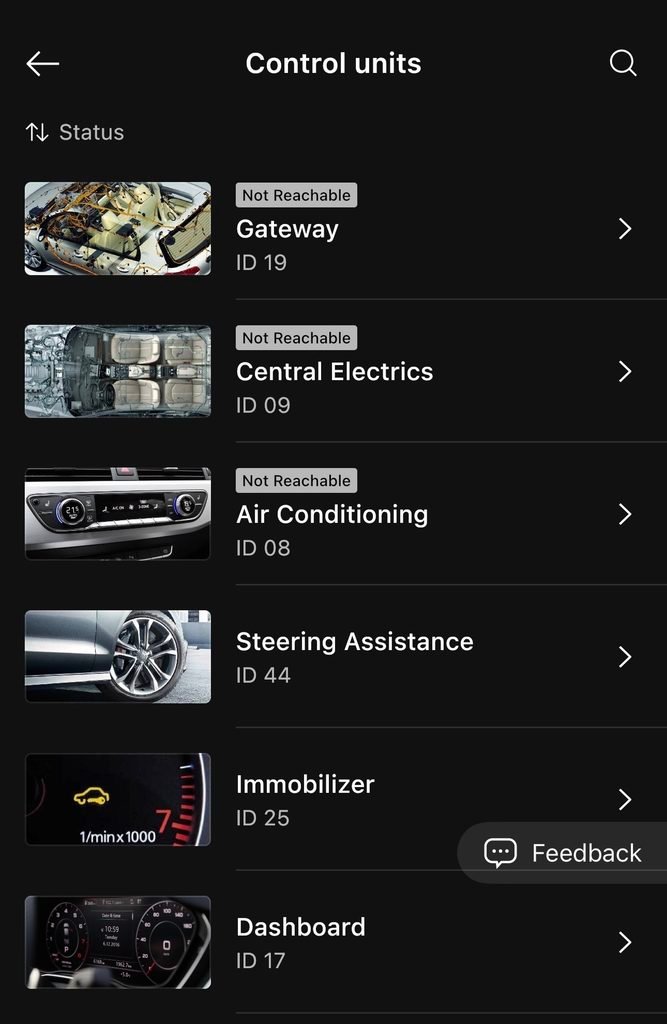
On my Skoda Rapid, OBDeleven marked the gateway, the central electrics and the air conditioning as not reachable. I put that down to my car’s older platform, not to the tool. So check which modules your tool read before you trust an empty scan.
What the Codes Next to U112300 Tell You
The codes stored next to U112300 usually name the sender, so read them before the U-code itself.
- A wheel speed sensor code in the brake module, such as C101AF1 or C101D29: that sensor. Clean it before you replace it.
- B17B8F2 or U133E00 in the gateway: the steering wheel’s touch sensor. On an Audi, a fault in the gateway value “Steering wheel touch recognition, status” confirms it.
- B114815 in the body control module of a 2021 to 2024 A3: that module’s software, which a dealer updates.
- P0562, system voltage too low: a voltage dip, so test the battery.
- U112100, a missing message: a module also went silent, so check its power supply and connector.
How to Fix U112300: Fix the Sender, Then Clear Every Module
U112300 is fixed by repairing whatever sent the error value, then clearing the fault memory in every module.
- Repair the part named by the sender’s own code. For a wheel speed sensor code, clean the sensor first.
- Test the battery, then charge or replace it if it fails.
- Clear the fault memory in every module, not only the one you scanned first.
- Drive the car normally for a few days.
- Scan every module again.
Do Not Replace the Module That Shows the Code
Do not replace the module that shows U112300, because it is the witness and not the culprit. None of the 19 bulletins behind this guide replaces it.
On the 2022 Golf R and GTI, lane change assist stores the code, and the fix is a sound system software update. On other models the radar and camera store it, and the fix is a new steering wheel. For its 2014 Car-Net module, Volkswagen says outright not to replace it.
The same goes for the gateway and the CAN wiring. Neither is a first suspect, because this code means the network delivered the message.
How to Confirm the Fix and Stop It Coming Back
The U112300 fix is confirmed when no module stores the code again after a week of normal driving. Also check that the frequency counter has stopped rising on any entry that remains.
To stop it coming back, scan the car after any retrofit. If you replace a wheel speed sensor, fit the genuine part or the Bosch equivalent. One owner went through three other sensors before a Bosch one cured his car.
What You Can Do Yourself, What Needs a Garage and What It Costs
You can read, sort and clear U112300 yourself, but two of the documented repairs are dealer work: a new steering wheel or a software update. A scanner that reaches every module does the first part. OBDeleven’s free plan reads the modules and clears faults.
The scanner I use for a full scan
OBDeleven. Reads the fault memory of every module it can reach and clears faults on the free plan. On my Skoda Rapid it reached six control units.
As an Amazon Associate and OBDeleven affiliate, TheCarLane earns from qualifying purchases.
Cleaning or changing a wheel speed sensor can be a home job. Before you buy one, swap the suspect sensor with its twin on the other side of the same axle. If the fault moves with it, the sensor is the cause.
However, the steering wheel repair means removing the driver airbag, so leave it to a workshop. Software updates run on the dealer’s own tester. Coding a retrofit needs a tool that can write to the modules, which on OBDeleven means the PRO plan.
At the garage, ask for a printout of every module with the status and mileage of each code. Then ask which module they believe is the sender. If your model is listed on this page, give them the bulletin number.
What Each Fix Costs
U112300 costs nothing to fix when the entry only needs clearing. A Bosch rear wheel speed sensor costs under £30 or $30 as a part.
| What you pay for | UK | US |
|---|---|---|
| Garage diagnosis, first visit | £90 to £120 | $100 to $150 |
| Rear wheel speed sensor, part only | £28.67 | $29.89 to $139.99 |
| AGM battery | £149.99 to £223.85 | $258.99 to $274.99 |
Prices come from Volkswagen retailers, one US specialist and parts sites, checked in November 2026. The sensor price is for a Mk7 Golf, and battery sizes vary by car.
The steering wheel and software fixes are warranty jobs while the car is covered. Audi’s US bulletins allow 48 months or 50,000 miles. Outside warranty, ask the dealer for a quote before you agree to the work.
FAQs
A sporadic entry can, because the module erases it after enough fault-free drives. A static entry stays until the sender is fixed.
Not by itself. The MOT fails a lit ABS, ESC, power steering, airbag, tyre pressure or engine warning lamp. So the lights matter, not the code.
Each module that uses the faulty value logs its own copy of U112300. So one bad sender can mark several modules.
U112300 means a message arrived carrying an error value. U112100 means the expected message never arrived.
On a Volkswagen group car, yes. VCDS prints U112300 as U1123 00. On other makes, U1123 can be a different fault, so match the brand first.
It can set it, so test the battery. However, a new battery alone did not clear the code for two owners, so find the sender as well.
Sources
- Volkswagen Technical Bulletins: 48-23-01, 96-22-01, 2040184, 91-14-02
- Volkswagen Technical Bulletins on irrelevant fault codes in the ID.4: 01-21-10, 01-22-06, 01-23-05, 01-24-01, 01-24-02
- Audi Technical Service Bulletin 2061932: revision 7 and revision 2
- Audi Technical Service Bulletins: 2074688, 2072549, 2069999, 2071392, 2042842
- Audi Technical Service Bulletins for the e-tron GT and Q4 e-tron: 2071972, 2064083, 2064758, 2067842
- Ross-Tech, Fault Codes screen guide for VCDS
- GOV.UK MOT inspection manual: cars and passenger vehicles, sections 1.6, 2.6, 5, 7.1.6, 7.12 and 8.2
- Public VCDS scan of a 2016 Golf, vagcode.info log 498
- Owner reports: VWROC forum, 2016 Golf R, OBDeleven forum, 2016 Golf R, TheeGTIGuy on YouTube, 2016 Jetta GLI, TX-Board, 2021 T6.1
- Prices, checked November 2026: Donnelly Volkswagen, Agnew Volkswagen, Oak City Auto, Autodoc, FCP Euro (sensor, battery), ECS Tuning, GoBatteries, Car Parts 4 Less
Last Updated: November 2026

Founder of TheCarLane | Automotive Enthusiast
Ayush shares practical automotive knowledge based on real-world ownership and hands-on experience. His work focuses on diagnostics, engine systems, common car problems, and clear explanations that help everyday drivers understand their vehicles better.