

P2463 means too much soot has built up inside your diesel particulate filter. The filter is restricted and the engine computer wants it cleaned. It is safe to keep driving short distances gently, but do not ignore it for weeks, and it usually does not mean you need a new filter.
In this guide you will find how to read your soot level with a cheap scanner, what that number means, every fix from a free drive to a professional clean, what each one costs in the UK and US, when to hand it to a mechanic, and how to stop the code coming back. The examples come from VW, Audi and Skoda diesels, with live data from my own car.
P2463 Code: Severity, Cost and Fixes at a Glance
| Question | Answer |
|---|---|
| Do I need a new DPF? | Rarely. Most cases end at free or under £100 |
| How serious is it? | Moderate. Caught early it is routine. Ignored for weeks it gets expensive |
| Can you keep driving? | Yes, gently and briefly. Do not sit on it |
| What decides the fix? | Your soot load reading, in grams or percent |
| Cheapest fix | A completed regeneration drive, free, if soot is below the block level |
| Typical garage fix | Forced regeneration, £80 to £150 or $100 to $200 |
| Worst case | DPF cleaning, and only rarely replacement |
| Can you check it yourself? | Yes, with a £30 adapter and a free app |
Start Here: Read One Number First
Before anything else, plug in your scanner and write down the soot load, shown in grams or percent. Every fix for P2463 branches from that number:
- Soot modest and no warning lights: you can probably fix this for free with one long drive. The fix section below has the exact drive.
- Glow plug light flashing or limp mode: skip the drive and book a forced regeneration at an independent garage.
- A garage already refused or failed a forced regeneration: the filter needs an off-car clean. That is normal at high soot levels, and far cheaper than a new filter.
No scanner yet? A £30 Bluetooth adapter and a free app do everything you need, covered below. The rest of this page explains each branch, what it costs, and how to stop the code coming back.
Can I Still Drive With a P2463 Code?
Yes, you can drive with a P2463 code. Short distances at normal speeds are fine, and the car is not about to break down. Treat it as a job for this week, not something to live with.
The engine will protect itself. VW Limp mode exists so you can get home or to a garage without damage. What you should not do is treat a restricted filter as background noise for weeks. A blocked DPF raises exhaust backpressure, and sustained high backpressure stresses the turbocharger; the turbo can’t spin up against it, which is why P0299 often appears alongside this code. On top of that, every failed cleaning attempt washes a little extra diesel into the engine oil.
There is one honest exception. If your soot reading is still below the level where the computer blocks driving regenerations, one long steady drive can genuinely fix this code for free. That is why the very next step is reading the number, not booking anything yet.
How Do I Check My Soot Level Myself?
A cheap Bluetooth OBD2 adapter (I use a Vgate iCar Pro, about £30) with the Car Scanner app, or an OBDeleven, will show you everything that matters:
- Soot load, in grams or percent. This is the number everything hangs on. Write it down.
- Regeneration status (0 = off, 1 = passive, 2 = active). You will use this during the fix drive: a 2 means the burn is running, so let it finish before you park.
- DPF differential pressure. On a healthy filter this sits near zero at idle and rises with revs. My own BMW X5 diesel reads 0.4 kPa at idle and 4.2 kPa at 2,000 rpm. A filter showing high pressure at idle is seriously restricted.
- Ash volume, where your tool shows it. Ash matters for the recurring cases, explained further down.
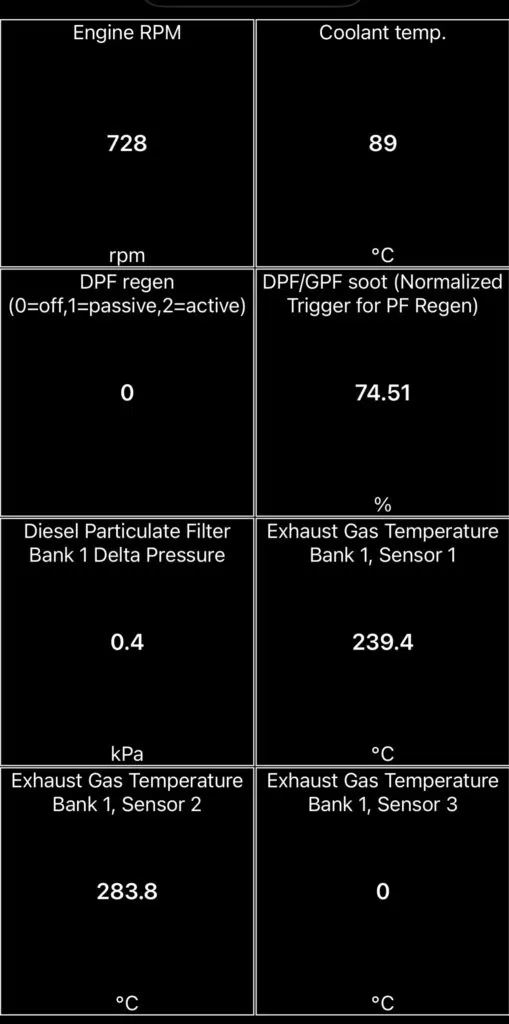
In OBDeleven, open the Engine control unit, then Live data, and look for particle filter soot mass (calculated and measured), ash volume, and regeneration status. In Car Scanner, the DPF channels sit in the sensor list once the adapter connects.
While you are in app, resist the clear button. P2463 describes the state of the filter, so clearing it changes nothing. The soot is still physically inside, the computer counts it again, and the code returns within minutes. Owners burn whole evenings on this loop. Clear codes after a fix, not instead of one.
How Much Soot Is Too Much?
The computer tracks soot as a calculated load, shown in grams or as a percentage in your scan tool. The fix available to you depends on where that number sits, because VAG software works in tiers:
Tier 1: elevated but below the block level. The computer will still run a regeneration while you drive. A proper 30 to 40 minute steady run at operating temperature can burn the soot down and clear the code. Cost: nothing.
Tier 2: above the block level. The computer refuses to regenerate on the move. It needs a stationary forced regeneration, started with a diagnostic tool at a garage. This is the tier most P2463 cars are in by the time the light comes on.
Tier 3: heavily overloaded. Above a higher limit, tools refuse the forced regeneration too. This is not the software being awkward. Burning off that much soot in one go creates enough heat to damage or destroy the filter, which is why the Ross-Tech documentation states that a filter loaded above specification needs replacement rather than regeneration. It is also why a garage may refuse to force a regen on your car. They are not fobbing you off. They are avoiding setting fire to your filter.
The exact gram thresholds vary by engine, so read your own numbers rather than trusting a universal figure. For a sense of scale from real cases: one T6 owner logged this code at 40 grams of soot and climbing, with limp mode expected around 50, and his forced regeneration already refused. On the other side of the Atlantic, GM’s own service documentation sets the equivalent code at 140 percent soot accumulation with a mandatory service regeneration. Different makers, same logic: past a certain load, the free fixes are gone.
How Do I Fix Fault Code P2463?
Match the fix to your tier. That is the whole method.
Soot below the block level: take the car for 30 to 40 minutes of steady main-road driving, engine fully warm, holding around 2,000 rpm in a middle gear. Watch the soot number fall if a passenger can hold the phone. The full drive technique is in our DPF regeneration guide.
Soot above the block level: book a forced regeneration at an independent garage with VCDS, ODIS or equivalent. German-speaking readers: the clearest German-language analysis of the Octavia 3 DPF pattern, including which ODIS values a workshop reads before choosing between an EGR clean, a filter clean or replacement, is KFZ Dietrich’s workshop article. Fifteen to twenty minutes stationary, done properly, and the soot burns down under controlled conditions.
Forced regeneration refused or failed: the filter needs to come off for a professional clean, which flushes out both soot and ash. This restores a filter that regeneration no longer can, at a fraction of replacement cost.
Cleaned but the code returns: the filter was the victim. Find the culprit: pressure sensor and hoses first, then EGR, intake flaps, injectors and thermostat. Replacing or cleaning a DPF without fixing the cause just schedules the same failure again.
When Should You Visit a Mechanic for P2463?
Go straight to a garage, and skip the DIY steps, if any of these are true:
- The glow plug light is flashing or the car is in limp mode. The soot is past the self-help stage.
- Your soot reading is above the driving regeneration block level. Only a diagnostic tool can start the burn now.
- A forced regeneration was refused or failed. The filter needs professional cleaning, not another attempt.
- The code returns after a completed regeneration. Something upstream is making too much soot, and finding it needs proper diagnosis.
- Your oil level is rising above the max mark. That is fuel dilution from failed regenerations, and it needs an oil change plus the cause fixed.
Two things make the visit cheaper. Bring your soot and pressure readings, because they save the first hour of diagnosis. And treat “you need a new DPF” as an opening quote, not a verdict: a fair garage reads the soot and ash values before condemning the filter, and a forced regeneration or off-car clean solves most of these cases for a tenth of what a replacement costs.
How Much Does It Cost to Fix P2463?
These are estimated prices from independent garages. Your exact cost depends on the engine and the cause, and dealers usually charge more.
| Fix | UK | US |
|---|---|---|
| Regeneration drive (Tier 1 only) | Free | Free |
| Forced regeneration | £80 to £150 | $100 to $200 |
| Differential pressure sensor and hoses | £80 to £160 | $120 to $250 |
| Professional DPF clean (off car) | £250 to £400 | $300 to $500 |
| DPF replacement | £900 to £2,000+ | $1,500 to $3,500+ |
The off-car clean is the row to remember. It rescues most filters that regeneration has given up on, including ash loading, for roughly a sixth of a new filter; DPF replacement cost by car, and the readings that decide it, are on their own page.
What Does the P2463 Code Mean?
Your diesel particulate filter (DPF) traps soot from the exhaust and burns it off in cleaning cycles called regenerations. Your car logs DTC P2463 when the trapped soot passes the limit the engine computer accepts. The filter is now restricted enough that the computer treats it as a problem, not a routine.
This makes P2463 different from most fault codes. It is not reporting an event that happened. It is reporting a state your filter is in right now. That difference explains two things owners find confusing: why the code comes straight back when you clear it, and why the right fix changes depending on how much soot is in there. The logic is identical across the group, from a Golf to a Q7, which is why the fix method below works on any of them.
Its sibling code tells the other half of the story. P2458 logs when regenerations keep failing to finish. P2463 logs when the soot those failed cleanings left behind has piled up past the limit. First the process fails, then the consequence arrives.
Why Does My Scanner Show P246300, 23902 or P2463 09?
Same fault, different costumes. Generic OBD2 apps show P2463. VAG tools such as OBDeleven, VCDS and dealer equipment show P246300, the five digit Volkswagen Group format. Some tools add a DTC prefix as well, so an Audi A3 logging DTC P246300 and a Skoda Octavia logging P2463 are reporting exactly the same fault. Some apps also print VW’s internal fault number 23902 next to it, which throws people because it looks like a different problem. It is not. One real world example: a T6 owner saw “23902 Volkswagen: P2463” in one app and “23902 Particulate Filter Restriction, Soot accumulation Bank 1” in another. Same filter, same soot.
One format that is not yours: P2463 09 belongs to Mercedes, which uses its own suffix. If that is what your screen says, you are reading a Mercedes fault, not a VAG one.
What Are the Symptoms of P2463?
Plenty of owners find this code on a routine scan with no symptoms at all, and if that is you, it means the soot crossed the logging threshold before it started affecting how the car drives. That is the cheap stage. When the load climbs further, the code stops being quiet:
- Engine warning light, often joined by a flashing glow plug light
- Reduced power or full limp mode, especially under load or uphill
- The car refusing to rev past a point it normally would
- Worse fuel economy and a flat, breathless feel
- In heavier cases, dark smoke on acceleration
A flashing glow plug light on a VAG diesel is the car telling you the DPF situation needs attention now, not next month. Our DPF warning light guide covers the full escalation of lights.
What Causes P2463 on VW, Audi and Skoda?
1. Months of short, slow trips. The overwhelming favourite. Regenerations need 10 to 20 minutes of sustained heat, city driving keeps interrupting them, and every interrupted cycle leaves soot behind. The debt compounds quietly until the limit trips. If you also have P2458 stored, that is the paper trail of the failed cleanings. It does not matter whether it is a 1.6 TDI Leon on school runs or a 2.0 TDI Passat crawling through traffic, the pattern is the same.
2. A lying differential pressure sensor. The computer partly estimates soot from the pressure across the filter. A faulty sensor or cracked, soot-blocked hoses feed it bad numbers, and it can either miss a loading filter or condemn a clean one. Cheap to check, cheap to fix, always worth ruling out before bigger spending.
3. An engine fault making extra soot.A stuck EGR valve, stuck swirl flaps (P2015 on a 2.0 TDI, usually a snapped lever), tired injectors, a lazy thermostat keeping the engine cool. Any of these loads the filter faster than regeneration can empty it. If P2463 returns after a successful clean, stop cleaning and start looking here.
4. Ash, the retirement problem. Regeneration burns soot but cannot burn ash, the mineral residue every burn leaves behind. Ash fills the filter slowly over its whole life. A high mileage car that keeps logging soot codes even after successful regenerations, with pressure that never returns to normal, has an ash problem. No drive fixes ash. Only off-car cleaning or replacement does.
A note for van owners. Transporters, Crafters and Caddys on short-trip trade duty are this code’s most loyal customers. Multi-drop work is the exact drive pattern regeneration hates. If that is your van’s life, the prevention section below is not optional reading.
Do DPF Cleaner Additives Work for P2463?
Honestly: sometimes, at the light end. A fuel additive lowers the temperature at which soot burns, which helps a mildly loaded filter regenerate more completely. As maintenance for a short-trip car, a bottle every few months earns its keep.
What no additive can do is rescue a Tier 3 filter or remove ash. If your soot reading is high and the forced regen is refused, a £15 bottle is not an alternative to a £300 clean, whatever the label implies. Use additives to help a working system stay working, not to bail out a blocked one.
Should I Just Delete the DPF?
You will find this advice ranking in search results, and it is a trap. In the UK, a car that had a DPF from the factory fails its MOT without one, checked since 2014, and driving without it carries a fine of up to £1,000 for a car and £2,500 for a van. In the US, removing emissions equipment is a federal tampering violation. Add voided insurance and a car you cannot honestly sell, and the maths never works. A full professional clean costs less than the fine, and the car stays legal. Fix the cause instead. It is cheaper than it looks and legal everywhere.
Why Do P2458 and P2463 Appear Together?
They are cause and consequence. P2458 records regenerations failing to finish. P2463 records the soot those failures left behind crossing the limit. Enough of the first and the second arrives on schedule.
Seeing both changes your starting point. P2458 alone: a proper drive has a real chance. Both codes: the soot is usually already past the driving-regeneration level, so start with the scanner reading and expect the answer to be a forced regeneration, not a motorway run.
How Do I Stop P2463 Coming Back?
- One proper run a week. Thirty minutes of steady main-road driving lets regenerations start and finish. For a short-trip car or a multi-drop van, this single habit is the whole game.
- Never park mid-regeneration. Fans roaring after shutdown and a raised idle mean the car is cleaning. Give it five more minutes of driving instead of the handbrake.
- Run the right oil. Modern VAG diesels need low-ash oil to VW 507 00 spec. The wrong oil literally becomes extra ash in the filter, and ash never leaves on its own.
- Fix the small stuff fast. A stuck thermostat or lazy EGR quietly ruins every regeneration until it is replaced.
FAQs
Short distances, gently, yes. The car protects itself with limp mode. Do not ignore it for weeks: backpressure stresses the turbo and failed regenerations thin the oil.
It depends on the engine, which is why you read your own number. The pattern from real cases: driving regenerations get blocked first, forced regenerations get refused at a higher load, and above that only cleaning or replacement remains.
No. P2463 describes the filter’s current state, so it returns as soon as the computer recounts the soot. Clear it after a completed regeneration or repair, to confirm the fix held.
The lit engine warning light is a major defect and an MOT fail in the UK, and a stored code fails OBD emissions inspections in US states that test. Fix first, test after.
It can help a lightly loaded filter regenerate and it works as maintenance. It cannot clear a heavily blocked filter or remove ash.
Last Updated: September 2026

Founder of TheCarLane | Automotive Enthusiast
Ayush shares practical automotive knowledge based on real-world ownership and hands-on experience. His work focuses on diagnostics, engine systems, common car problems, and clear explanations that help everyday drivers understand their vehicles better.