
In the UK in September 2026, DPF replacement cost is £600 to £1,200 fitted with a good aftermarket filter, £1,200 to £2,000 with the genuine part at an independent, and £1,800 to £3,000 at a dealer; bigger engines and vans sit at the top. Most quotes for a new filter are for one that doesn’t need replacing: soot comes out with a £200 clean or a £100 forced regeneration, and only ash, which builds over 150,000 miles or more, needs the filter changed. Every quote site gives a range and no car; the table below gives yours. Before you agree to anything, get the soot and ash readings.
I haven’t replaced a DPF on either of my cars, and TheCarLane doesn’t sell cleaning or take quotes. The readings on this page come from my own BMW X5 diesel; the prices are UK garage-network averages and parts-retailer listings, named where they’re used, and were checked in September 2026. Treat the ranges as a guide for a written quote, not a price.
DPF Replacement Cost by Car
Fitted prices at a UK independent, September 2026. Find your engine, not your model: it’s on the V5C and on the sticker in the boot floor, and it decides the price. The VW-group rows name the common cars; a Leon, Superb, Ateca or Q3 with the same engine sits in the same row. Aftermarket means a type-approved filter from a known maker; dealer prices run 30 to 50 percent above the genuine-part column.
| Car | Aftermarket, fitted | Genuine part, fitted |
|---|---|---|
| VW 1.6 TDI: Polo, Fabia, Ibiza, Golf, A3 | £600 to £950 | £1,100 to £1,600 |
| VW 2.0 TDI, transverse: Golf, Octavia, Passat, Tiguan | £700 to £1,200 | £1,300 to £2,100 |
| Audi 2.0 TDI, longitudinal: A4, A5, A6, Q5 | £850 to £1,300 | £1,600 to £2,400 |
| Audi 3.0 TDI: A6, A7, Q7, Touareg | £1,200 to £1,800 | £2,200 to £3,200 |
| VW vans: Caddy, Transporter, Crafter, Amarok | £900 to £1,500 | £1,700 to £2,800 |
| Ford: Focus, Kuga, Mondeo TDCi | £600 to £1,000 | £1,200 to £1,900 |
| Ford Transit, Transit Custom | £900 to £1,400 | £1,600 to £2,600 |
| BMW: 1, 3, 5 Series, X1, X3 | £800 to £1,300 | £1,600 to £2,600 |
| Mercedes: A, C, E-Class | £800 to £1,300 | £1,700 to £2,800 |
| Vauxhall: Astra, Insignia CDTi | £600 to £1,000 | £1,100 to £1,800 |
| Nissan: Qashqai, X-Trail dCi | £600 to £1,000 | £1,200 to £1,900 |
| Land Rover: Evoque, Discovery Sport | £900 to £1,500 | £1,800 to £3,000 |
On a Golf, Octavia, Passat or Tiguan 2.0 TDI, a new DPF costs £700 to £1,200 fitted with an aftermarket filter and £1,300 to £2,100 with the genuine part; on a 3.0 TDI Audi it’s £1,200 to £1,800 and £2,200 to £3,200.
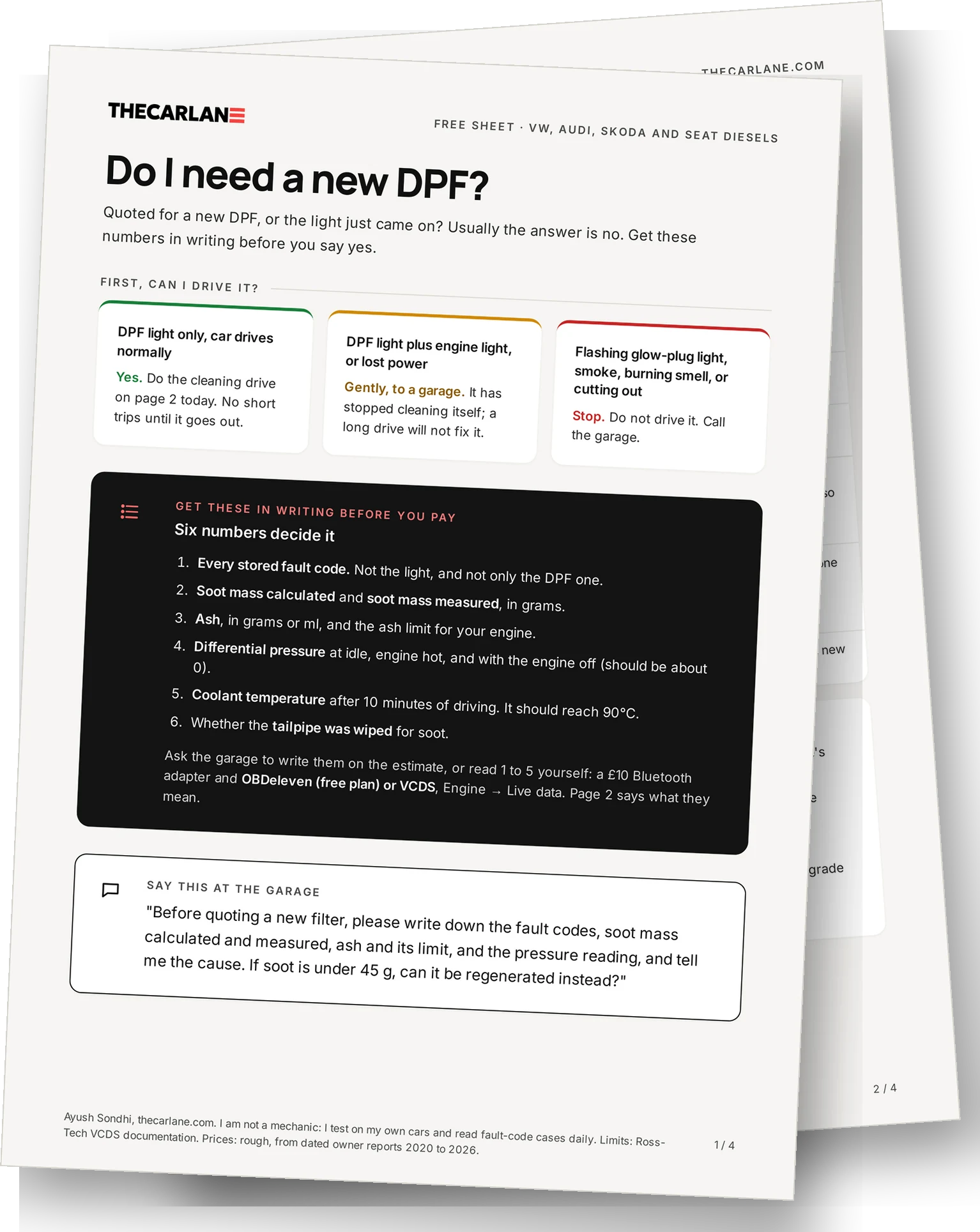
Free sheet · 4 pages · before you pay for a new DPF
Been quoted a new DPF? Six numbers decide if you need one
Most quotes for a new filter are written without the readings that decide it. The sheet gives you the six numbers to ask for, what they mean, and what a regen, a clean and a new filter should each cost.
No spam. One email with the sheet, then nothing unless you reply.
Already have the quote in hand? The $19 written check is here.
How the Table Was Built
The VW-group rows combine WhoCanFixMyCar’s booking averages, dpfguide.co.uk’s parts and labour ranges and Autodoc’s listings; the other makes use Engines Market’s segment bands with the dealer margin taken out.
The average DPF replacement booked through WhoCanFixMyCar is £445, which shows how many of those bookings are aftermarket filters on small cars. At the other end, a genuine Audi 2.0 TDI filter was quoted at £1,440 for the part alone on the VW Audi Forum. Engines Market’s bands, £800 to £3,500 by vehicle size, include dealer margin; the rows above don’t.
US and India
The US diesel market is mostly pickups, and the DPF on a Ford Power Stroke, Ram Cummins or GM Duramax is a bigger, dearer unit than anything in the table. PartCatalog’s guide puts a fitted DPF at $600 to $1,200 on a compact diesel and $1,200 to $2,500 on trucks and larger engines at an independent, with dealers above that; one VW dealer bill for a 2012 TDI came to $2,470 before tax, $1,647 in parts and seven hours of labour. In India a genuine filter for a 2.0 TDI Octavia or Superb is a dealer-only part at roughly ₹80,000 to ₹1,50,000 fitted
Does My DPF Need Replacing, or Will a Clean Do?
The rule that separates the two is what fills the filter: soot, which regeneration burns off and a clean removes, or ash, the mineral residue every burn leaves behind, which only an off-car clean or a new filter takes out. Two numbers tell you which you have, and a garage can read both in ten minutes.
Read two numbers before anyone quotes
A scan tool that reads VW-group data shows soot load in grams and ash volume, and reading them yourself takes a £30 adapter and fifteen minutes; how to read them is on the regeneration page. The same readings exist on other makes under slightly different names. If you don’t have a scanner, ask the garage for both figures in writing with the quote. A quote for a new filter that doesn’t come with an ash reading is a quote for a part nobody has checked.
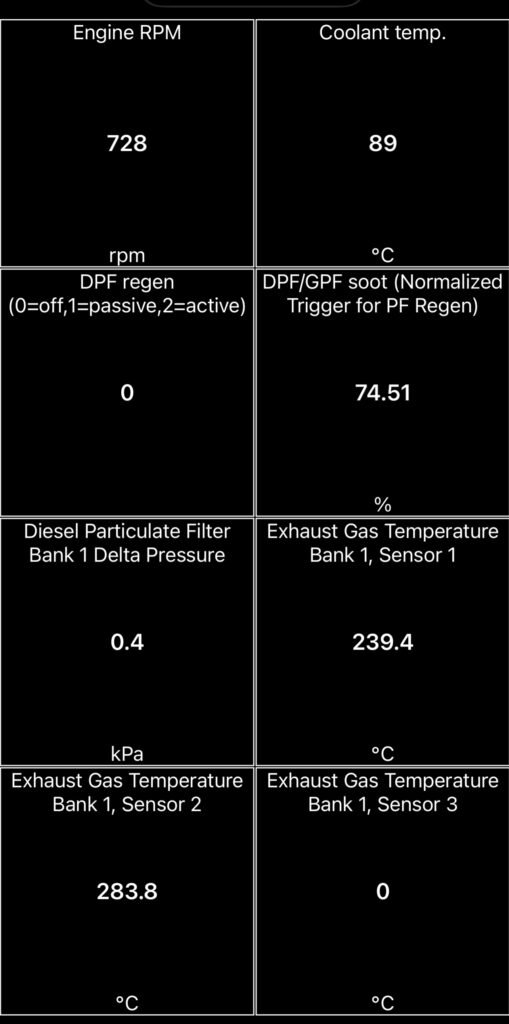
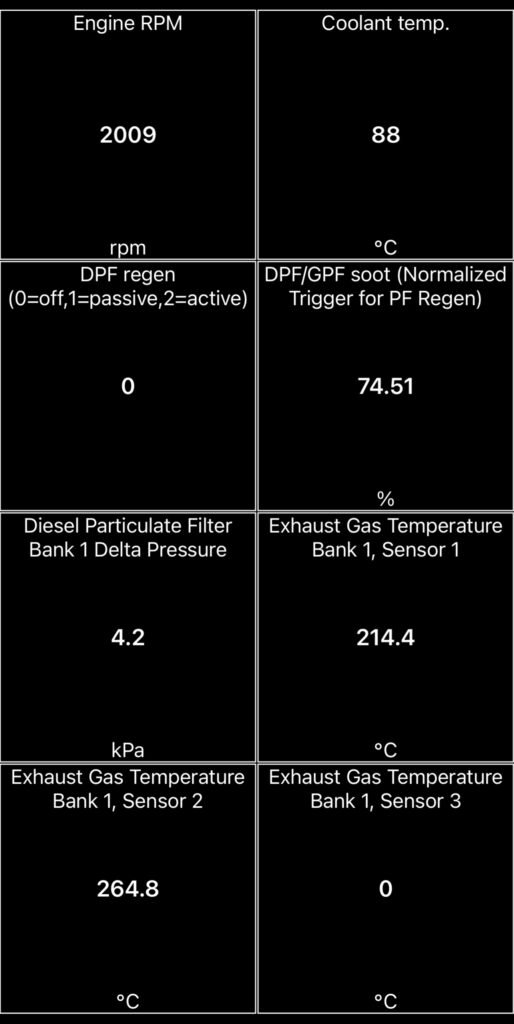
The third number is the differential pressure across the filter. On a healthy filter it sits near zero at idle and rises with revs; my BMW X5 reads 0.4 kPa at idle and 4.2 kPa at 2,000 rpm. High at idle means restriction. A reading that never moves, or sits at an implausible fixed value, means the sensor or its hoses, and a £50 to £120 sensor gets condemned as a £1,500 filter often enough to rule it out first.
Cleaning usually works when
- Soot is high and ash is low. The filter is blocked, not worn. A forced regeneration burns the soot off with the car stationary; if the tool refuses because the load is past its safe limit, an off-car clean does the same job. Either way a new filter buys nothing a clean doesn’t.
- The warning came after months of short trips. Regenerations kept getting interrupted, and the soot compounded. One completed regeneration, driven or forced, clears it; the drive that completes one is on the regeneration page.
- The filter is high-mileage but the substrate is sound. Ash near its limit is what an off-car clean exists for, and it’s the route to ask about before agreeing to a replacement on any car over 100,000 miles.
Replace when
- Ash is at its limit and an off-car clean has failed or been refused. The honeycomb has no room left. Nothing burns ash, and no drive or additive moves it.
- The substrate is cracked or melted. Usually the aftermath of an uncontrolled regeneration on an overloaded filter, or a filter that was forced when the tool said not to. A specialist confirms it by looking; a pressure reading that’s suddenly near zero with the code still set is the clue.
- The filter was removed and refitted badly, or it’s leaking at the can. Physical damage, not loading.
Neither, until the cause is fixed
If the code comes back within weeks of a successful clean or regeneration, the filter was the victim. A stuck EGR valve, a lazy thermostat, tired injectors, a faulty pressure sensor or the wrong oil loads the next filter the same way. Cleaning or replacing without finding which one schedules the same bill again; the P2002 page has the cause list.
What this saves, and what it doesn’t
The readings put the cheap routes first: a forced regeneration or an on-car clean for under £300 before a filter for £1,000 or more. They don’t make a worn-out filter last, and a garage that has read the ash and still says replace is usually right. On a car worth less than £3,000, that order is the whole answer; a £1,500 filter on a £2,000 car is a decision you make only once the readings say nothing cheaper will work.
Main dealers replace; they don’t clean, which is why a dealer quote is for a new filter every time. Where the numbers are on the line, get a second quote from a DPF specialist rather than a general garage or a dealer. It costs a diagnosis fee, and it’s the cheapest second opinion in the trade Or send me the readings and the quote and I’ll check both in writing for $19. Whoever cleans it, ask for the differential pressure before and after: a clean that worked shows in the numbers. One PistonHeads owner’s Focus went from 9 psi to 0.8 psi across the filter after a mobile clean at a fifth of the dealer’s £1,000 quote.
How often a clean is enough
DPF Clean Team, a UK reconditioner, puts its off-car success rate at 96 percent and says seven in ten fleet managers are advised to replace unnecessarily. It’s a cleaning company, so treat the figure as the upper bound, but the direction matches every owner thread on the subject.
What the Job Involves
The DPF is a ceramic honeycomb in a steel can, bolted into the exhaust just after the turbo, with a pressure sensor and a temperature sensor on it. On most VW-group cars it’s a separate unit from the catalyst; on some the two share one can.
Replacement is three to five hours at an independent: undertray off, sensors and clamps off, the old unit out, the new one in with fresh gaskets and clamps, then the step nobody mentions in the quote. After a new DPF is fitted, the ECU’s learned soot and ash values must be reset with a diagnostic tool; without that reset the car keeps counting the old filter’s ash and the warning returns on an empty filter. VCDS has a DPF replacement routine for it; on OBDeleven it’s a basic setting, which needs a PRO plan.
Parts vs Labour
The filter is most of the bill. Aftermarket VW-group filters list at £316 to £695 on Autodoc; genuine ones run £700 to £1,800 depending on the car. Labour is £150 to £500 at an independent for three to five hours, more on a van or a V6 where the exhaust has to come apart in pieces. Add £50 to £120 for the scan and the adaptation reset, and £30 to £80 for gaskets and clamps; the old ones don’t go back on. A new differential pressure sensor, £50 to £120, is worth fitting at the same time if the old one is over 100,000 miles.
What Changes the DPF Replacement Cost
- Genuine or aftermarket. The biggest swing, two to three times on the part. A type-approved aftermarket filter from a known maker is fine on a car you’ll keep three years; an unbranded one is a filter you’ll be quoting for again.
- One can or two. Engines with the catalyst and DPF in one housing replace both whether the catalyst needed it or not, which is why two cars with the same engine can get quotes £600 apart.
- Access. Transverse four-cylinders are the easy end. Vans, longitudinal Audis and the 3.0 TDI take longer and sometimes need the exhaust dropped.
- What comes off with it. Seized studs, a snapped sensor, a crumbling flexi pipe. Expect a call from the garage on any car over ten years old.
- Dealer or independent. Dealers use the genuine part and their own labour rate; the same job is 30 to 50 percent more.
- The cause. A new filter on a car that’s still making too much soot lasts as long as the last one. If the cause isn’t fixed, budget for it too.
Cheaper Than Replacement, in Order
At a garage
- A forced regeneration, £80 to £150. A garage runs a forced DPF regeneration with VCDS, OBDeleven or an equivalent tool, burning the soot off with the car stationary in 30 to 60 minutes. Works when soot is high and ash is low, and the tool will refuse it if the load is past the safe limit.
- An on-car chemical clean, £150 to £300. Cleaner sprayed into the filter through a sensor port, then a regeneration. The average DPF clean booked through WhoCanFixMyCar is £188, and the site is where to get three quotes in an evening: £215 on a Volkswagen, £221 on an Audi, £193 on a Skoda, £235 on a BMW, £228 on a Ford. Good on a moderately loaded filter; it can’t reach ash.
- An off-car clean, £250 to £400. The filter comes out and goes through a machine that flushes soot and ash. This is the route that saves the high-mileage filter a garage has just condemned, and it’s the one to ask about before agreeing to a replacement.
Parts and routes that cost less
- A reconditioned genuine filter on exchange, £300 to £700. A cleaned and pressure-tested original, supplied against your old one. Cheaper than aftermarket on many cars and the same part the car left the factory with.
- Cleaning it yourself, about £35 plus a day. If you can get the filter off, an off-car cleaning solution soaked in overnight and rinsed through does what a garage’s machine does at lower pressure; it’s the method owners on PistonHeads describe. New gaskets on refit, and it does nothing for a cracked substrate.
- An in-tank additive, £15 to £20. Lowers the temperature soot burns at, which helps a lightly loaded filter finish a regeneration. Useful as maintenance on a short-trip car; it can’t reach ash and it doesn’t rescue a blocked filter.
- A used filter. Only with a pressure-test certificate, and only from a car with a known mileage. A used filter with unknown ash is the same gamble you’re trying to avoid.
- Not a delete. Removing the filter fails the MOT, which has checked for a DPF since 2014, and carries a fine of up to £1,000 for a car and £2,500 for a van. A clean costs less than the fine.
After the New Filter Goes In
Three things make a new filter last: the adaptation reset, so the ECU starts its soot and ash counters from zero; the cause fixed, or the new filter goes the way of the old one; and one proper run a week, thirty minutes at a steady speed, so regenerations finish.
Related Codes and Symptoms
P2463 means soot past the limit, and it’s the code behind most replacement quotes. P2002 means the filter’s efficiency reads low, which is as often the sensor as the filter. P2458 means regenerations keep failing to finish. The DPF warning light is the dashboard version of all three. A DPF that’s blocked also stops the turbo spinning up, so P0299 often appears beside them.
FAQs
£600 to £1,200 fitted with an aftermarket filter, £1,200 to £2,000 with the genuine part at an independent, £1,800 to £3,000 at a dealer. Vans and 3.0 TDIs sit at the top.
Almost always. Soot cleans out with a forced regeneration or a chemical clean for £80 to £300. Only ash, or a cracked filter, needs replacement.
Until its ash limit, typically 150,000 miles or more on a car that gets driven, less on a short-trip car or one on the wrong oil. Low-ash oil to the VW spec is what stretches it.
A type-approved one from a known maker, yes, for normal use. An unbranded one may not meet the emissions standard the MOT tests and often blocks early.
Yes. The ECU’s learned soot and ash values have to be reset so it treats the filter as new. Without the reset the warning can come back on an empty filter.
A cracked substrate or a failed sensor usually is. A filter blocked by soot usually isn’t, because manufacturers class that as driving pattern. Read the exclusions in the warranty booklet before accepting “not a warranty issue” at the desk, and ask for the soot and ash readings behind it.
Three to five hours at an independent, and some garages book a full day. A forced regeneration takes 30 to 60 minutes; an off-car clean is usually a day with the filter away.
Last Updated: September 2026

Founder of TheCarLane | Automotive Enthusiast
Ayush shares practical automotive knowledge based on real-world ownership and hands-on experience. His work focuses on diagnostics, engine systems, common car problems, and clear explanations that help everyday drivers understand their vehicles better.