

P2458, or VW P245800 as your scanner shows it (16848 or 23967 in VCDS), means a DPF regeneration ran past its time limit or kept stopping before it finished. It does not mean the filter is blocked. Most of the time the car never got the conditions a regeneration needs, or one sensor is stopping the engine computer from seeing it finish. You can usually keep driving. Before anyone quotes you for a new DPF, read three readings: soot, ash and the exhaust temperature sensors.
Can You Drive With P2458?
Yes, while the engine light is steady and the car pulls like normal. A regeneration needs a warm engine at road speed to finish, so driving is part of the cure. VW’s own cure for a filter under 40 g of soot is a 20-minute drive at a steady road speed.
Three things change that. Get the soot reading the same day if you see any of them:
- Limp mode, or revs capped at about 2,500. Soot has gone past its limit.
- The glow plug light flashing with the DPF light. The car has stopped allowing regenerations. Another motorway run will not change that.
- Oil above the max mark on the dipstick. Every regeneration that does not finish leaves fuel in the oil. Thin oil does not protect a turbo, so check the dipstick before a long drive.
Symptoms of P2458
P2458 symptoms are often just the engine management light. The rest arrive as the failed regenerations stack up:
- Engine management light on, often with nothing else wrong
- DPF warning light on
- Glow plug light flashing, on some cars
- Less power, or revs capped at about 2,500
- Regenerations more often: higher idle, a hot smell, the radiator fan running after you switch off
- Using more fuel
- Oil level rising on the dipstick
What VW P245800 Means: Particulate Filter Regeneration Duration Bank 1
VW P245800 is the engine computer’s record that a DPF regeneration ran past its time limit, or kept starting and stopping until the total ran over. It is a timer fault, not a measurement of how blocked the filter is. VW does not publish the limit, so ignore any page that gives you a single number of minutes.
The regeneration itself: every few hundred miles the engine computer burns the soot out of the filter
It squirts extra fuel after the main burn, which heats the filter to between 350°C and 600°C and turns the soot to ash. VW’s tech tip puts the start of a driving regeneration at 18.9 g of soot on the 2.0 TDI Passat, and the burn should take 20 to 30 minutes. A finished burn ends near 6 g: about 7 minutes to heat up, then 20 or more burning (a T6 Forum moderator’s VCDS logs).
A Real P2458 Freeze Frame, Read Line by Line
An Audi A1 1.6 TDI owner posted his VCDS scan on the Ross-Tech forum: 131,445 km, limp mode, glow plug and DPF lights, only P2458 stored. His freeze frame, and what I read into it (this is reasoning; the thread does not record the fix):
- Soot calculated 15.14 g, soot measured minus 3.99 g. The computer’s estimate is a normal mid-cycle figure. The pressure sensor says less than empty. A negative measured figure is a sensor that cannot see the filter.
- Differential pressure (the pressure drop across the filter) 0.00 hPa at 780 rpm. With the engine running there should be a reading. Zero means the sensor or its two hoses.
- Regeneration time counter 12,596 seconds, 404 km since the last burn. 210 minutes on the clock for a burn that should take 30. The pressure side never confirmed it finished, so the timer ran out.
- Coolant 89°C. Conditions were fine. One reading was the problem.
P2458, P2463 or P2002: Which One You Have
- P2458 says the regeneration took too long. The filter is usually fine.
- P2463 says soot is over its limit, often because of the failed regenerations behind P2458. The soot number decides what happens next.
- P2002 says the filter is not trapping enough soot: cracked, removed, or worn out.
If you have two of them, read them in that order: cause, then result.
What Causes P2458 on VW, Audi, Skoda and SEAT Diesels
The common causes of P2458: regenerations that never finish (short trips, low fuel, a thermostat stuck open), a DPF pressure sensor or its hoses, an exhaust temperature sensor, too much soot from an EGR, boost or injector fault, ash at its limit, and on two engines a software bug. The filter itself is last on the list.
Conditions the car never met
Short trips and cold running. The most common cause, and the cheapest to rule out. A nine-mile commute starts a regeneration and switches the engine off in the middle of it, every day, until the timer gives up. Winter makes it worse (colder starts, longer warm-ups, shorter trips), which is why P2458 turns up in November on cars that were fine all summer.
Low fuel. Below about a quarter of a tank the computer holds off regenerations. Run the car low for a few weeks and it never completes one.
A thermostat stuck open. The computer wants the coolant above 70°C before it starts a burn, and a burn stalls on an engine that only just gets there. P2181 or P0128 next to P2458 settles it. Without a scanner, the clue is a heater that blows lukewarm.
A sensor that stops the regeneration finishing
Pressure sensor or its hoses. A sensor across the filter measures how blocked it is through two rubber hoses. If the sensor or a hose (split, or full of soot) reads a full filter after the burn, or nothing at all, the burn runs until the timer trips. Measured soot at zero or below, or calculated and measured far apart, points here. Codes P2452 to P2455 may come with it; the A1 in the freeze frame had none.
Exhaust temperature sensor. Three sit along the exhaust, and one reading nonsense stops the burn. A T6 owner’s sensor 2 read minus 40°C; a new sensor and a forced regeneration lasted two days before sensor 1 failed. Codes P0544, P2032, P2033 or P242A to P242D name the sensor, and VW’s tech tip says no regeneration runs with an exhaust temperature, airflow (MAF) or differential pressure fault stored.
The engine making too much soot
EGR valve stuck or coked. More soot every mile, so each regeneration has more to burn. P0401 or P0403 with P2458.
A boost leak. VW’s tech tip says a charge-air leak makes soot climb rapidly. A split intercooler hose or a loose clip shows as P0299 or P0101 beside P2458, with a whistle under load.
A leaking injector. Black smoke, rough idle, fuel in the oil. The injector balance values in a full scan show which one.
Ash. Ash is what is left after soot burns, and it never comes out. Past its limit, which VW does not publish, every regeneration is short and frequent. High ash with normal soot needs a clean or a new filter, and no sensor changes that.
Software
On some cars the timer or the soot model was wrong. VW fixed P2458 on the 2011 Golf and Jetta 2.0 TDI (engine code CJAA) with an engine computer update and nothing mechanical (Technical Bulletin 2026578). Audi did the same on the 2015 A3 TDI (CRUA), where the software counted soot wrongly at idle and set P2463 and P2458 on a filter that was fine (TSB 2040489/4). That bulletin tells dealers not to replace parts for these codes unless the guided test points at one. Say that to any garage. Both are US bulletins; a UK or EU dealer checks for open updates by VIN the same way.
An update is a check, not a cure. A UK garage saw a 2016 A3 the dealer had already updated; the fault was a dead temperature sensor. A remap that alters the post-injection can set P2458 too; the tuner puts it right.
How to Diagnose P2458 Step by Step
To diagnose P2458, read every stored code, then five DPF values (soot calculated, soot measured, ash, time since last regeneration, differential pressure) and the three exhaust temperatures, then watch one regeneration run. The pattern of readings names the cause before any part is bought.
Start with what the car is doing
Light on, car drives fine, mostly short trips: the regenerations are not finishing. One long drive, then see whether the code comes back.
P2458 on its own and measured soot at zero or below: the pressure sensor cannot see the filter. Check its two hoses, then the sensor.
Heater slow to warm, gauge below the middle: the thermostat. Watch the coolant temperature on a 20-minute drive.
1. Read every code
Scan the engine module and write the whole list down before clearing anything. A sensor, EGR, boost or thermostat code is the diagnosis. P2458 is what it caused.
2. Read the DPF live data
Five values: soot calculated (the computer’s estimate), soot measured (from the pressure sensor), ash, time since last regeneration, and differential pressure. OBDeleven shows them on the free plan under the engine module’s live data; the VAG DPF app on Android shows the same set through a cheap adapter. Healthy after a regeneration: soot under about 6 g, calculated and measured within a few grams of each other, time since regeneration in the low hundreds of minutes or less (a Briskoda Octavia with failing burns showed 1,267). Differential pressure should read about zero with the engine off and climb when you rev it.
3. Check the exhaust temperature sensors
Warm engine, after a drive. The three sensors show as EGT 1, 2 and 3 in the live data. They should read sensible, rising values: a few hundred degrees at idle, climbing together under load. A sensor stuck at minus 40°C, at zero, or far away from its neighbours is dead, and nothing regenerates until it is replaced. If one has failed, read the other two closely; on the T6 the second one went two days later.
4. Watch the coolant temperature
On a 20-minute drive it should reach 85°C to 90°C and stay there. Stuck in the 60s or 70s means the thermostat.
5. Complete one regeneration and watch it
If soot is under 40 g and no sensor code is stored: drive for 20 to 30 minutes at 60 km/h or more, holding 2,000 to 2,500 rpm in a lower gear, with more than a quarter of a tank. Watch regeneration status, the filter temperature and soot. You want the status active, the filter between 350°C and 600°C, and soot falling toward zero from about 7 minutes in. If it finishes and the code stays away for two weeks, the cause was conditions. If it starts and never finishes, a sensor is stopping it, and steps 2 and 3 say which.
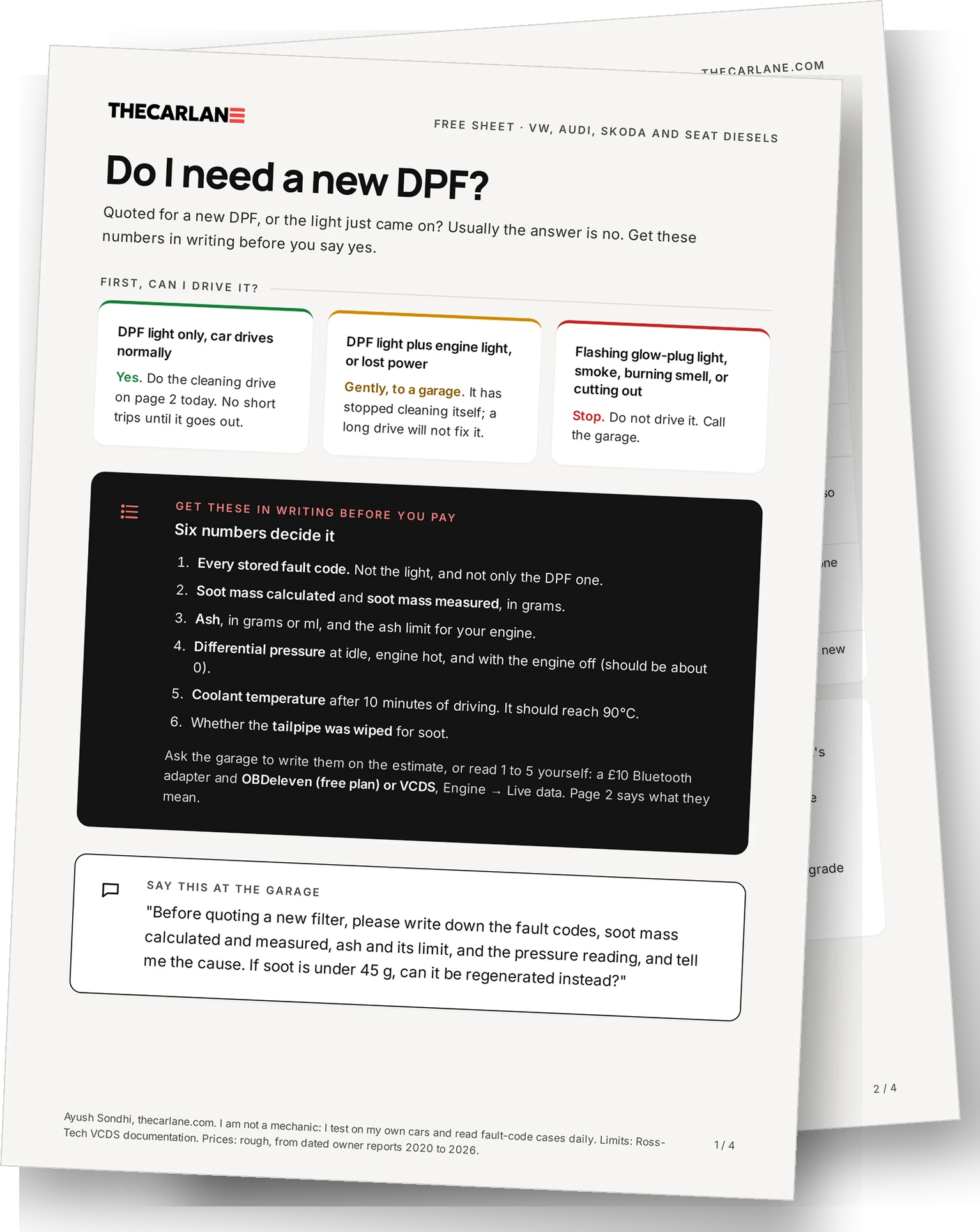
Free sheet · 4 pages · before you pay for a new DPF
Been quoted a new DPF? Six numbers decide if you need one
Most quotes for a new filter are written without the readings that decide it. The sheet gives you the six numbers to ask for, what they mean, and what a regen, a clean and a new filter should each cost.
No spam. One email with the sheet, then nothing unless you reply.
Already have the quote in hand? The $19 written check is here.
How to Fix P2458, by Cause
The fix for P2458 is whatever stopped the regeneration finishing, then one completed regeneration. It is rarely the filter.
Short trips. The drive in step 5: 20 to 30 minutes at 60 km/h or more, 2,000 to 2,500 rpm, more than a quarter of a tank. One finished regeneration clears the cause. The code goes after a few more drives.
Low fuel. Fill to above a quarter, then do the same drive.
Thermostat stuck open. Replace the thermostat, then one regeneration.
Exhaust temperature sensor. Replace the sensor the code names, clear the codes, then one regeneration. Check the other two in live data before you pay for the burn.
Pressure sensor. Replace its two rubber hoses first. If measured soot still reads zero or disagrees with calculated, replace the sensor. Clear, then regenerate.
EGR valve. Clean or replace it, then regenerate.
Boost leak. Fix the hose or clip, clear P0299 or P0101, then regenerate.
Leaking injector. Have the injectors tested, replace the one that fails, change the oil, then regenerate.
Ash at its limit. A professional clean. A new filter only if the clean shows the core is cracked.
Software. Ask the dealer to check your VIN for an open update: VW bulletin 2026578 for the 2011 CJAA, Audi 2040489/4 for the 2015 A3 CRUA. If the update changes nothing, go back to the sensors.
Oil above max, whatever the cause. Change the oil and filter before the regeneration, not after.
Confirm it. A week later: P2458 has not come back, the regeneration duration value, where your tool shows it, reads 0, time since last regeneration is counting normally, and the oil level is steady. Back within a fortnight means the cause is still there, usually the one that was not tested.
Home or Garage?
Most of P2458 is a home job with a scanner. The sensors are a garage job if you would rather not, and anything over 40 g of soot always is.
At home: reading the codes and the five DPF values, the regeneration drive, the oil change, the pressure sensor hoses. A service regeneration too, for soot between 30 and 40 g: a standing regeneration burns it off with the car parked, up to 30 minutes at raised revs. It needs a VAG tool, OBDeleven on the PRO plan or VCDS; a generic adapter reads the code but cannot start the burn. The tool still offers a driving regeneration between 40 and 45 g, but VW hands anything over 40 g to a dealer, and above the specified load the tool refuses, because a filter that full can crack when it burns.
At a garage: the temperature and pressure sensors if you would rather not work under a hot exhaust (half an hour each), the thermostat (a few hours on a 2.0 TDI), injector testing, the DPF clean, and anything over 40 g of soot.
Ask for the numbers in writing: soot calculated, soot measured, ash, the three exhaust temperatures. A garage that will not give them has not read them. Ask for the regeneration after any sensor job, on the invoice.
Refuse a new filter on soot alone; soot burns off, and a clean comes before a replacement.Refuse anyone offering to “reset” P2458 by typing zero into the soot adaptation; it hides the fault and tells the car a loaded filter is empty. Refuse a “delete”: illegal on a road car in the UK and most of Europe, an MOT failure, and a problem with your insurer.
Which Engines and Models Get P2458
The common-rail diesels with a DPF, 2008 onwards: the 1.6 TDI (CAYC and later) in the A1, Polo, Fabia, Ibiza, Golf, Yeti and Octavia; the 2.0 TDI (CBAB, CFFB, CJAA, CRUA and the EA288 family) in the Golf, Jetta, Passat, Tiguan, Octavia, Superb, Leon, A3 and A4; and the 2.0 TDI in the Transporter T5.1 and T6, where long idling loads the filter. The 2011 CJAA and the 2015 CRUA are the two with documented software fixes. Older pumpe-düse engines with a DPF (BMN, BMR) store the same code for the same reasons. Sensor part numbers vary by engine, so take the VIN to the parts counter.
What P2458 Costs to Fix
Fixing P2458 costs £50 to £300 in most cases: a scan and live-data check, then a pair of hoses or a sensor. A professional DPF clean is £150 to £350 when ash is the cause. A new filter, which this code rarely needs, is £600 to £1,200 fitted. Approximate, independent garages, October 2026.
| Repair | UK | US | EU |
|---|---|---|---|
| Scan and live-data check | £40 to £90 | $80 to $150 | €50 to €100 |
| Exhaust temperature sensor, fitted | £90 to £200 | $150 to $350 | €100 to €220 |
| Pressure sensor, fitted | £80 to £180 | $120 to $300 | €90 to €200 |
| Pressure sensor hoses | £10 to £30 | $15 to $40 | €10 to €30 |
| Thermostat, fitted | £120 to £350 | $250 to $600 | €150 to €400 |
| Forced regeneration at a garage | £50 to £120 | $100 to $200 | €60 to €130 |
| Professional DPF clean | £150 to £350 | $300 to $600 | €180 to €400 |
| DPF replacement, aftermarket | £600 to £1,200 | $1,000 to $2,500 | €700 to €1,400 |
How to Stop P2458 Coming Back
One 30-minute drive a week at road speed. Keep the tank above a quarter. Check the oil level monthly, and change it rather than top it up when it rises. Scan the car every few months, because a temperature sensor code sits quietly for weeks before it turns into P2458.
What to Do Now With P2458
- Today, scan every module and write the codes down, then read the five DPF values and the three exhaust temperatures, and check the dipstick.
- If there is no other code, soot is under 40 g and the oil level is normal, do the step 5 drive and watch the burn finish. Clear the code once it has.
- If a sensor, EGR, boost or thermostat code is stored, or measured soot reads zero or below: fix that part first. Then one regeneration, then the check a week later.
- Limp mode, soot over 40 g, or ash at its limit is a garage job: Take the numbers in writing before anyone quotes you for a filter. If P2463 is stored beside P2458, the soot page is your next read.
FAQs
Yes, if the engine pulls normally and the light is steady. In limp mode, get it scanned first.
Drive 20 to 30 minutes at road speed if soot is under 40 g. Between 30 and 40 g, a standing regeneration with a VAG tool. Above 40 g, a professional clean.
About 6 g after a regeneration, rising to about 19 g before the next one. Above 40 g is a dealer job.
You do not. It clears after a completed regeneration, or with a scanner once the cause is fixed. Zeroing the soot value hides the fault; it does not reset anything.
Yes, through the engine management light, which is a major defect until the fault is fixed and the light is off.
Last Updated: October 2026

Founder of TheCarLane | Automotive Enthusiast
Ayush shares practical automotive knowledge based on real-world ownership and hands-on experience. His work focuses on diagnostics, engine systems, common car problems, and clear explanations that help everyday drivers understand their vehicles better.