
A DTC P2102 Volkswagen, Audi, Skoda or SEAT fault means the wire that powers your throttle motor is touching metal it shouldn’t. The engine computer sends current to the motor, sees it drain away to ground instead of reaching the motor, and logs “Throttle Actuator Control Motor Circuit Low”. Scanners that use the VAG format show it as P210200. Petrol cars get the EPC light and limp mode. A TDI gets the engine light instead, and if the flap has jammed shut, it won’t start at all.
The throttle body is the last thing to buy. On petrol engines the short is usually in the harness or the plug. On 2.0 TDIs it’s usually the throttle valve motor itself, a part that costs £92 to £240, not the manifold and not the engine computer.
Below: whether you can drive, which of the three throttle codes you have, a two-minute test that splits wiring from part, the TDI failure most guides miss, and what each fix costs.
Quick Verdict
- Drive? Petrol in limp mode: gently, short distance. Petrol with a dead pedal, or a TDI that won’t start: no.
- Usual cause, petrol: a chafed wire or a wet plug at the throttle body.
- Usual cause, 2.0 TDI: the throttle valve motor has stripped its gears or burnt out.
- First test: unplug the throttle body and rescan. Two minutes, no tools.
- Cost: £1 if it’s the fuse, £40 to £150 for wiring, £200 to £450 for a throttle body fitted.
Can You Drive With P2102?
On a petrol car the computer cuts power to protect the engine, which is limp mode. You can move, slowly, to get off the road or to a nearby garage. Don’t overtake and don’t use the motorway. If the pedal does nothing at all, stop and call recovery. A car that can’t accelerate can’t get out of anyone’s way.
On a TDI it depends on where the flap failed. If it failed open, the car runs and the light stays on. Drive it to a garage this week. If it failed shut, the engine can’t take in air and won’t start. Don’t keep cranking it. There’s a way to get it home further down.
Symptoms of P2102: Petrol and Diesel Look Different
Petrol (TSI, TFSI, MPI):
- EPC light on, engine light usually with it
- Limp mode: flat pedal, high or unstable idle
- Sometimes fine after a restart, then back within minutes
Diesel (TDI):
- Engine light, without the EPC light on many cars
- Rough idle and no power if the flap is half open
- Won’t start if the flap is shut
- A grinding or clicking noise from the front of the engine for days or weeks before it fails
That last one matters. One Audi 2.0 TDI owner heard grinding for about a week and thought it was a fan. It was the gears inside the throttle valve motor wearing away. (Audi-Sport thread)
What Does DTC P2102 Mean on a Volkswagen, Audi or Skoda?
On a Volkswagen the throttle body is J338 in VW’s naming, the throttle valve control unit, and the motor inside it is G186. The engine computer powers it through two wires and watches the current. When it sees the current fall to ground instead of passing through the motor, that’s “circuit low”. It’s an electrical fault, not a mechanical one. Carbon on the plate doesn’t cause it, and cleaning won’t clear it.
On a 2.0 TDI the same J338 is the throttle valve at the mouth of the intake manifold. It closes when you switch off, to stop the engine shuddering, and it helps the EGR do its job. Forums call it the intake flap or the anti-shudder valve. It is not the swirl flap motor. That’s V157, and it belongs to P2015, a different fault on the same manifold. Both motors sit within a few inches of each other, and people replace the wrong one.
Why your scanner shows P210200, DTC P2102 or 008450
All one fault. Generic apps show P2102. OBDeleven, VCDS and dealer tools show P210200, or space it as P2102 00. Older VCDS logs show it as 008450 – Throttle Valve Actuator Module (J338): Motor Circuit P2102 – 000 – Signal Low. If a garage quotes you for “fault 8450”, it’s this.
P2100, P2101 or P2102: Which One Do You Have?
These three share a motor and a plug, and scanners often show more than one. The difference decides what you test.
| Codes stored | What it says | Start here |
|---|---|---|
| P2102 alone | Motor wire shorted to ground | The unplug test below |
| P2102 + P2100 | Circuit low and open circuit on the same motor | On a TDI, the motor has usually stripped or burnt out. On a petrol, the harness is damaged in more than one place, or the motor is dead |
| P2102 + P2101 | Short to ground, plus the plate not reaching its target | Fix the short first. P2101 often clears with it. If not, the P2101 guide takes over |
| P2102 with other “short to ground” codes (fans, solenoids, sensors) | Several circuits shorting at once | A shared wiring loom or a bad earth strap, not the throttle body |
That last row is real. A 2010 Jetta TDI logged P2100, P2101 and P2102 together, next to a cooling-fan short to ground. Three throttle codes at once point at wiring the circuits share, not three separate throttle faults. (TDIClub log)
For P2100 on its own, the open-circuit fault, see the P2100 guide.
The Two-Minute Unplug Test for P2102
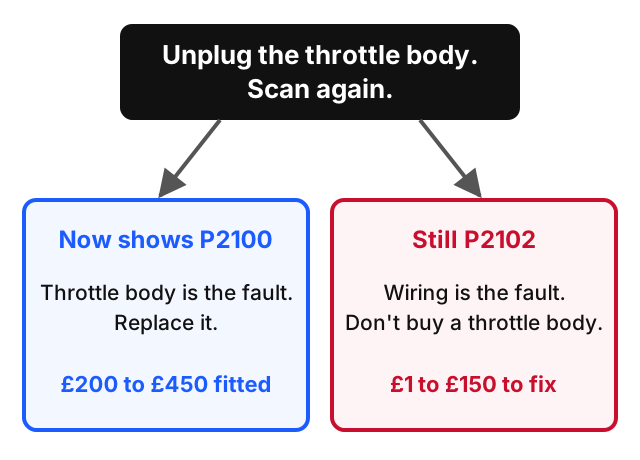
This is the one test that tells you whether the fault is in the part or in the wiring, and you need no tools.
- Ignition off. Unplug the connector on the throttle body.
- Ignition on. Clear the codes and rescan, or just switch the ignition off and on and rescan.
- Read what comes back.
The code changed to P2100. The computer now sees an open circuit, which is correct, because you’ve unplugged the motor. The short was inside the throttle body. Replace it.
The code is still P2102. The motor isn’t even connected and the computer still sees the wire touching ground. The short is in the harness between the plug and the engine computer, or in the plug itself. Don’t buy a throttle body.
Plug it back in when you’re done. It should click.
What Causes P2102 on a Volkswagen? Where the Short Usually Is
In rough order of how often it turns up on VAG cars.
A chafed wire near the throttle body. The harness runs close to the engine, the alternator bracket and the exhaust side. Vibration wears the insulation through until the copper touches metal. Look for shiny spots, melted sleeving, or a wire that’s been trapped under a bracket.
Water in the plug. Engine washes and pressure washers push water into the connector. It sits between the pins and shorts them. Unplug it and look. Green or white deposits are the giveaway.
The fuse. On VW and Audi models the electronic throttle fuse, a 10A in the engine-bay fuse box, is reported as a common failure point. The standard fault listing for this code on VW names wiring, connectors and fuses ahead of the motor. Check it before anything else; it costs nothing.
The motor itself. The windings inside can melt and fuse together. On petrol cars this is the less common case. On 2.0 TDIs it’s the usual one, for the reason below.
Low battery voltage or a poor engine earth. Rare as a sole cause, but a low battery or a corroded engine earth strap makes other electrical codes appear alongside this one. If the car has been jump-started recently, test the battery.
The engine computer. Almost never. Prove the wiring and the part first.
P2102 on a VW, Audi, Skoda or SEAT 2.0 TDI: The Throttle Valve
How the throttle valve fails
The throttle valve on the common-rail 2.0 TDI sits at the front of the engine, on the intake manifold, with the big air hose feeding into it. Soot and oil from the EGR system get inside the mechanism. The motor works harder, the plastic gears wear, and eventually the motor either burns out or the gears strip and the flap stops where it happens to be. This applies to every car with the engine, whatever the badge: Octavia, Superb and Yeti on the Skoda side, Leon, Altea and Alhambra on the SEAT side, the same throttle valve as the Golf and Passat.
Where it stops decides what you get:
| Flap fails | What you see | What the car does |
|---|---|---|
| Open | Engine light, code stored | Runs normally. Drive it to a garage |
| Half open | Engine light, rough idle, no power | Runs badly. Restricted air |
| Shut | Engine light, won’t start | Can’t breathe. Don’t keep cranking |
Getting it home if it’s shut
If the flap has failed shut, the engine can’t breathe and won’t start. You can open it by hand to reach a garage (Audi-Sport thread):
- Ignition off, engine cover off.
- Pull the big air hose off the throttle valve, on the front of the intake manifold next to the EGR valve.
- Push the flap open with your fingers. Refit the hose. Start the car.
The flap may close again when you switch off, so go straight to the garage. This isn’t a fix.
The part you need, and what to pay
On the common-rail 2.0 TDI it’s the throttle valve, 03L 128 063 plus a letter. Check the letter on your old unit; a newer letter than yours is fine, the latest has a plastic flap. Around £90 to £110 aftermarket, about £240 from a dealer, both work.
Cleaning rarely fixes it. One owner cleaned the oil out of his and the code came back (repair log). If you’re paying for labour, replace it: a T25 Torx, three bolts, about an hour, then the adaptation.
Don’t buy a manifold. The valve comes off on its own.
Checking P2102 With a Multimeter
If the unplug test said “harness”, or you want to confirm the motor, three readings settle it. Ignition off, connector unplugged.
| Reading | Where | Healthy | Fault |
|---|---|---|---|
| Motor resistance | Between the motor’s two terminals on the throttle body | 0.5 to 3 ohms | 0 ohms means shorted windings. No reading means an open motor |
| Motor wire to ground | Each motor wire on the car side of the plug, to the battery negative | No continuity | Continuity means the wire is touching ground somewhere. That’s your P2102 |
| Motor terminal to casing | Either motor terminal to the throttle body’s metal casing | No continuity | Continuity means the motor is shorting to its own case |
Pin positions vary between throttle bodies. Get the wiring diagram for your engine code before you put a probe on anything.
If the car-side test shows continuity to ground, follow the harness from the plug back towards the engine computer, moving it by hand while you watch the meter. The reading changes when you touch the damaged spot.
How Do You Fix DTC P2102?
- Fuse first. Replace it if it’s blown, then rescan. If it blows again, there’s a short downstream and you’re back to the harness.
- Dry and clean the plug. Contact cleaner, straighten any bent pin, refit until it clicks.
- Repair the harness. A chafed section gets cut out and a new piece spliced in with heat-shrink, then routed away from whatever it was rubbing on. Any garage with an oscilloscope finds an intermittent short faster than a multimeter will.
- Replace the part if the unplug test pointed at it. Petrol: a throttle body for your engine code. TDI: the throttle valve, 03L 128 063 family or whatever your engine uses.
- Adapt and clear. After a new throttle body or throttle valve, clear the codes and run the throttle adaptation with a VAG tool. The P2101 guide shows how, and which OBDeleven plan you need for it. Skip it and the EPC light comes back with a new part fitted.
A generic Bluetooth adapter reads and clears this code. A Vgate iCar Pro with a free app is enough for the unplug test. The adaptation needs a VAG tool such as OBDeleven on the PRO plan or VCDS.
Do It Yourself, or Book It?
Do yourself: the fuse, the unplug test, drying and cleaning the plug, the three multimeter readings. None of them needs a lift or special tools, and together they tell you what the fault is.
Do yourself if you’re comfortable with an engine bay: swapping the throttle body on a petrol, or the throttle valve on a TDI. Both are bolt-off, bolt-on jobs, and the TDI one needs a T25 and about an hour. You’ll still need a VAG tool for the adaptation afterwards.
Book it: tracing a short that only appears when the engine is hot or the car is moving. That’s an oscilloscope job. Also book it if a new part and an adaptation haven’t cleared the code, because the fault is then in wiring you can’t see.
Which Volkswagen, Audi, Skoda and SEAT Models Get P2102?
Any drive-by-wire VAG car can log it, because any harness can chafe. It clusters in two places.
| Engine | Cars | Why |
|---|---|---|
| 2.0 TDI, PD (e.g. BKD) | Golf V, A3 8P, Octavia II, Leon, Passat B6 | Throttle valve motor gears wear from EGR soot and oil |
| 2.0 TDI, common rail (e.g. CBAB, CFFB, CJAA, CKRA) | Golf VI, Passat B7, Octavia II/III, Superb, Yeti, Jetta and Passat NMS in the US | Same failure, 03L 128 063 throttle valve |
| Petrol TSI and FSI | Any | Harness chafe and water in the plug, not the motor |
Skoda owners: the Octavia, Superb and Yeti use the same 2.0 TDI and the same throttle valve as the VWs above. Same test, same part.
How Much Does It Cost to Fix P2102?
Rough prices for P2102 on a Volkswagen, Audi or Skoda, independent garages unless stated. The fuse row is the reason to check it first.
| Fix | UK | US | India |
|---|---|---|---|
| Fuse | £1 | $1 | ₹50 |
| Connector clean and dry | £40 to £80 | $50 to $100 | ₹800 to ₹2,000 |
| Harness section repair | £60 to £150 | $80 to $200 | ₹1,500 to ₹4,000 |
| TDI throttle valve, part only | £92 to £240 | $120 to $300 | ₹8,000 to ₹20,000 |
| TDI throttle valve, fitted and adapted | £200 to £400 | $250 to $500 | ₹10,000 to ₹25,000 |
| Petrol throttle body, fitted and adapted | £200 to £450 | $250 to $500 | ₹10,000 to ₹22,000 |
| Dealer, either part | £400 to £650 | $450 to $750 | ₹15,000 to ₹30,000 |
If the first quote you get is a throttle body, ask whether anyone has done the unplug test. It takes two minutes and it’s the difference between a £60 wiring repair and a £400 part.
Before You Spend Anything
Unplug the throttle body and scan it again. That’s the whole diagnosis for this code, and it takes less time than reading this page. If the code changes, buy the part. If it doesn’t, the part is fine and a new one would sit there with the same light on.
And if you drive a 2.0 TDI and you’ve been hearing a grinding noise from the front of the engine, that isn’t a fan. Order the throttle valve now, while the car still starts.
FAQs
Yes. Fuses are on the standard cause list for this code, and the 10A throttle fuse is reported as a weak spot on VW and Audi. Check it before anything else.
Jump-starting a flat battery can pull the motor circuit’s voltage low enough to log the code once. A wash pushes water into the throttle body plug. Test the battery and dry the plug. If the code stays away, that was it.
Treat them as one problem. On a TDI it usually means the throttle valve motor has failed. On a petrol it means the wiring is damaged badly enough to read as both open and shorted, or the motor is dead. The unplug test still separates part from harness.
No. The throttle valve bolts to the manifold and comes off on its own. The swirl-flap motor next to it is a different part with a different code, P2015.
Whatever the unplug test says. Code changes to P2100 with the plug off: the part. Code stays P2102: the wiring, and a new throttle body won’t fix it.
Last updated: September 2026

Founder of TheCarLane | Automotive Enthusiast
Ayush shares practical automotive knowledge based on real-world ownership and hands-on experience. His work focuses on diagnostics, engine systems, common car problems, and clear explanations that help everyday drivers understand their vehicles better.